Podcast

September 23, 2026
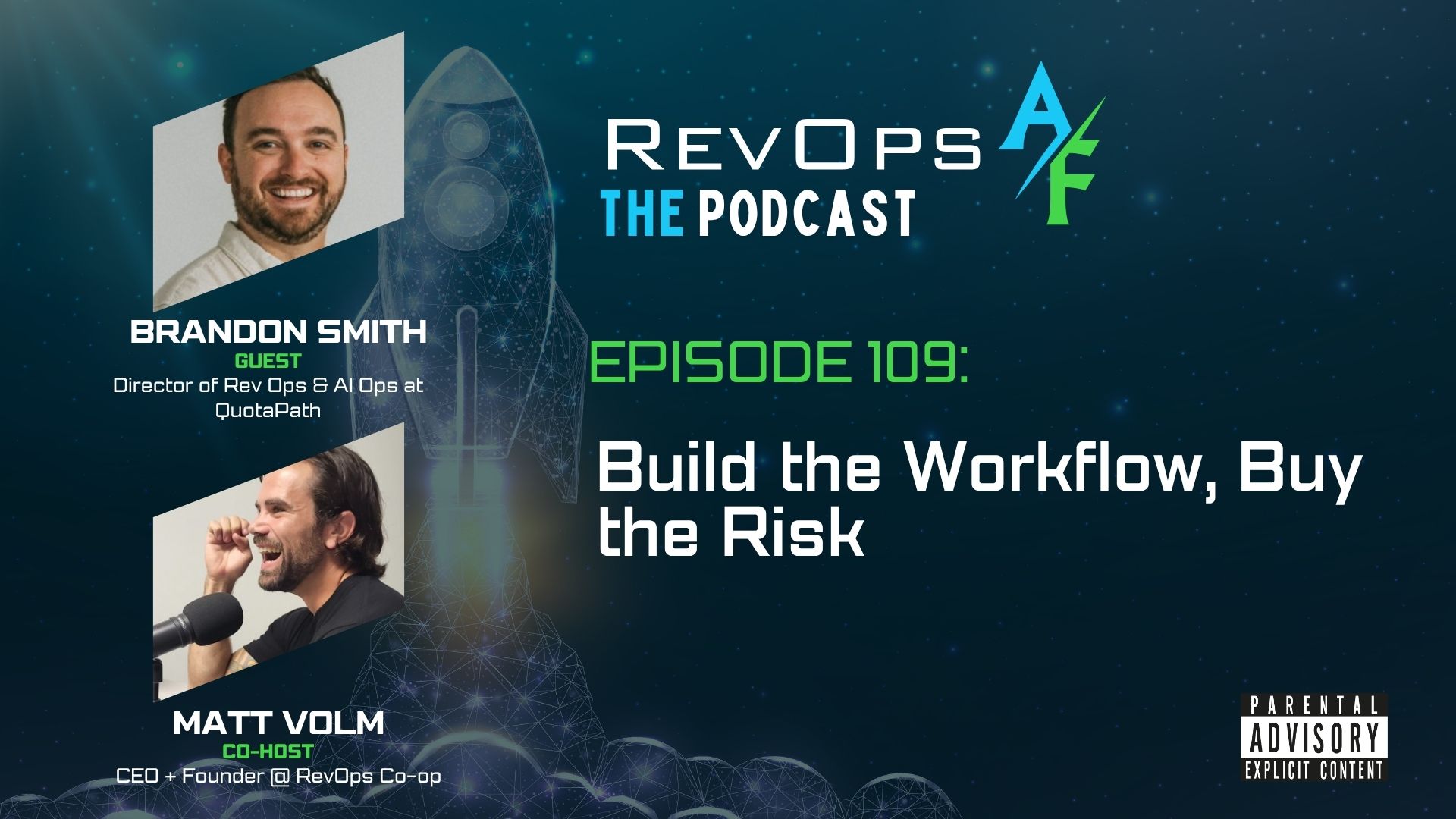
Episode 109: Build the Workflow, Buy the Risk
Brandon Smith of QuotaPath breaks down the build vs. buy decision for RevOps teams — including when AI-built tools make sense and when to pay the vendor.


Think partner ecosystems are just for massive enterprise companies with complex distribution networks? Think again. In a revealing conversation on RevOpsAF, Camela Thompson sits down with partner operations expert Allen Smolinski (Founder of The Channel Method) to uncover why 95% of businesses are leaving serious money on the table by neglecting their partner strategy.
If you're a RevOps professional who's ever had partner operations dumped on your already overflowing plate, this episode is your survival guide. Spoiler alert: there's a reason why dedicated partner ops roles exist, and it's not just corporate bureaucracy.
Allen's journey into partner operations started with a family cross-stitching business that had a dangerous dependency problem. "95% of our business was through that one distributor," he recalls. "That's a bad ratio." This early lesson in revenue diversification shaped his understanding of why partner ecosystems matter for businesses of all sizes.
The reality? Partner ecosystems exist everywhere, whether you formalize them or not. Even if you're a freelance consultant, you're working with vendors, referral sources, and collaborative networks. The question isn't whether you need partnerships—it's whether you're managing them strategically.
"Technically, partner ecosystems make sense for every business organization because it's just an existing thing." — Allen Smolinski
Whether you're a sub shop working with vendors or a SaaS company integrating with cloud providers, partnerships are already part of your revenue operations framework.
Here's where things get interesting—and where most organizations mess up. Too often, companies assume their existing RevOps team can just "handle" partner operations as an add-on. Allen's take? That's like asking your sales operations team to also run customer success operations because "they both deal with data."
"The unfortunate part is oftentimes organizations don't hire for a partner operations role. They rely on the revenue operations team to go do that, which I think is so unfortunate because you need to have that subject matter expertise.” — Allen Smolinski
The key differences are substantial:
RevOps Focus: Internal processes, customer journey optimization, sales forecasting accuracy, and internal team alignment.
Partner Ops Focus: External relationship management, multi-party deal coordination, partner enablement, and complex revenue sharing models.
While RevOps professionals excel at fixing tech bloat and optimizing internal systems, partner operations requires a different skill set entirely. You're managing legal contracts, external stakeholder relationships, and revenue models that span multiple organizations.
If you've ever been tasked with "setting up a partner portal" and wondered why adoption was terrible, you're not alone. Allen identifies this as one of the biggest mistakes organizations make.
"The focus should always be on driving simplicity. Partner portals are a tool, and they shouldn't be the means to the way of the process." — Allen Smolisnki
The problem? Most companies approach partner portals like they approach CRM implementations—they focus on the technology instead of the process. Partners don't want to log into another system to register deals and wait months for updates. They want streamlined communication and clear next steps.
Instead of defaulting to portal solutions, successful partner operations teams focus on:
Here's where partner operations gets really complex, and why your existing RevOps infrastructure might not cut it. When you introduce partners into your revenue model, your data analytics requirements explode in complexity.
"There's this common problem of the data and data model neglect. What happens is these organizations want an answer to something that you can't get because there's no data or there's missing holes in that data model." — Al Smolinski
Consider the attribution nightmare: A lead comes through a partner, gets nurtured by your marketing team, goes through your sales process, and closes. How do you attribute revenue? How do you track partner influence? How do you measure the true ROI of your partner program?
Most RevOps teams are already struggling with marketing attribution for internal channels. Adding partner attribution into the mix without proper planning creates data chaos.
This is where Allen's expertise really shines. While most organizations get stuck on basic metrics (deal count, revenue volume, conversion rates), the real insights come from what he calls "Level 2 and Level 3 analysis."
Level 1 Metrics: How many deals closed? What's the total opportunity amount? Basic conversion percentages.
Level 2 & 3 Analytics: What's driving partner success rates? Which partner types accelerate deal velocity? How do different partner engagement models impact customer lifetime value?
"The second you sit there and you dwell on level one and everyone thinks 'oh, we've got our data analytics covered,' you're wrong. You're missing out on how you're gonna drive more productivity and how you're gonna make individuals' lives better." — Allen Smolinski
This deeper analysis helps RevOps teams understand not just what happened, but why it happened and how to replicate success. It's the difference between reporting and actual revenue intelligence.
One of the most contentious issues in partner operations? Attribution. And if you think marketing and sales attribution is complicated, wait until you add partners to the mix.
"There's this weird place where there's partnerships and then there's a lot of organizations out there that have got partnerships embedded in marketing. And then there's other organizations that don't have partnerships embedded in marketing. They're embedded in sales." — Allen Smolinski
The solution isn't to create separate attribution models for each channel. Instead, successful organizations extend their existing attribution frameworks to include partner touchpoints. This requires:
So how do you build partner operations that drive real results instead of just creating more administrative overhead? Allen's approach focuses on three key principles:
"Don't try to do everything that you want from a strategy side. You want to work with your revenue operations teams tightly. You want to figure out what the existing processes look like and then have that discussion to be able to say, how do we simplify this?" — Allen Smolinski
This means starting with pilot programs, testing processes with a small group of partners, and iterating based on feedback before rolling out company-wide.
Just like customer onboarding impacts retention and expansion, partner experience directly impacts program success. Partners who can't easily work with you will find partners who can.
This doesn't mean buying the most expensive partner management platform. It means building data models, processes, and systems that can scale with your partner program growth.
Allen drops a crucial insight for companies targeting government or federal markets.
"If you're in the federal space, if you don't have a partner program, you're gonna have problems." — Allen Smolinski
This isn't just about compliance—it's about market access. Federal sales cycles are long, relationships matter enormously, and having the right partner ecosystem can be the difference between winning and losing deals.
For RevOps teams supporting federal sales, partner operations isn't optional—it's mission-critical infrastructure.
The most successful partner operations programs don't just manage partnerships—they actively contribute to revenue growth strategy. This happens when partner ops teams can answer questions like:
This level of strategic contribution requires the advanced analytics capabilities Allen advocates for, plus tight alignment with broader revenue operations initiatives.
Allen's involvement with the RevOps Co-op Seattle chapter highlights an important point: partner operations professionals need community just as much as traditional RevOps roles do. The challenges are unique, the skill sets are specialized, and having peers who understand the complexity makes a huge difference.
"The RevOps co-op has done a really good job of reaching out, and especially within the operator network, I think it's often misunderstood and underrepresented and under budgeted often.” — Allen Smolinski
Whether you're a dedicated partner ops professional or a RevOps generalist dealing with partner challenges, connecting with others who've solved similar problems accelerates your success.
If partner operations keeps landing on your desk, here's what you need to know:
The bottom line? Partner operations isn't just about managing relationships—it's about unlocking revenue growth that's impossible to achieve through direct sales alone. And for RevOps professionals, understanding how partner operations fits into the broader revenue engine is becoming increasingly essential.
Whether you're building your first partner program or optimizing an existing one, the principles Allen shares provide a roadmap for creating partner operations that actually drive results instead of just creating more work.
Check out our blog, join our community and subscribe to our YouTube Channel for more insights.