Podcast

September 16, 2026
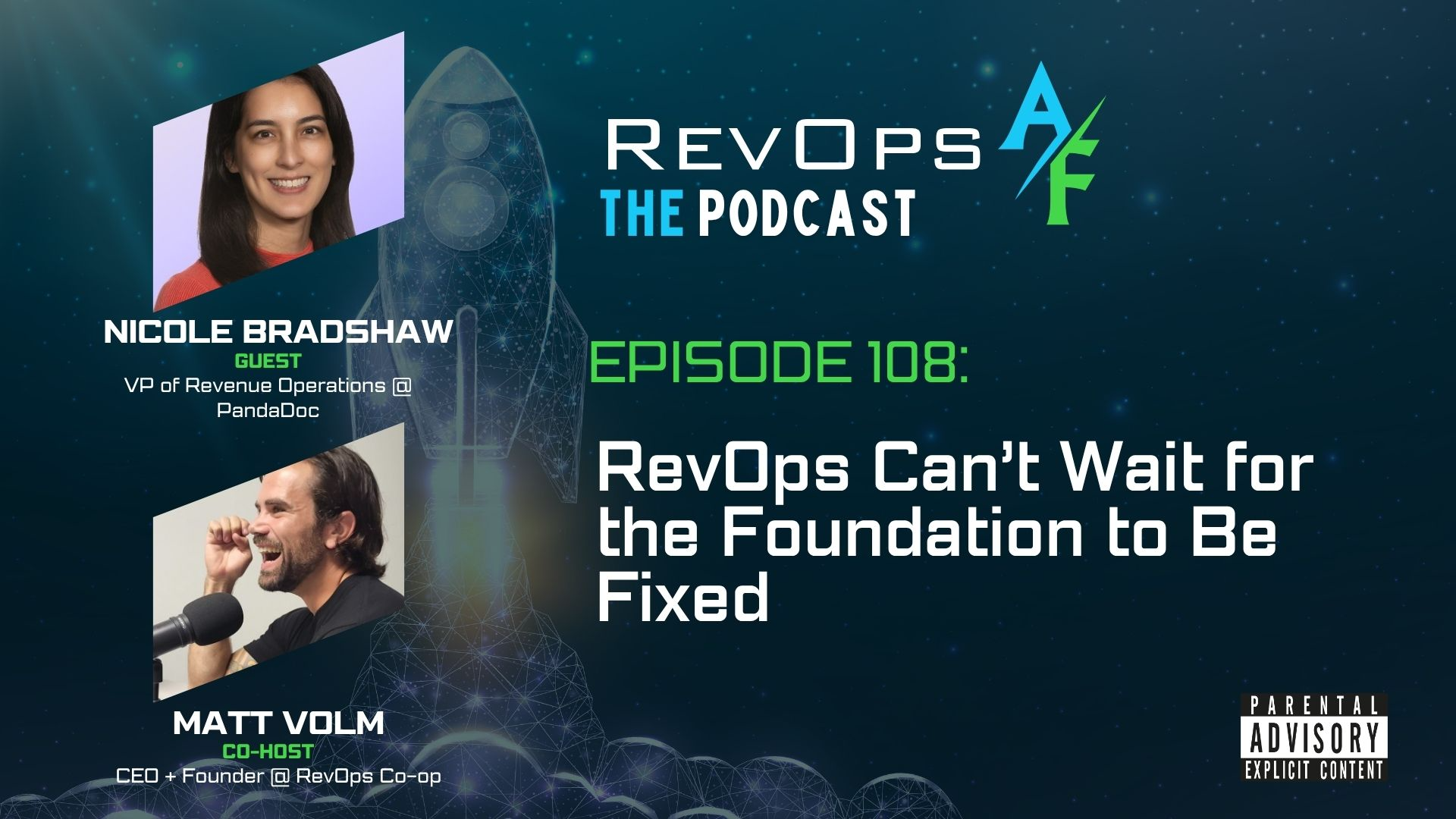
Episode 108: RevOps Can't Wait for the Foundation to Be Fixed
Nicole Bradshaw, VP of RevOps at PandaDoc, shares her framework for fixing broken GTM foundations without stalling what leadership is asking for.


The job market is brutal right now, especially for RevOps professionals. But what if you could leverage the same analytical mindset and systematic approach that makes you successful in revenue operations to transform your job search? That's exactly what Arriel Balogun, RevOps career coach and founder of Infinitely Elevated, shared with host Camela Thompson in this game-changing episode.
Balogun brings a decade and a half of Bay Area tech experience spanning finance, RevOps, and program management to her coaching practice. After witnessing a pattern of operators doing critical work without visibility or strategic alignment, she founded Infinitely Elevated to help RevOps and go-to-market professionals operate with clarity and confidence, and not just chase the next role, but build long-term career leverage.
Balogun identifies three core struggles that hit RevOps professionals particularly hard during job transitions. The first is identity shock, a psychological challenge that's often overlooked.
“People in RevOps, we're fixers. And when everything stops suddenly, the question becomes, who am I if I'm not solving problems?” — Arriel Balogun
This resonates deeply with anyone who's built their professional identity around solving complex revenue operations challenges. When that constant problem-solving suddenly stops, it creates an existential crisis that goes beyond just needing a paycheck.
The second struggle is information overload and decision paralysis. Most people aren't ready to launch a job search at the drop of a dime, yet suddenly they're rewriting resumes, networking intensively, and making major decisions while dealing with real-life pressures like rent, healthcare, and family responsibilities.
The third challenge is underestimating your own value. RevOps professionals are firefighters who build alignment and bridge gaps, but this often translates into imposter syndrome instead of recognizing transferable impact.
“We're putting out the fires. We're trying to build alignment and bridge gaps. And that sometimes that turns into imposter syndrome instead of recognizing your transferable impact.” — Arriel Balogun
Balogun calls this your "RevOps superpower," the ability to bring things together and get new products to market. Understanding this value is crucial for building long-term career leverage in the revenue operations field.
The core insight of this episode is deceptively simple: if you're in RevOps, act like one during your job search. This means applying the same diagnostic skills you use for pipeline health, forecasting, and risk assessment to your job search strategy.
“We're RevOps, so act like one. Our skills are very diagnostic by nature, so that's understanding pipeline health, forecasting, risk, aligning teams, and making trade-offs. Think about applying that to your job search and your job search strategy.” — Arriel Balogun
Instead of just listing tools and certifications, focus on the business problems you solved and the decisions you influenced. This approach aligns with best practices for revenue operations professionals who need to demonstrate strategic value beyond technical execution.
Balogun emphasizes using clear, defendable metrics. Even if you don't have direct CRM access, you can create ranges or percentages through simple math. The key is being able to defend your impact with data, which is something every RevOps professional should excel at.
One of the most actionable insights from this conversation is treating your job search like a RevOps dashboard. Track everything: interview invites, rejections, feedback from recruiters and hiring managers, questions you're being asked, and questions that stump you.
“Track your applications, like a RevOps dashboard. How many interview invites are you getting? How many rejections? What is the feedback that you're getting during the interview?” — Arriel Balogun
This data becomes signal intelligence that tells you where your experience resonates. If you're consistently getting rejected in one sub-industry (like ed tech) but gaining traction in another (like healthcare tech), that's valuable market feedback that should inform your strategy.
This systematic approach mirrors the analytical mindset that drives successful revenue operations, where data-driven decisions consistently outperform gut instincts.
Balogun makes a crucial distinction about interview preparation that every RevOps professional should internalize:
“Interviews aren't sandbox environments. They are production. We don't want to go into a real interview where things are at stake and treat it like it's a sandbox environment where you're practicing your pitch.” — Arriel Balogun
This means doing your experimenting beforehand, like practicing your 30-second intro, rehearsing responses to standard interview questions, and especially preparing for emotionally charged questions about why you left your last company or gaps in employment.
Thompson reinforces this point from an interviewer's perspective, noting how candidates who seem unprepared for predictable questions create negative impressions that are hard to overcome. The solution is working with mentors or friends to practice difficult questions until your responses feel natural and confident.
While technical certifications remain important, Balogun is hearing more emphasis on soft skills in the current market. Companies are making significant investments in new hires and want to go deep on knowledge and expertise.
“A lot of soft skills. I'm actually hearing more of coming through in the interview process with my clients. So focusing on how do you communicate well, how do you communicate up across different stakeholders, across different teams?” — Arriel Balogun
The key soft skills include:
This emphasis on communication skills aligns with the growing importance of influence without authority in revenue operations roles, where success depends on aligning teams and driving decisions across organizational boundaries.
Balogun also stresses the human impact of RevOps work. Whether you're doing territory alignment, quota planning, or creating reports and dashboards, your decisions directly affect someone's livelihood and ability to make money. This perspective adds weight and responsibility to the role that goes beyond technical execution.
Beyond the mindset shifts, Balogun offers practical tactical advice. She strongly advocates for tailoring your resume, but with an important caveat: start with a clear "why" for targeting specific sub-industries.
“Before you go into tailoring your resume, you have to start with a very clear goal. Why am I going into one sub tech industry versus another?” — Arriel Balogun
This strategic focus prevents the exhaustion that comes from trying to be everything to everyone. Instead of applying broadly across all of tech, focus on aligned sub-industries where your talking points, interview responses, and resume content can remain consistent and compelling.
She also emphasizes the importance of follow-up and staying top of mind throughout lengthy interview processes. With some candidates going through 8-11 interview rounds, maintaining momentum and enthusiasm becomes crucial for success.
One of the most practical pieces of advice is creating what Balogun calls a "brag box": a collection of screenshots, accomplishments, and metrics that you can reference when updating your resume or preparing for interviews.
“Sometimes I call it a brag box where you just take a screenshot of someone that is praising you for helping put out a fire or doing something that was above and beyond.” — Arriel Balogun
This aligns with Thompson's advice to keep a running log of projects, benchmarks, and business impact while you're still employed. The key is storing this information somewhere accessible, because memory tends to go blank the moment you need to update your resume.
This practice of documenting impact is essential for revenue operations professionals who often work behind the scenes but drive significant business outcomes.
Perhaps most importantly, Balogun emphasizes treating your job search like a program with defined scope, timelines, and success metrics, including built-in recovery time.
“Build in time for rest, build in time for play, build in time for relaxation. It sounds counterintuitive, but if you are just hustling... the burnout shows up.” — Arriel Balogun
This systematic approach prevents the burnout that makes it impossible to show up well for interviews when they finally arrive. It's about working smarter, not just harder. A principle that should resonate with any RevOps professional who's optimized processes for efficiency and sustainability.
The job market may be challenging, but RevOps professionals have unique advantages when they apply their analytical and systematic approach to career transitions. As Balogun demonstrates, the same skills that make you successful in revenue operations can transform your job search from a frustrating grind into a strategic, data-driven process that delivers results.
Check out our blog, join our community and subscribe to our YouTube Channel for more insights.
Our average member has more than 5 years of RevOps experience. That means you’ll have real-time access to seasoned professionals. All we ask is that you’re generous with your knowledge in return.