


If you ask five companies to define Revenue Operations, you’ll get at least seven answers—and none of them will match. Some orgs call RevOps “the Salesforce team.” Some think it’s just Sales Ops with a glow-up. Others treat it as a catch-all for everything no one else wants to own, stuffing every orphaned responsibility into one unlucky person’s job description.
At RevOps Co-op, we align with the definition created by Natalie Furness:
Revenue Operations is the business function dedicated to aligning people, processes, and data systems across all go-to-market teams to maximize revenue while minimizing costs.
In other words: RevOps exists to make the entire revenue engine work—Sales, Marketing, Customer Success, Finance, and Product. Not one team’s corner of it.
But here’s the reality: most companies still operate with at least some siloed operations teams. Sales Ops, Marketing Ops, and/or Customer Success Ops each optimize for their own department’s goals, even when that undermines performance everywhere else.
So let’s break down what each function typically owns when siloed, how they contribute to the full revenue lifecycle, and what changes when they come together under a truly strategic, centralized RevOps organization.
As companies grow, data governance becomes a much bigger deal. Mature organizations implement strict rules to reduce security risk and prevent system downtime—which often affects who can access customer data or make changes to GTM systems.
This is why many enterprises shift ownership of go-to-market systems to IT. Some also rely on centralized data science teams to maintain schemas, data definitions, and the organization’s “source of truth.” In these cases, RevOps still plays an active role—but more in defining requirements for reporting, dashboards, and workflows than in owning the systems directly.
But that’s not the only model.
In other organizations, RevOps works closely with IT, Finance, and Legal to ensure data governance rules are understood and followed, while still owning major components of the GTM systems landscape (including the CRM). And in many companies, functional ops teams still produce their own reporting and dashboards.
All of this is to say: there is no universal rule. It is possible—and often desirable—for RevOps to centralize GTM systems, analytics, and governance.
Which raises an important question:
Is shifting systems and data ownership into IT or data science the “right” evolution? Or is it simply the default path for older organizations that grew up with siloed ops teams and are accustomed to technical roles living outside of GTM?
Based on what we hear from RevOps leaders, it’s a blend of:
And let’s be honest: forcing very large GTM organizations to share priorities and processes is hard—especially when their leaders aren’t incentivized to work together. That dynamic can create a deeply frustrating environment for Revenue Operations teams that are trying to work cross-functionally.
Sales Operations (or “Sales Ops”) is often traced back—at least in industry lore—to IBM in the 1970s, where the earliest versions of the function began taking shape. Back then, Sales Ops was mostly administrative support: handling paperwork, entering data, and keeping field reps organized.
As selling became more digital—and especially with the rise of automation and AI—the role transformed. Today, Sales Ops is the backbone of a scalable sales organization, owning the systems, processes, and infrastructure that allow sellers to work efficiently, consistently, and predictably.
These aren’t “nice-to-haves.” In a mature organization, they’re essential:
And no—one person can (or should) own all of this.
In smaller businesses, leaders should work closely with operations professionals to prioritize what’s achievable based on organizational maturity and the sales team’s size and complexity.
Works with business leaders to understand company objectives and shapes how sales strategy supports those goals. Guides prioritization, provides clarity for the rest of the Sales Ops team, and communicates risks or gaps back to leadership.
A highly technical role responsible for designing and maintaining the CRM and related point solutions. They understand data flow across systems, build integrations, configure user interfaces, and constantly balance ease of use with data quality—an extraordinarily difficult line to walk.
Owns dashboards and insights, standardizes metrics and definitions, and helps identify performance trends. They provide the analytical foundation needed to optimize the sales motion and improve efficiency.
Collaborates with Sales and Finance to create compensation plans aligned to business goals. Monitors performance metrics, evaluates ramp time and seller productivity, adjusts plans when necessary, and often contributes to hiring models.
Coordinates with Legal, Sales, and Finance to finalize complex contracts. Manages redlines, exception approvals, standardizes approval rules, accelerates deal cycles, and provides insights into discounting patterns—valuable feedback for product and pricing teams.
Often focuses on sales methodology, training, asset development, and the techniques used in successful deals. While not always part of Sales Ops, many RevOps leaders tell us they own this function.
Under Revenue Operations, Sales Ops roles typically maintain a dotted line to Sales leadership but formally report into a centralized RevOps leader. This structure keeps the team aligned to broader company objectives while keeping them plugged into cross-functional changes that impact the sales organization.
The model works best when Revenue Operations groups team members by strengths and functional responsibilities, not by the department they support. If RevOps leaders recreate department-based silos within ops, the organization loses many of the benefits of centralization—namely visibility, collaboration, and aligned prioritization.
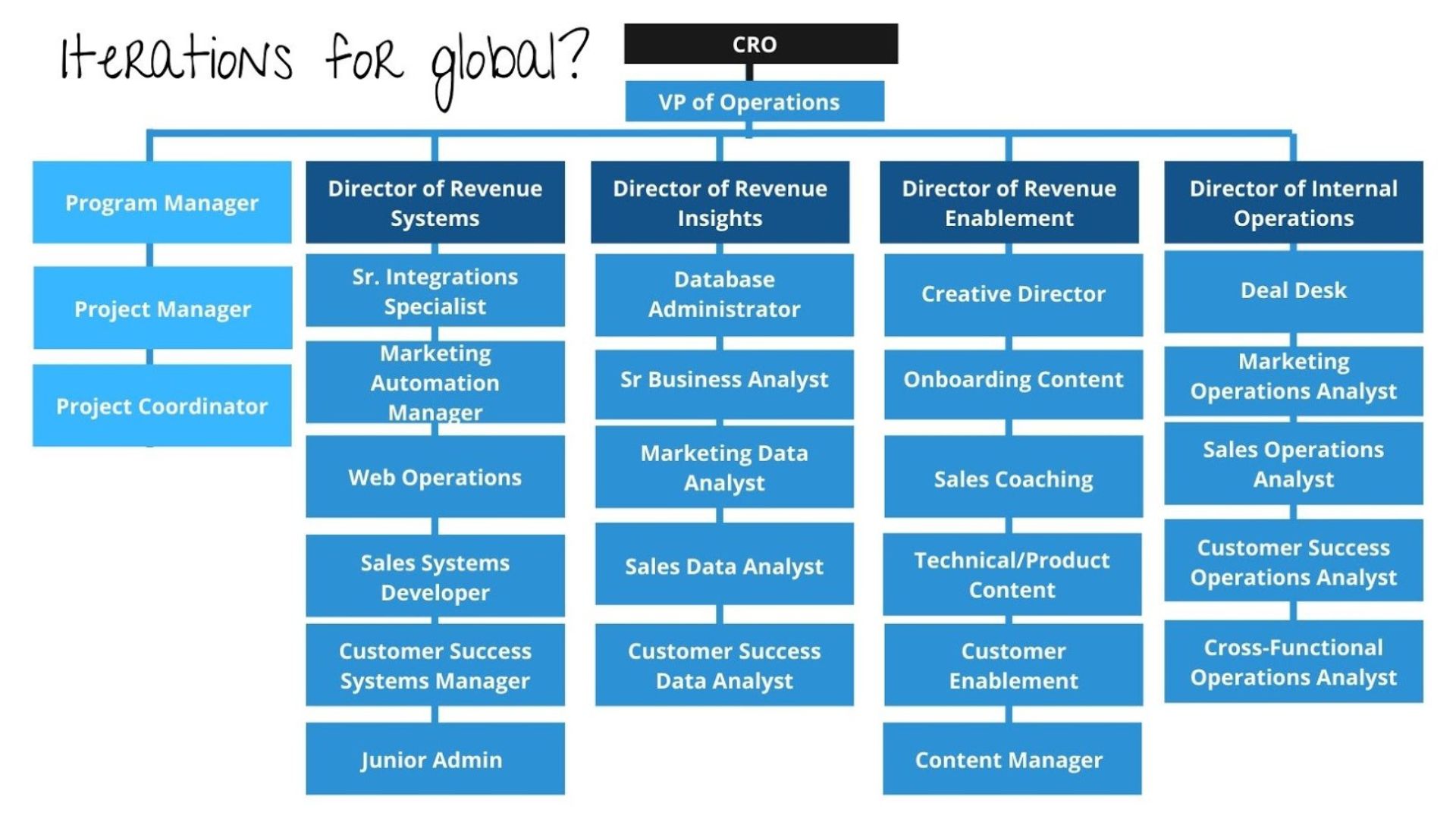
Take a CRM Architect. Many companies treat this as a purely “Sales” role because the CRM is seen as a sales tool. But in reality, the CRM is the system of record for the entire revenue engine. Sellers rely on data from Customer Success, Marketing, Finance, and Product—and misalignment here creates a poor customer experience (nothing worse than a rep calling a “prospect” who is already a paying customer).
In a centralized RevOps department, the CRM Architect sits on the Systems team but supports multiple GTM teams. They ensure that integrations and data flows across CS tools, MAPs, enrichment tools, and product systems all work together rather than interfere with one another. This structure elevates the role from “CRM admin for Sales” to “architect of the revenue system.”
For more on how we see Revenue Operations structured, click here.
Marketing Operations (MOPs) is the execution engine and technical backbone of modern Marketing. Marketing teams have to inspire interactions across all the places your buyers spend time—which means they have to use a ton of tools to get their content and advertising to show up all over the internet. If Sales Ops keeps deals moving, MOPs keeps demand flowing—cleanly, measurably, and repeatably.
And here’s the important nuance:
MOPs isn’t just “campaign support.” They are the connective tissue between strategy, systems, data, and outcomes.
In most organizations, Marketing Ops is responsible for the infrastructure that translates strategy into action:
This is where a lot of companies underestimate the function. A “broken MQL” isn’t a marketing problem—it’s almost always a systems, process, or data definition problem. These professionals have to understand how other teams are creating and changing data and systems so their team can adjust and continue operating at peak performance.
Owns the overall marketing tech stack, governance, campaign workflow design, and cross-functional alignment between Marketing, Sales, and Customer Success.
Builds segmentation logic and system automations, as well as supporting programs, nurture sequences, and other workflows. Ensures campaigns execute correctly and data flows cleanly. This includes how data flows to and from other systems, like the CRM.
Supports campaign planning, oversees execution timelines, conducts QA, and ensures campaigns actually do what marketers think they’ll do.
Designs and maintains attribution models, analyzes channel performance, and communicates insights back to leadership—not just reporting numbers, but explaining why they matter.
Owns website infrastructure, integrations, data privacy governance, CRO experiments, and anything involving web-to-CRM data flow.
When Marketing Ops is part of a centralized RevOps team, the focus should more clearly align with the goals of the overall organization. This happens through:
Another added benefit is the opportunity to create a communication loop that includes Customer Success insights about which customers actually stick around and upgrade versus those who churn. Adjusting top-of-funnel targeting accordingly can go a long way in improving customer retention.
Customer Success Operations (CS Ops) is the least understood—and most underfunded—of the three ops pillars, despite having the biggest long-term revenue impact. CS Ops owns the people, processes, and systems that drive retention, expansion, and customer health.
Many companies now recognize that acquisition alone won’t sustain growth, but they still underinvest in Customer Success and CS Ops. AI has widened this gap, with some executives overvaluing automated support—regardless of whether customers actually want it. (We’ve all yelled “representative!” at a bot at least once.)
Traditional CS Ops responsibilities include:
This function is essential but often treated as “extra” or “nice to have,” which is how organizations end up with preventable churn and no real understanding of customer risk.
Manages system infrastructure, partners with CS leadership, and shapes the data and processes that guide post-sale activities.
Configures the CS platform, builds workflows and automations, and ensures clean data flows between CS tools, the CRM, and product usage systems.
Analyzes product usage, customer behavior, risk indicators, NPS feedback, and renewal data to provide actionable insights.
Forecasts renewals, tracks expansion pipelines, monitors contract risk, and collaborates with Sales and Finance on pricing or terms.
When CS Ops joins a centralized RevOps function:
And—maybe most importantly—RevOps finally sees the entire revenue funnel, not just pre-sale.
This is how companies eliminate the “black box” between closed-won and renewal.
When Sales Ops, Marketing Ops, and CS Ops operate independently, they optimize for their own metrics:
None of these are wrong—but they are incomplete.
Under a centralized Revenue Operations organization, these teams shift from department-first to business-first decision-making.
Here’s what changes:
This is where RevOps stops being “the Salesforce team” and turns into a true strategic function.
Rebrands and semantics aside—whether we call it Revenue Operations or Go-To-Market Operations—the real issue isn’t the name. It’s the structural, cultural, and leadership challenges that make the ideal RevOps vision hard to achieve.
Below are the biggest obstacles we see across organizations of all sizes.
We wish this were rare, but it isn’t: GTM leaders who openly resist working together can bring the entire revenue engine to a standstill. If a Sales leader refuses to collaborate with Marketing, or CS feels sidelined, everyone feels the ripple effects.
Business relationships are human relationships. Without trust and communication, alignment is impossible.
And when a RevOps leader doesn’t sit at the same level as the executives who are at odds, they’re forced to influence without authority—or accept misalignment as the cost of doing business. Most of us have lived through this, and it’s exhausting.
The CRO role was supposed to solve this by creating a single tie-breaker. In practice, most CROs come from Sales—and often default to prioritizing Sales—leaving Marketing and CS underrepresented. The imbalance continues, just with a new title.
Many of us didn’t enter operations intentionally. We were the ones who learned new systems fastest, got voluntold into admin roles, or picked up the “broken” tool because someone had to. Leadership valued the tool—but not enough to hire someone dedicated to owning it.
This is why so many organizations end up with:
Not because the people in the role weren’t smart or hardworking—but because they weren’t given the time, training, or support to do it right. Unless the company eventually invests in experienced operators, these issues become deeply embedded.
Exceptional Revenue Operations leaders are rare—and incredibly valuable. The best operators can:
These leaders are out there, but they’re hard to find—and harder to hire. We hear this from founders, CEOs, and recruiters constantly.
If you want to level up your own strategic capability, check out our recommended resources (article, podcast, certification)—each designed to help operators move from tactical execution to strategic influence.
Let’s be candid: finding someone who can “do it all” is nearly impossible. The best RevOps leaders blend strategic thinking, technical fluency, and deep cross-functional understanding—and then layer strong interpersonal skills on top of it.
Yes, we’ve retired words like “unicorn” and “purple squirrel,” but the reality hasn’t changed. This role requires broad experience across Sales, Marketing, CS, systems, data, and business operations. Most people simply don’t get that range of exposure early enough in their careers.
And even when they do, aligning executives and driving change requires soft skills that take years to develop.
In an ideal world? Yes.
But there’s a catch: centralization only works when the company is willing to elevate RevOps leadership to the same level as the teams they’re expected to align. Without that authority and trust, a centralized model becomes performative instead of effective.
Some organizations aren’t ready—or willing—to make that investment. In those cases, siloed ops teams can still function well, especially if the operators are talented, collaborative, and trusted within their own orgs.
Just know that the barriers preventing a unified Revenue Operations department come with real costs. Misalignment always shows up in the data, processes, customer experience, and eventually—revenue.
If you’re feeling this pain firsthand, whether as a lone operator or someone stuck in a siloed structure, know that you’re not alone. You are a Revenue Operator, regardless of where you sit on the org chart. And you can find support, peers, and community by joining us online or connecting at our RevOpsAF conference.
We’re rooting for you.


