Podcast

September 16, 2026
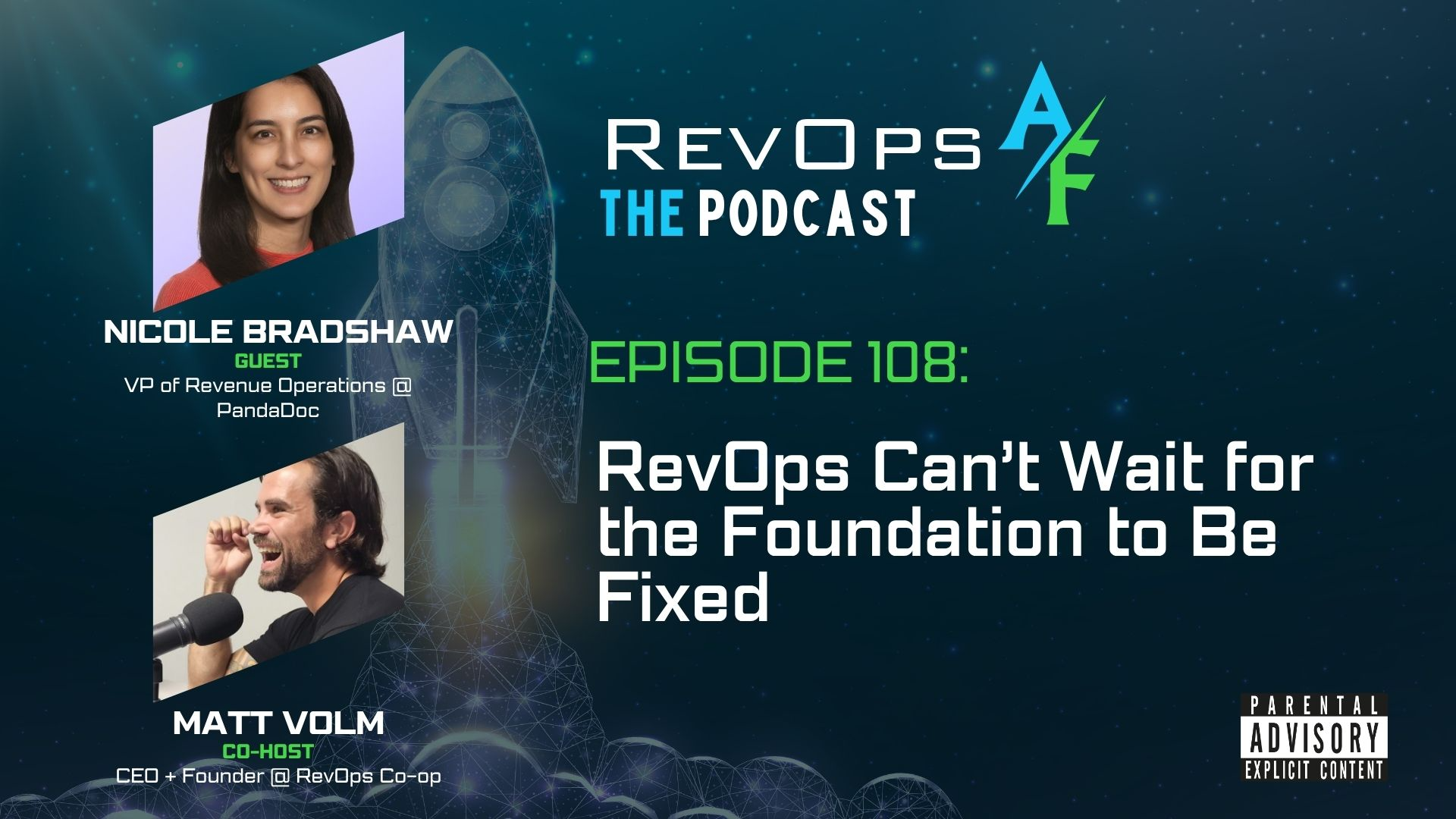
Episode 108: RevOps Can't Wait for the Foundation to Be Fixed
Nicole Bradshaw, VP of RevOps at PandaDoc, shares her framework for fixing broken GTM foundations without stalling what leadership is asking for.


Sales kickoffs don't have to be expensive events where leadership hope no one gets arrested. When done right, they become the strategic foundation for year-long revenue success—and RevOps professionals are the secret weapon that makes it happen.
In this episode of RevOpsAF, co-host Camela Thompson sits down with enablement expert Roderick Jefferson to discuss how revenue operations can elevate sales kickoffs from one-time events into ongoing revenue engines. Jefferson, who has run enablement at major companies like Salesforce, Oracle, and eBay, brings decades of experience in transforming how organizations approach go-to-market alignment.
Too many organizations treat sales kickoffs like content dumps, throwing every piece of information at their teams in a TikTok-attention-span world. Jefferson argues this approach is fundamentally flawed.
"Sales kickoff is not about throwing every bit of content in the kitchen sink at people because we're a TikTok, Instagram, and microwave mentality today. You can't do it the way we used to." — Roderick Jefferson
The key insight? Sales kickoff should be the floor, not the ceiling. Think of it as laying the foundation and framing of a house—everything else gets built throughout the year. This mindset shift transforms SKO from a standalone event into the launching pad for continuous enablement and process improvement.
Jefferson emphasizes focusing on the "why" behind initiatives rather than jumping straight to the "what," "when," and "how." This approach reduces resistance and creates buy-in across teams, which is essential for aligning revenue teams around shared KPIs.
One of the biggest mistakes organizations make is treating RevOps as an afterthought in SKO planning. Jefferson advocates for including RevOps in the pre-planning process from day one.
"They should be a part of the pre-planning process because there is nothing worse, and I know this as an enablement leader of someone build something and you throw it over the fence and they say, okay, go train this." — Roderick Jefferson
RevOps brings critical capabilities to SKO planning:
Systems Integration: When rolling out new platforms, processes, or methodologies, RevOps ensures the technical infrastructure supports the strategy. This prevents the common scenario where great ideas fail due to poor execution.
Metrics Alignment: RevOps helps establish success metrics upfront, ensuring all teams understand what they're working toward. This prevents the dreaded post-SKO scramble where leaders ask for metrics that weren't planned for.
Cross-Functional Translation: RevOps professionals excel at speaking different departmental languages, helping translate initiatives across sales, marketing, and customer success teams.
For organizations looking to improve their go-to-market operations alignment, involving RevOps in SKO planning is non-negotiable.
Jefferson makes a compelling case that SKO sets the cultural tone for the entire year. This is where RevOps can shine by demonstrating cross-functional collaboration.
"Culture is what happens when no one is watching. And believe it or not, your culture for that year starts at SKO." — Roderick Jefferson
One tactical approach Jefferson recommends is hosting a go-to-market panel during SKO featuring representatives from marketing, product marketing, HR, RevOps, and even product. This public demonstration of collaboration shows the entire organization how teams work together.
The benefits extend beyond SKO itself. When RevOps is visibly included in major initiatives, it becomes natural to include them in quarterly business reviews and ongoing strategic discussions. This visibility helps RevOps professionals move from reactive support to strategic partnership.
For RevOps professionals struggling with stakeholder relationships, Jefferson's advice is particularly relevant: participate in the social aspects of SKO. Building personal connections during dinners and networking events (before midnight, as Thompson wisely notes) creates the foundation for better working relationships throughout the year.
Jefferson, despite being a founding member of the Sales Enablement Society, declares that "sales enablement is passé." The future belongs to go-to-market enablement, which recognizes that no single department drives revenue alone.
"Sales enablement is like having a Walkman. Really. It is because it has evolved now to go to market enablement because when you're talking about sales enablement, it invariably infers that sales is above all and everybody else works for them." — Roderick Jefferson
This evolution aligns perfectly with modern RevOps thinking. Revenue operations has always been about breaking down silos and creating unified processes across the entire revenue cycle. The shift to go-to-market enablement reflects the same philosophy applied to training and development.
For organizations implementing modern quote-to-cash systems, this holistic approach becomes even more critical. When systems span multiple departments, enablement must do the same.
One of Jefferson's most practical insights involves the need for RevOps professionals to become "translators of dialects and languages" across departments. Each function has its own priorities and metrics:
RevOps professionals must learn to communicate in each department's language while translating needs and feedback between teams. This skill becomes particularly valuable during SKO planning, where competing priorities must be balanced.
Jefferson's example of explaining meeting-set metrics to an SDR illustrates this perfectly. Instead of just asking for field completion, Thompson explained why tracking effort and contribution matters for the business. The attitude change was immediate because the "why" was clear.
This approach works for larger initiatives too. When implementing AI-ready revenue systems, RevOps must explain benefits in terms each stakeholder cares about, not just technical capabilities.
Jefferson introduces an often-overlooked concept: the mid-year summit. This isn't another expensive event, but rather a strategic checkpoint to review first-half performance and adjust for the remainder of the year.
The mid-year summit serves several purposes:
For RevOps professionals, this creates an opportunity to demonstrate value through data-driven insights and recommendations. Organizations that implement effective marketing budget planning often find mid-year reviews essential for optimizing spend and strategy.
Jefferson's final advice for RevOps professionals is both direct and empowering: "Stop being the piñata of an organization." Instead of constantly defending against criticism, RevOps should proactively change the narrative by changing relationships.
This transformation happens through:
Early Involvement: Get included in planning processes, not just executionShared Ownership: Ensure all stakeholders have skin in the game for initiativesRegular Communication: Establish ongoing touchpoints, not just crisis meetingsValue Demonstration: Show how RevOps contributions drive business outcomes
The conversation also touches on AI's role in RevOps. Jefferson's perspective is nuanced: "AI is wonderful for content, not so good for context." RevOps professionals provide the human context that makes AI-generated content valuable and actionable.
His formula for success combines traditional skills with modern tools: "IQ plus EQ plus AI equals go-to-market productivity and increase revenue." This framework acknowledges that while AI enhances capabilities, human intelligence and emotional intelligence remain irreplaceable.
Jefferson's upcoming book, "Stroke of Success," adds a personal dimension to the conversation. After suffering a massive stroke four years ago with only a 2% chance of survival, he brings a unique perspective on work-life balance and the dangers of letting work consume identity.
"Take some time and stop worrying about connections and start focusing on connecting." — Roderick Jefferson
This message resonates particularly for RevOps professionals, who often work long hours managing complex systems and processes. The reminder to prioritize relationships and personal well-being provides important context for career sustainability.
For RevOps professionals dealing with tech stack bloat and competing priorities, Jefferson's experience serves as a reminder that success isn't just about professional achievements—it's about maintaining perspective and taking care of yourself and those around you.
The conversation between Thompson and Jefferson demonstrates that successful RevOps isn't just about technical skills or system management—it's about building relationships, communicating effectively, and thinking strategically about the entire revenue cycle.
For organizations preparing for their next sales kickoff, the message is clear: include RevOps from the beginning, focus on the foundation rather than trying to build the entire house in one event, and remember that success is a team sport requiring all players to be aligned and engaged.
Check out our blog, join our community and subscribe to our YouTube Channel for more insights.
Our average member has more than 5 years of RevOps experience. That means you’ll have real-time access to seasoned professionals. All we ask is that you’re generous with your knowledge in return.