Podcast

September 23, 2026
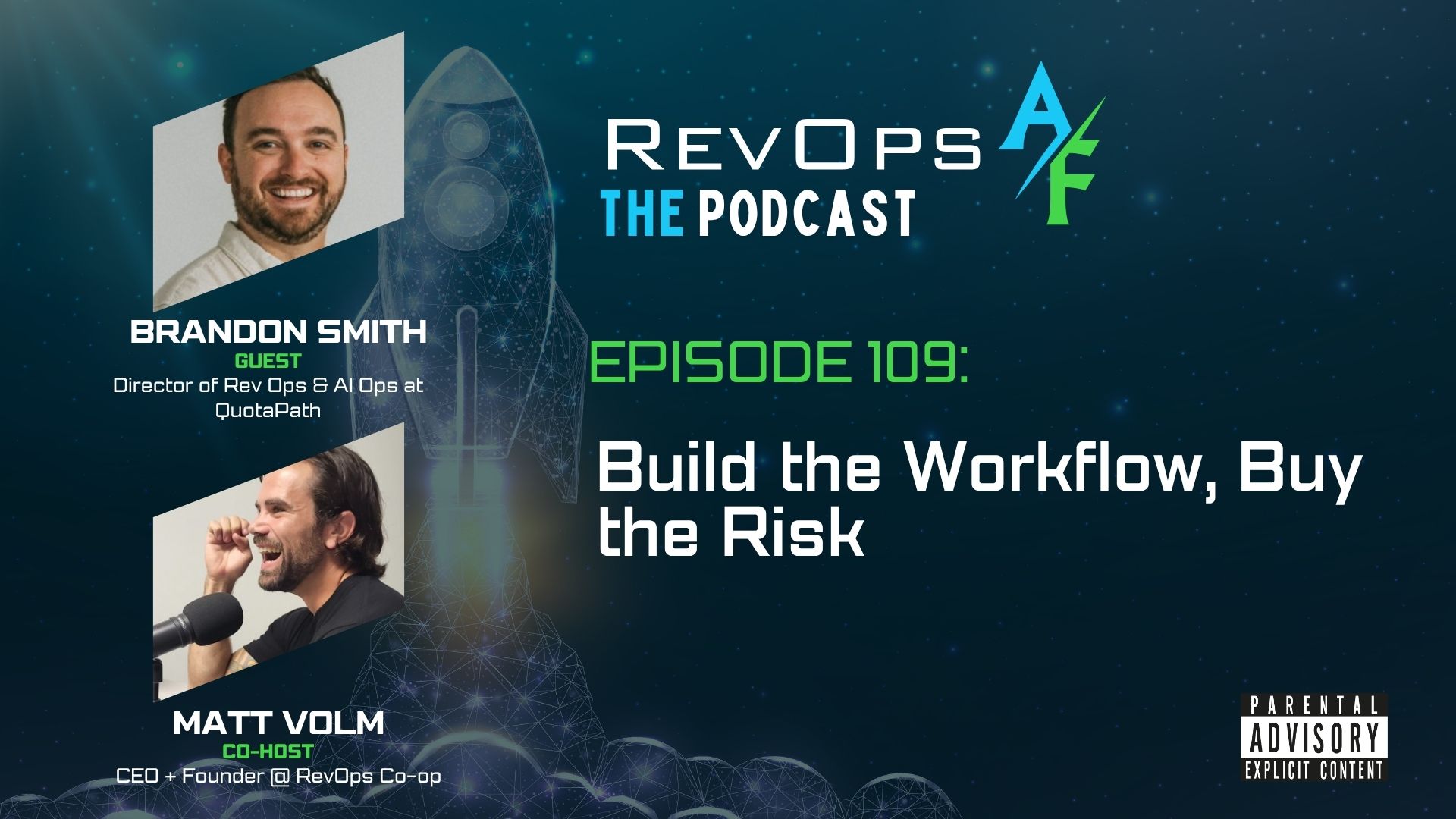
Episode 109: Build the Workflow, Buy the Risk
Brandon Smith of QuotaPath breaks down the build vs. buy decision for RevOps teams — including when AI-built tools make sense and when to pay the vendor.


Ever feel like your RevOps title is more of a catch-all than a career path? You're not alone. In a landscape where job descriptions seem to change faster than your CRM integrations, many revenue operations professionals are grappling with an identity crisis that goes far beyond semantics.
In this episode of RevOpsAF the Podcast, Mahak Vedi, CEO of Revology Consulting, joins co-host Camela Thompson to dissect the evolution—and confusion—surrounding RevOps roles. What emerges is a candid discussion about how the profession has both expanded and diluted, creating challenges for practitioners and employers alike.
The numbers tell a compelling story. According to Mahak's research, there are approximately 7,000 RevOps roles globally, alongside 1,200-1,400 Go-to-Market Engineering positions. But these figures only scratch the surface of a deeper transformation happening across revenue operations.
"RevOps became something of a catchall. RevOps only started three to five years ago. Because the different GTM silos needed unsiloing, so we created RevOps." — Mahak Vedi
The challenge isn't just about role definitions—it's about how companies have approached the RevOps function. Many organizations, eager to capitalize on the promise of unified revenue operations, simply rebranded existing roles without fundamentally changing responsibilities or expectations.
This approach has created a problematic dynamic where RevOps professionals find themselves managing everything from CRM administration to strategic planning, often without the authority or resources to execute effectively. As Mahak points out, this reactive approach undermines the proactive, strategic function that RevOps was meant to fulfill.
Enter Go-to-Market Engineering—a specialization that's gaining traction as AI and automation reshape revenue operations. While RevOps focuses on strategy, governance, and cross-functional alignment, Go-to-Market Engineers concentrate on the technical implementation of tools and systems.
"Go-to-Market Engineers roles are being posted. I think in December 2025 the number for that was 1200 or 1400. So much lower than RevOps roles. But of course we're going see an increase because it, because of the way that AI is moving, we are going see Go-to-Market Engineer role increase as well." — Mahak Vedi
Camela's perspective adds nuance to this distinction. She believes Go-to-Market Engineering was first coined by Clay, and represents a natural evolution for revenue operators working with smaller companies who need to bridge strategy and systems. The role becomes particularly valuable when organizations need to leverage AI for niche use cases that require both technical expertise and business acumen.
The differentiation matters because it addresses a fundamental tension in RevOps: the need for both strategic thinking and technical execution. Rather than forcing one person to excel at everything, organizations can now structure teams with complementary skill sets.
One of the most revealing aspects of the conversation centers on how RevOps professionals are often caught between strategic aspirations and tactical realities. Mahak shares a telling example from her consulting work:
"I was going in as RevOps and I could clearly see things that need fixing in the business. Like their Salesforce was an absolute mess. They had a massive tech stack. They weren't using their tools to the best advantage. They were spending a lot of money on it. There was a lot of churn with their customers as well, but I didn't have the authority to be able to go in and say, strategically, this is what you're supposed to be doing. When I tried, they flat out told me, ‘That's above your pay grade.’ But it's not above my experience." — Mahak Vedi
This disconnect highlights a critical issue in how organizations structure and empower their RevOps functions. The most effective revenue operations strategies require both deep technical knowledge and strategic authority—a combination that's difficult to achieve when roles are poorly defined or hierarchically constrained.
The solution isn't necessarily to eliminate specialization, but to ensure that specialists can communicate effectively across domains. As Camela notes, there's tremendous value in having people who understand both the technical constraints and the strategic imperatives, even if they don't execute everything themselves.
For RevOps professionals looking to advance their careers, the current landscape presents both opportunities and challenges. The proliferation of titles—RevOps, Sales Ops, Business Operations, Go-to-Market Engineering, Go-to-Market Operations—creates confusion for both job seekers and hiring managers.
"It is so difficult to say, title wise I can do this job. I've done this many times over a number of years. Oh, hang on. There's these bullet points that are completely new here that I've not seen before." — Mahak Vedi
The key to navigating this complexity lies in understanding the underlying functions rather than getting caught up in titles. Whether you're looking at fixing tech bloat or building marketing budgets, the core skills of analysis, process design, and cross-functional collaboration remain valuable.
Both speakers emphasize the importance of networking and community involvement. Mahak notes that when she was hiring for RevOps roles, she found candidates through the RevOps Co-op community. Similarly, her consulting business grew with connections made through the same network.
Perhaps the most important insights from this conversation are directed at executives and hiring managers who are structuring RevOps functions. Mahak's observations about the "thankless" nature of operations work ring true for many practitioners:
"RevOps is a thankless job. All operations is a thankless job. If you are doing a good job, people don’t know that you exist. If you're doing a bad job, that's when all eyes are on you because you failed at something." — Mahak Vedi
This dynamic creates several challenges for organizations. First, it makes it difficult to measure and reward good operations work. Second, it can lead to underinvestment in operations capabilities. Third, it often results in operations teams being reactive rather than proactive.
The conversation also touches on the importance of context sharing between executives and operations teams. Too often, RevOps professionals are asked to optimize systems or processes without understanding the broader business strategy or constraints. This leads to wasted effort and suboptimal outcomes.
Despite the challenges, both speakers remain optimistic about the future of RevOps. The key is building strong professional networks and continuously developing skills that bridge technical and strategic domains.
For those currently in RevOps roles, the advice is clear: focus on building relationships, understanding business context, and developing the ability to translate between technical capabilities and business outcomes. Whether you're working on CRM data quality or account-based marketing strategies, the ability to connect tactical work to strategic outcomes is what separates good operators from great ones.
The RevOps Co-op community serves as a valuable resource for this development, providing both networking opportunities and access to best practices from experienced practitioners. As the profession continues to evolve, these connections become increasingly important for career development and knowledge sharing.
Check out our blog, join our community and subscribe to our YouTube Channel for more insights.