Podcast

October 9, 2026
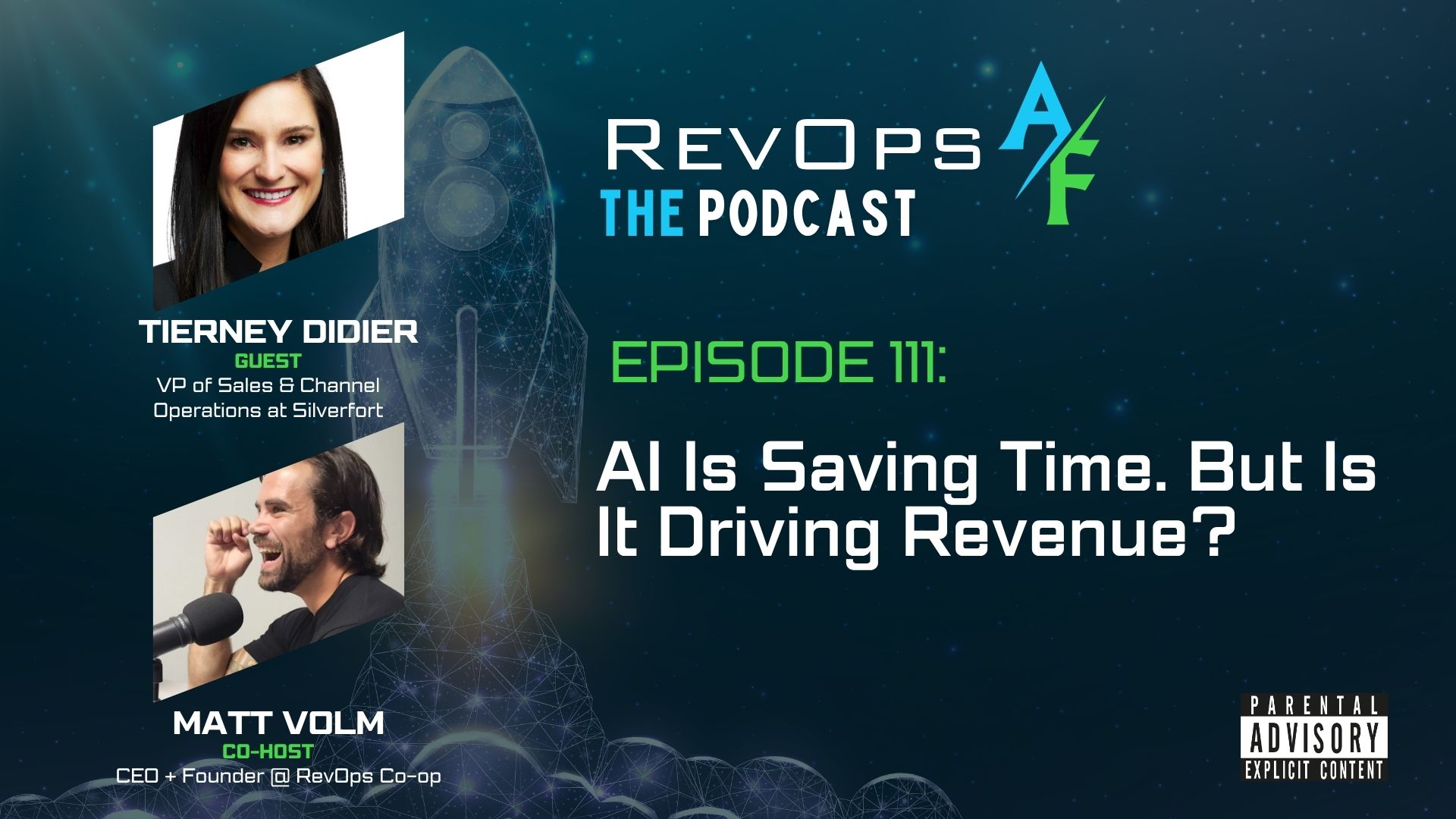
Episode 111: AI Is Saving Time. But Is It Driving Revenue?
AI is saving time in RevOps — but is it driving revenue? Tierney Didier of Silverfort breaks down what's actually working and what's still TBD.


Stop wasting time on your bottom performers. Your biggest revenue opportunity isn't hiding in your CRM data or buried in some complex sales forecasting model—it's sitting right in front of you in the form of your middle 60% of sales reps.
In this eye-opening episode of RevOpsAF, Matthew Volm sits down with Ross Rich, CEO and co-founder of Accord, to reveal why the AI era is forcing a reckoning for the "movable middle" and how smart RevOps leaders are capitalizing on this massive opportunity.
Here's the reality check most revenue teams need: if you're spending all your energy on your top 20% and bottom 20%, you're ignoring 60% of your team. And in an era where revenue per employee metrics are declining while costs continue to climb, that's a luxury you can't afford.
"There's always been this breakdown from a rep performance perspective. A small group, maybe 10-15% of the team, drives 70-80% of the revenue. There's a minority at the very bottom that drives almost nothing. And then there's the majority of people that make up the rest of the revenue." — Ross Rich
But here's where it gets interesting—and why now is the critical moment to act.
The AI revolution isn't just about automating CRM hygiene or generating better email sequences. It's fundamentally changing what's possible for average performers.
"With this push for AI that can solve a lot of simple people-based things, that group either needs to go up to the top or are gonna get bunched into the bottom because of how much AI can solve for making those top reps even more effective.” — Ross Rich
The implications are staggering. If your top 20% can now handle 150% of their previous capacity thanks to AI-powered tools, you might need fewer total sellers. But that also means the bar for productivity is rising across the entire market.
This connects directly to what we've seen in our recent discussions about AI adoption in RevOps—teams that embrace AI strategically are seeing dramatic improvements in efficiency, while those that don't are falling behind.
Before diving into solutions, Ross identifies the two biggest mistakes RevOps leaders make when trying to improve team performance.
"You end up spending a ton of your time with the lowest performers because you think, ‘Oh, okay, that's the biggest lever I have.’” — Ross Rich
But this is often a time sink that yields minimal returns.
The harsh reality? Most bottom performers lack either the skill or the will to improve.
"If they're in a place where they're not gonna be successful with the skills that they have or the effort that they're willing to put in, there's a ton of places to work out there where that's gonna be a fit for everyone." — Ross Rich
"A lot of tools and investments out there... become about internal inspection and homework, showing and saying that we did those things [rather than] actually doing them with the client.” — Ross Rich
This connects to a broader problem we've explored in our enablement content—the difference between training that feels like homework and systems that make excellence unavoidable.
Think about it: everyone knows about frameworks like MEDDPICC or BANT, but knowing the concepts and actually executing them consistently with customers are two completely different things.
So how do you actually solve for the middle 60%? Ross's approach is elegantly simple in concept, though it requires discipline to execute.
"We have a group of reps that are being successful. They figured out how to engage with customers, find the right accounts, help them understand their solution, and help them prove out value and onboard successfully." — Ross Rich
But here's the key insight: top performers are often "unconsciously competent." They might not have a detailed process they're following, but they've figured out what to say to whom and how to run an amazing process.
This is where RevOps becomes critical.
"If you're responsible for operationalizing these best practices and standardizing them as you grow your company, you really need to deeply dissect that." — Ross Rich
The goal isn't more training—it's creating systems where doing the right thing becomes the path of least resistance.
"We know that, for example, if there's maybe mid-market deals where we have less than three stakeholders, our win rate drops by 80%, or in the enterprise segment, if we don't get to a C-suite stakeholder by stage three, we have a 30% lower ACV.” — Ross Rich
Once you understand these patterns, you can build workflows that make it required—not optional—for your team to follow these best practices. This aligns perfectly with what we've seen in successful mutual action plan implementations and digital sales room strategies.
"How do you make it easy for the rest of the team to do those things that... you're never gonna have a group of people that are just organically doing all that stuff by themselves?" — Ross RIch
The answer lies in integration, not separation. Instead of separate training sessions or documentation that reps have to remember to reference, the best practices need to be seamlessly integrated into their daily workflow.
This is where tools like Accord come into play—platforms that embed playbooks directly into the deal execution process, making it impossible to skip critical steps.
One of the most powerful insights from the conversation centers on culture and accountability:
"Culture's defined by the behaviors that you put up with, right? It's not necessarily defined by what your top people are doing. It's typically defined by what leadership is willing to put up with." — Ross Rich
This resonates deeply with what we've learned from successful RevOps transformations. The teams that see the biggest improvements aren't necessarily those with the best individual performers—they're the ones that create mutual accountability and refuse to accept substandard execution.
"If there are people that are going to have conversations with customers, asking the same questions again, if there's activities that you see that are just below your standard — if you're willing to put up with that... that's not an inspiring culture to be around." — Ross Rich
Ross offers several immediately actionable recommendations:
"I would be shocked if there was not more time you could be spending with those top performing managers, directors, and sellers to really understand what wins at your company and helping replicate that." — Ross Rich
Instead of spending time behind closed doors looking at data and creating theoretical processes, get out there and understand the winning behaviors firsthand.
"When you look at the dollars and cents, 90% of it is gonna be in your headcount. A fraction of that is gonna be in your tooling." — Ross Rich
While tech consolidation is important, the real leverage comes from improving human performance. "Far more than that is the reps that aren't ramping or the folks that... spent all of your manager's times is super expensive."
"It's not just that they're expensive... It's that you're investing all your people time and energy on them versus how to uplevel the people that do have the skill and the will, and just need you to help them be more successful." — Ross Rich
Every hour spent managing poor performers is an hour not spent scaling what works with your middle 60%.
Beyond Accord, Ross shares insights about AI tools that are delivering real value:
"Being able to use those transcripts to turn into assets in a structured way has been a huge unlock... How do you take dozens of conversations and thousands of hours that there's no way we could actually listen to... and turn that into an executive summary or into a point of view around how to engage with a customer?" — Ross Rich
This connects to broader trends we're seeing in AI adoption across RevOps teams—the most successful implementations focus on turning unstructured data into actionable insights, not just automating existing processes.
The conversation reinforces a critical point about where to focus your energy.
"60% is greater than 20%. If you’ve got 10 people and you can actually do some things to move the needle for six of them, versus spending all your time trying to do something for two of them, what makes more sense to you?" — Ross Rich
The math is simple, but the execution requires discipline. It means:
As we look ahead, the companies that will win are those that recognize this shift early. The era of accepting "good enough" from the majority of your team is over. AI is raising the bar for what's possible, and the most successful revenue teams will be those that systematically elevate their middle 60% to perform like their top 20%.
This isn't just about better tools or more training—it's about fundamentally rethinking how we approach revenue team performance. It's about making excellence the only option, not just for your top performers, but for everyone.
The opportunity is massive. The question is: will you seize it?
Check out our blog, join our community and subscribe to our YouTube Channel for more insights.