Podcast

September 16, 2026
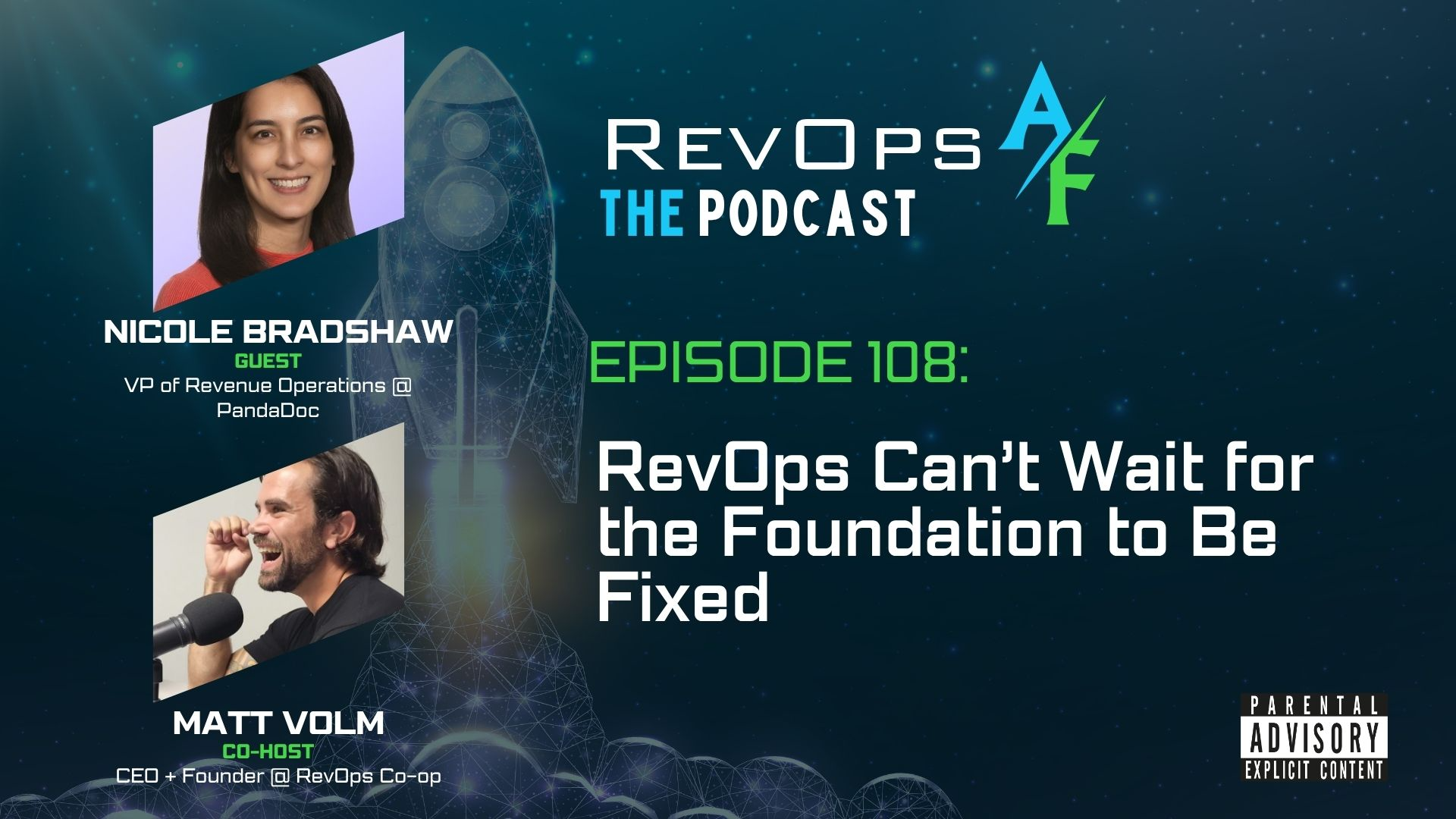
Episode 108: RevOps Can't Wait for the Foundation to Be Fixed
Nicole Bradshaw, VP of RevOps at PandaDoc, shares her framework for fixing broken GTM foundations without stalling what leadership is asking for.


If you're banking on AI to solve all your sales problems, you might want to pump the brakes. While 40-50% of decision makers are experimenting with AI in sales, most are stuck in what Jiaxi Zhu calls "pilot purgatory." In this episode of RevOpsAF, the RevOps Analytics expert at Google sits down with host Camela Thompson to reveal why most AI deployments fail—and what you can do differently.
The conversation cuts through the AI hype to deliver practical insights about strategic deployment, ROI measurement, and the critical difference between augmenting your sales team versus replacing them entirely.
Zhu breaks down AI deployment into two distinct categories that most organizations approach in isolation. The first bucket focuses on customer-facing applications: personalized outreach emails, chatbots for inbound lead qualification, and real-time translation for global prospects. The second bucket targets internal sales productivity through meeting note summarization, predictive lead scoring, and automated approval workflows.
"The problem there is it often happens in silos. Most of these companies and teams are stuck in pilots, mainly because they're deploying this at the tactical level rather than the strategic system level." — Jiaxi Zhu
This siloed approach explains why so many AI initiatives never scale beyond initial experiments. Without a strategic systems approach, organizations end up with disconnected tools that create more friction than value.
Thompson highlights a critical mistake she sees repeatedly: smaller organizations trying to use AI to solve massive problems before establishing basic foundations. If you're attempting to scale cold outbound without a clear ideal customer profile or product-market fit, AI won't magically create success.
"It's not going to be super productive," Thompson notes. This mirrors the broader challenge many RevOps teams face when building marketing budgets or implementing new systems without proper groundwork.
Zhu emphasizes that successful AI deployment starts with identifying specific business outcomes, not intermediate metrics. Too many teams measure success through adoption rates or dashboard visits rather than tangible revenue impact.
One of the most valuable segments focuses on ROI calculation. Zhu warns against the common pitfall of measuring AI success through intermediate metrics like user adoption or email volume. Instead, he advocates for identifying the specific business outcome the AI solution will drive.
For an AI assistant handling inbound customers, success might mean improved conversion rates due to the AI's patience and consistency, or operational efficiency from reducing human resource allocation to lower-ROI segments.
"The most important first step for folks to take is to identify the business outcome metric that the AI deployment will impact." — Jiaxi Zhu
The ROI equation includes both the numerator (increased revenue from time reinvestment) and often-overlooked costs like change management and the temporary productivity loss during adoption periods.
A recurring theme throughout the conversation is the importance of seamless integration. Zhu points out that many AI tools are built by IT or engineering teams and then retrofitted onto existing sales workflows, creating friction rather than efficiency.
The classic example: an AI tool that requires salespeople to constantly switch between their CRM and the new system becomes a distraction rather than a productivity enhancer. This connects to broader RevOps systems challenges where poor integration undermines tool effectiveness.
Timing matters enormously. Launching new AI tools during busy sales quarters can be disruptive, while rolling them out too early in the quarter may result in low adoption when reps finally need them.
Zhu advocates borrowing user experience research methods from consumer tech companies. This means sitting with salespeople, observing their actual workflows, and understanding where AI recommendations would fit naturally into their existing processes.
"Really understanding the rhythm of the way salespeople work is also very important.” — Jiaxi Zhu
This includes mapping the quarterly sales cycle—from planning in week one to execution in weeks five and six, to presentation preparation at quarter-end.
This user-centric approach aligns with broader RevOps best practices around understanding stakeholder needs before implementing solutions.
While some sales functions can be replaced by AI—particularly for simple products or high-volume, low-touch scenarios—complex B2B sales require a different approach. At Google, Zhu notes, advertising sales involves complex auction systems, multiple stakeholders, and relationship-building that AI cannot replicate.
"These are things that are, at least in the short term, very hard to replace by AI. But it doesn't mean that there's no room for AI to play a significant role in that process." — Jiaxi Zhu
The key is redefining roles and expectations. When AI automates approval processes and saves salespeople hours per week, organizations must provide explicit guidance on how to reinvest that time into value-adding activities. Should reps call more prospects or go deeper with existing customers? Without clear direction, the time savings won't translate to revenue impact.
This connects to broader compensation planning considerations as sales roles evolve with AI augmentation.
Successful AI deployment requires acknowledging the human element. Zhu emphasizes the importance of training, workshops, and hand-holding rather than simply launching tools and expecting adoption.
The conversation touches on the need to reset executive expectations about AI's role. Rather than viewing AI as a path to immediate headcount reduction, leaders should focus on how it can make existing team members more effective and strategic.
This mirrors challenges discussed in previous episodes about building influence without authority and managing organizational change.
Zhu's closing advice centers on three critical principles:
Intentional Deployment: Think through upsides and risks before building and deploying AI tools. This strategic approach prevents the pilot purgatory that traps so many organizations.
User-Centric Design: Consider the complex needs of different personas within your sales organization, from junior reps to sales managers to customers who interact with AI-powered systems.
Role Evolution: Actively define the division of labor between AI and salespeople, then cultivate the new skills and expectations required for success.
These principles apply beyond AI to any RevOps technology implementation, from CRM optimization to analytics platform deployment.
As AI continues evolving, the organizations that succeed will be those that approach it strategically rather than tactically. This means starting with clear business outcomes, designing for user adoption, and managing the human side of technological change.
For RevOps professionals, this conversation reinforces the importance of taking a systems-thinking approach to any new technology. Whether you're implementing AI tools or optimizing existing processes, success depends on understanding the broader organizational context and designing solutions that truly serve end users.
The episode serves as a valuable reminder that in the rush to adopt cutting-edge technology, the fundamentals of good RevOps practice remain unchanged: understand your users, measure what matters, and always keep the bigger picture in mind.
Check out our blog, join our community and subscribe to our YouTube Channel for more insights.
Our average member has more than 5 years of RevOps experience. That means you’ll have real-time access to seasoned professionals. All we ask is that you’re generous with your knowledge in return.