Podcast

October 1, 2026
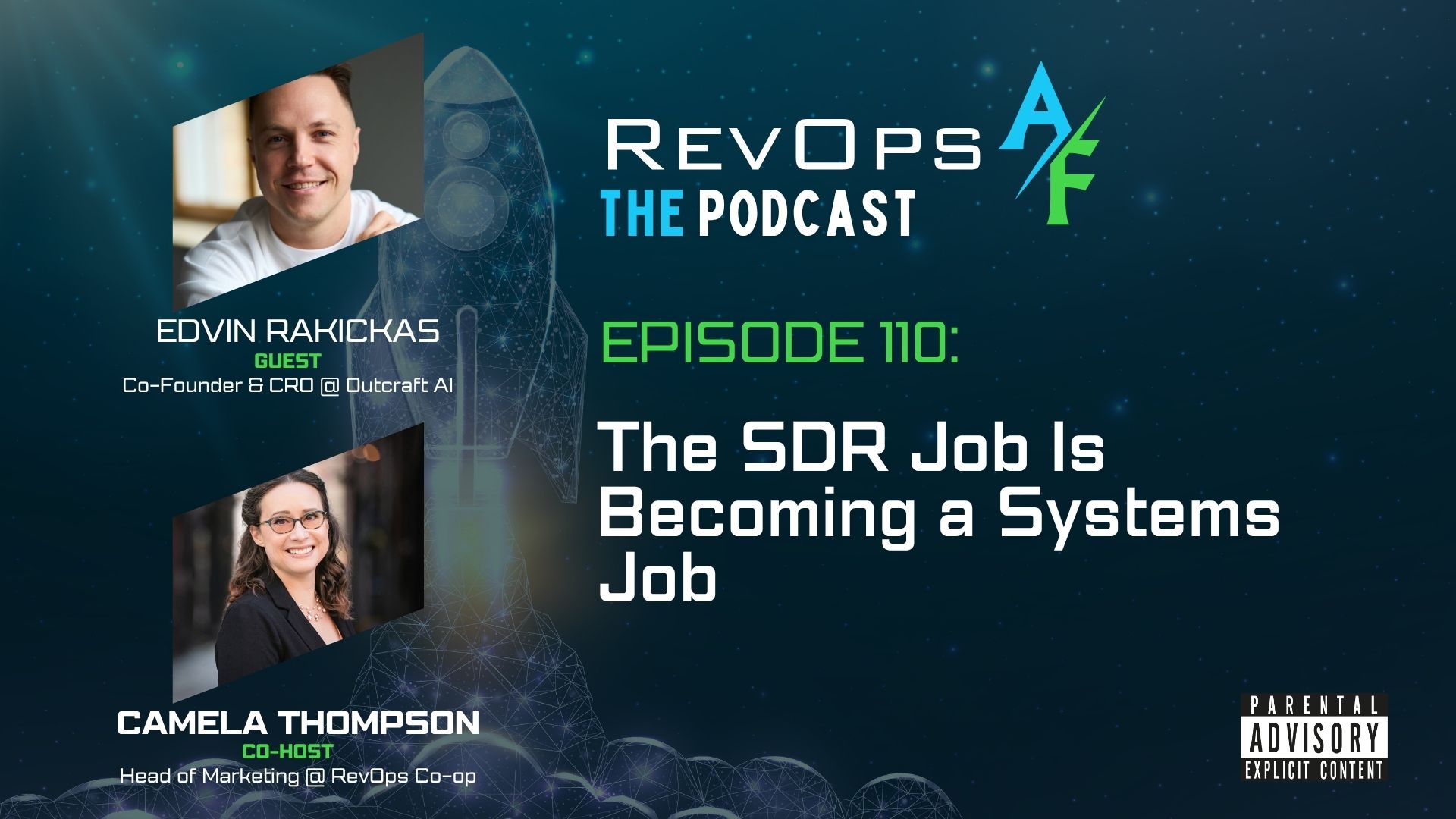
Episode 110: The SDR Job Is Becoming a Systems Job
AI is reshaping the SDR role from activity-based to systems-based. Outcraft AI co-founder Edvin Rakickas on what actually breaks in AI outbound.


The AI revolution in revenue operations isn't coming—it's here. But while everyone's talking about AI's potential, most RevOps teams are still stuck in the experimentation phase, burning through budgets without seeing real results.
In this episode of RevOpsAF, Matthew Volm sits down with Fabrice Buron, VP of Revenue Operations and Strategic Alliances at Outreach, to cut through the hype and deliver a practical roadmap for turning AI experiments into revenue-generating machines.
Fabrice brings a unique perspective to this conversation. As a revenue operations leader at a company that's building AI agents for other RevOps professionals, he's both implementing AI internally and helping customers navigate their own AI journeys. This dual vantage point gives him insights that most operators simply don't have access to.
Before diving into shiny AI tools, Fabrice emphasizes a critical but often overlooked reality: your infrastructure needs to be rock-solid first. This aligns perfectly with what we've seen in our guide to fixing tech bloat—you can't build AI success on a foundation of disconnected systems and dirty data.
"Garbage in, garbage out, right? So first of all is your data and your stack, the tech stack connected enough to be able to have your AI basically powered with the right information to take action." — Fabrice Buron
The conversation reveals three levels of AI that most operators don't distinguish between:
Understanding these distinctions is crucial because each requires different infrastructure investments and delivers different types of value. Too many teams jump straight to complex implementations without ensuring their systems are properly integrated and their data quality meets AI requirements.
One of the most valuable insights from this conversation is Fabrice's emphasis on working backward from business problems. This mirrors the approach we've advocated in our sales forecasting accuracy guide—start with the outcome you want, then build the process to get there.
"You need to start with a business problem you're trying to solve. So when you map your entire customer journey and user journey, you are able to say, okay I might be very good right now at customer acquisition, but what about retention?" — Fabrice Buron
Fabrice walks through a practical example of AI-driven customer retention monitoring. Instead of having customer success managers manually track 20 accounts, AI can monitor signals across all customers simultaneously—website visits to competitor pages, decreased system adoption, or changes in user behavior patterns. This kind of comprehensive monitoring is impossible to do manually but becomes trivial with the right AI implementation.
The key is identifying where manual processes create blind spots in your revenue engine. Our customer onboarding strategies article explores similar concepts around systematic approaches to revenue operations.
Perhaps the most definitive take in this episode comes when Matthew and Fabrice discuss the build-versus-buy decision for AI tools. Their conclusion? It's not even a debate worth having.
"Just because you can doesn't mean you should, and just because it's easier than it was before doesn't mean it's something that you should do." — Matthew Volm
Fabrice shares his own painful experience trying to build AI solutions internally before joining Outreach. The reality is that building AI tools requires not just engineering resources, but ongoing maintenance, user experience design, customer support, and continuous iteration based on market feedback.
"I was not able to deliver a compelling result with the solution. And discussing this problem with peers is very interesting. They've spent tons of millions for a pilot and experimenting to see what was possible." — Fabrice Buron
This connects directly to broader RevOps consultant considerations—sometimes the expertise and infrastructure investment required makes external solutions the only viable path forward.
The conversation reveals that many companies have burned through millions in AI experimentation without clear business outcomes. This year, executives are demanding results, not just pilots.
When it comes to measuring AI success, Fabrice advocates for focusing on fundamental revenue metrics rather than AI-specific vanity metrics. The key indicators he tracks include:
This approach ensures AI initiatives tie directly to revenue outcomes rather than getting lost in technical metrics that don't translate to business value. It's similar to the measurement frameworks we discuss in our mutual action plans article—focus on metrics that directly correlate with revenue impact.
"For example, we're going to look at the number of sequences that are run. What was the reply rate that we had? Where was abandonment in the sequence?" — Fabrice Buron
The conversation emphasizes breaking down high-level metrics into actionable components. This granular approach allows teams to identify what's working and optimize accordingly, rather than treating AI as a black box.
One of the most practical sections of the episode focuses on designing AI workflows that go beyond simple automation. Fabrice describes a comprehensive AI-driven prospecting motion:
This systematic approach creates what Fabrice calls "AI GTM motions"—end-to-end workflows that augment human capabilities rather than just automating individual tasks.
The key insight here is that AI's value multiplies when you connect multiple capabilities into cohesive workflows. This mirrors concepts we've explored in our digital sales rooms article—the power comes from orchestrating multiple touchpoints, not just optimizing individual interactions.
Looking ahead, Fabrice sees RevOps professionals evolving into something resembling data scientists from a few years ago—unicorn roles that combine technical skills with business acumen. The future RevOps professional will need to understand:
"Rev Ops is going through the same transformation where, of course the market pressure is to become a unicorn. I don't know if we will become that, but we need to be able to understand the GTM motion, the data, AI." — Fabrice Buron
This evolution positions RevOps at the center of AI-driven revenue growth, orchestrating not just internal processes but also how AI agents interact across different business functions. The role becomes less about running engines in the background and more about designing and optimizing AI-augmented revenue systems.
The conversation touches on agent-to-agent communication and cross-functional AI workflows—concepts that will likely define the next phase of RevOps evolution. As our recent podcast on Partner Ops explored, the future of operations is increasingly about orchestrating complex, interconnected systems.
The conversation between Matthew and Fabrice provides a refreshingly practical perspective on AI in revenue operations. Rather than getting caught up in the hype, they focus on actionable strategies that RevOps teams can implement today to start seeing real results from their AI investments.
For teams still in the experimentation phase, this episode offers a clear roadmap for moving from pilots to production. The key is treating AI as an amplifier of good processes, not a replacement for foundational RevOps work.
Check out our blog, join our community and subscribe to our YouTube Channel for more insights.