Podcast

October 1, 2026
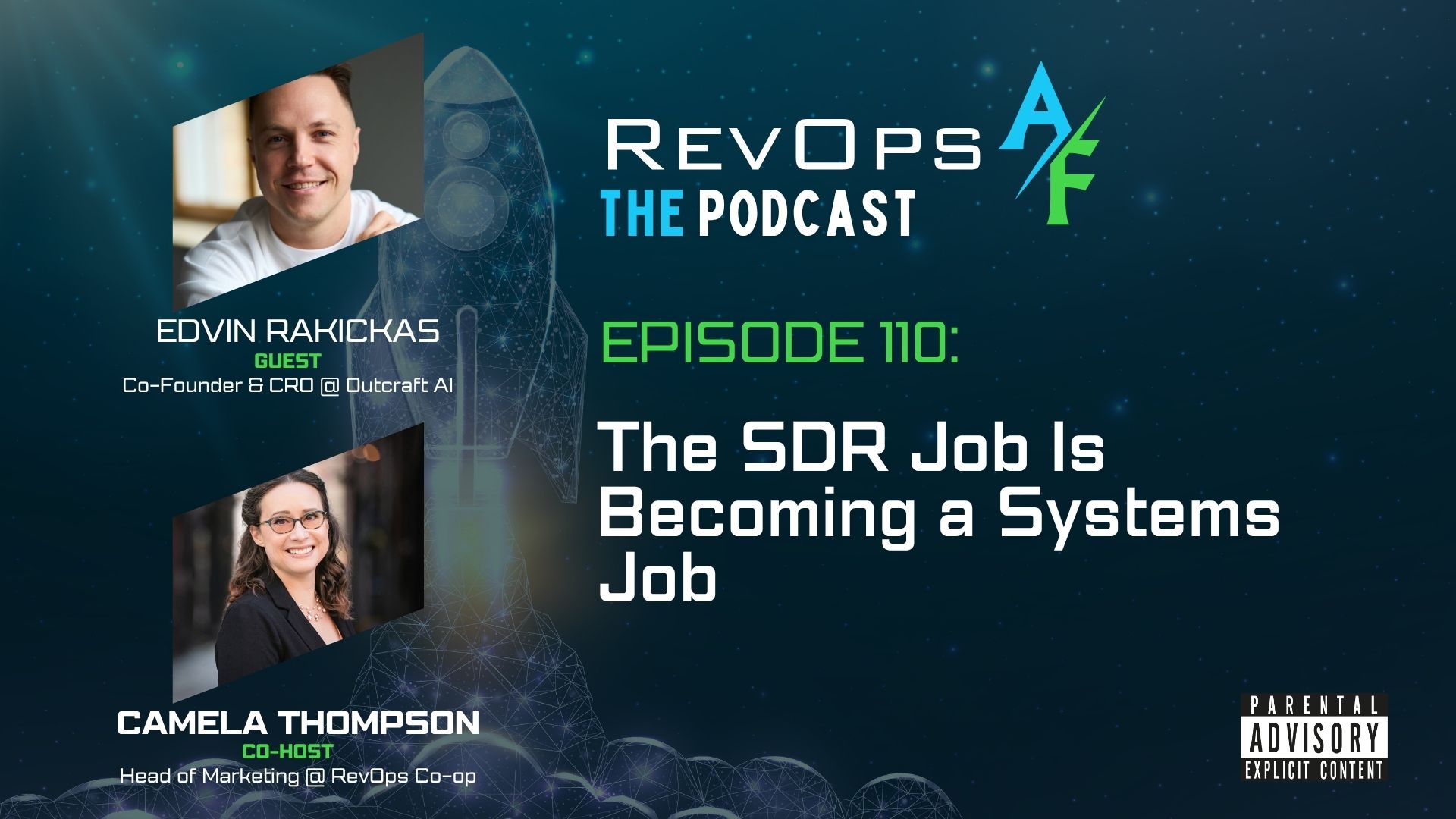
Episode 110: The SDR Job Is Becoming a Systems Job
AI is reshaping the SDR role from activity-based to systems-based. Outcraft AI co-founder Edvin Rakickas on what actually breaks in AI outbound.


What if the biggest barrier to your sales team's success isn't competition, market conditions, or even product-market fit — but the endless administrative tasks that pull them away from actually selling? That's the "bureaucracy gap" that Amanda Lin, Senior Manager of Go-to-Market AI Operations at MongoDB, is on a mission to eliminate.
In this episode of RevOpsAF, co-host Matthew Volm, CEO + Founder of Eventful and RevOps Co-op, sits down with Amanda to explore how one of the world's leading database companies is leveraging artificial intelligence to transform their revenue operations — and what other RevOps teams can learn from their approach.
Amanda's path to RevOps leadership wasn't traditional. Starting in management consulting, she worked with tech companies on complex organizational challenges before realizing her passion lay in day-to-day operations where she could see immediate impact. After earning her MBA from Booth, she took on a chief of staff role at a software testing company, wearing multiple hats from pricing and packaging to customer satisfaction.
It was during the AI boom that Amanda found her calling. When her company needed help with their AI testing business, she jumped at the opportunity to build out the RevOps function from scratch. As she puts it:
“I really jumped at that opportunity because I saw that as a space to be incredibly scrappy. There wasn't really a playbook on how to price our AI solution or track the pipeline.” — Amanda Lin
This experience led her to MongoDB, where she now leads AI operations within go-to-market, focusing on optimizing and transforming every role in the funnel using artificial intelligence.
Before diving into solutions, Amanda and Matthew establish what they mean by the "bureaucracy gap"—a concept that will resonate with anyone who's worked in revenue operations.
“The bureaucracy gap is really what are some of the tasks or activities that the go-to market team does that they need to do for whatever reason? Whether it's for tracking purposes or for helping other team members understand what's happening with the deal. But these are all just tasks that really take away from them spending time with their customers and building that relationship with the customers.” — Amanda Lin
This definition hits at the heart of a common RevOps challenge: balancing the need for process, tracking, and visibility with the reality that every minute spent on administrative tasks is a minute not spent with customers. It's a problem that has only grown as revenue models have evolved from simple annual contracts to complex consumption-based pricing and now AI-powered intelligent systems.
Rather than treating AI as a magic bullet, MongoDB has taken a strategic approach to building what Amanda calls a "cognitive offload engine" for their sales reps. The platform focuses on one of the most time-consuming aspects of a sales rep's day: meeting preparation.
Consider the math: 60-70% of MongoDB's sales reps are taking discovery meetings, and each meeting requires 30 minutes to an hour of preparation time for account research, understanding the customer, and gathering relevant proof points. Multiply that across hundreds of reps and thousands of meetings, and you're looking at a massive productivity drain.
MongoDB's AI solution tackles this by:
But as Amanda discovered, the real challenge wasn't the AI itself — it was the data foundation.
Here's where MongoDB's story becomes a cautionary tale for any organization considering AI implementation. When Amanda's team tried to build their proof point recommendation system, they hit a wall: hundreds of case studies and proof points trapped in massive PowerPoint presentations with zero tagging or searchability.
“We had, with our enablement team, a lot of different proof points, hundreds of proof points that were really trapped inside this massive like 200 page PowerPoint presentation with zero tagging and you can't really search through and find effectively what you're looking for.” — Amanda Lin
This is where many AI initiatives fail—not because of the technology, but because of data strategy fundamentals. MongoDB had to pause their AI development to build a structured tagging system that would allow AI to effectively map proof points by industry, company, and use case.
The lesson here connects directly to broader RevOps systems challenges: you can't simply input unstructured data into AI and expect magic. The foundation has to be solid first.
One of the most practical insights from Amanda's experience is her approach to perfectionism in AI implementation. Rather than trying to solve every edge case before launch, MongoDB focused on getting 80% of their proof points properly tagged and searchable.
“A lot of times we don't want to let perfect be the enemy of progress here. Being able to find some sort of way to break down this big problem... what's the minimum acceptable amount of proof points that we can get tagged so that at least our AI system can have something in there that we could start testing and getting user feedback for?” — Amanda Lin
This philosophy aligns with successful process management approaches across RevOps: start with what works for the majority of cases, learn from real usage, and iterate. As Matthew points out, even an 80% solution that saves 30+ minutes per meeting is infinitely better than a 0% solution while you wait for perfection.
While MongoDB's initial focus has been on pre-sales activities, Amanda shared insights into how they're thinking about AI across the entire go-to-market engine. For SDRs, rather than replacing human connection with AI-generated spam, they're focusing on:
For solution architects, they're exploring AI-assisted sizing calculations and technical requirement gathering from meeting transcripts—again, focusing on eliminating administrative overhead rather than replacing expertise.
This approach reflects a broader trend in sales operations where AI augments human capabilities rather than replacing them entirely.
Looking ahead to 2026, Amanda predicts significant changes in how RevOps teams measure success. Traditional metrics like email volume for SDRs become meaningless when AI can send thousands of emails instantly. Instead, she envisions new KPIs focused on:
These predictions align with broader discussions about aligning revenue teams using KPI metrics in an increasingly complex go-to-market environment.
Amanda's experience at MongoDB offers several actionable insights for RevOps professionals considering AI implementation:
Start with Data Foundation: Before building AI solutions, audit your data structure. Can your systems actually support the intelligence you want to create?
Focus on Cognitive Offload: Look for tasks that require research and preparation but not human judgment. These are prime candidates for AI automation.
Embrace the 80% Solution: Don't let perfect be the enemy of good. Start with solutions that work for the majority of cases and iterate based on real usage.
Maintain Human Connection: AI should eliminate busywork, not replace the human elements that drive revenue. As Amanda notes, MongoDB still believes in human SDRs and the importance of authentic customer relationships.
Think Cross-Functionally: Successful AI implementation requires buy-in across enablement, product, and other teams. It's not just a RevOps project.
Perhaps the most insightful moment in the conversation comes when Amanda shares her CEO's philosophy on scaling:
“Scaling isn't really about getting bigger. It's about staying simple.” — Amanda Lin
This mindset shift—using AI to hide complexity rather than add it—represents a fundamental change in how we think about revenue operations systems. Instead of building more complex dashboards and processes, the goal becomes surfacing only the essential information each person needs to do their job effectively.
The conversation takes an interesting turn when Matthew and Amanda discuss how go-to-market strategies often cycle back to previous approaches. From bundled to unbundled products, from complex to simple pricing models, and now potentially back to more human-centric sales approaches as AI handles the administrative overhead.
This observation connects to broader trends in marketing budget planning and account-based marketing strategies, where intimate, relationship-focused approaches are gaining renewed attention in an increasingly digital world.
MongoDB's approach to AI in RevOps offers a refreshing perspective in a market full of overhyped solutions and unrealistic promises. By focusing on eliminating bureaucracy rather than replacing human judgment, they're creating sustainable competitive advantages while maintaining the customer relationships that drive long-term success.
For RevOps professionals, the key takeaway isn't about the specific AI tools MongoDB uses, but about their methodical approach to identifying friction points, building solid data foundations, and implementing solutions that truly serve their go-to-market teams.
As Amanda puts it, the goal isn't to make reps into order takers, but to give them the headspace to be trusted partners for their customers' most complex challenges. That's a vision of AI in RevOps that actually serves revenue growth — and it's one that any organization can work toward, regardless of their current technology stack.
Check out our blog, join our community and subscribe to our YouTube Channel for more insights.