Podcast

October 9, 2026
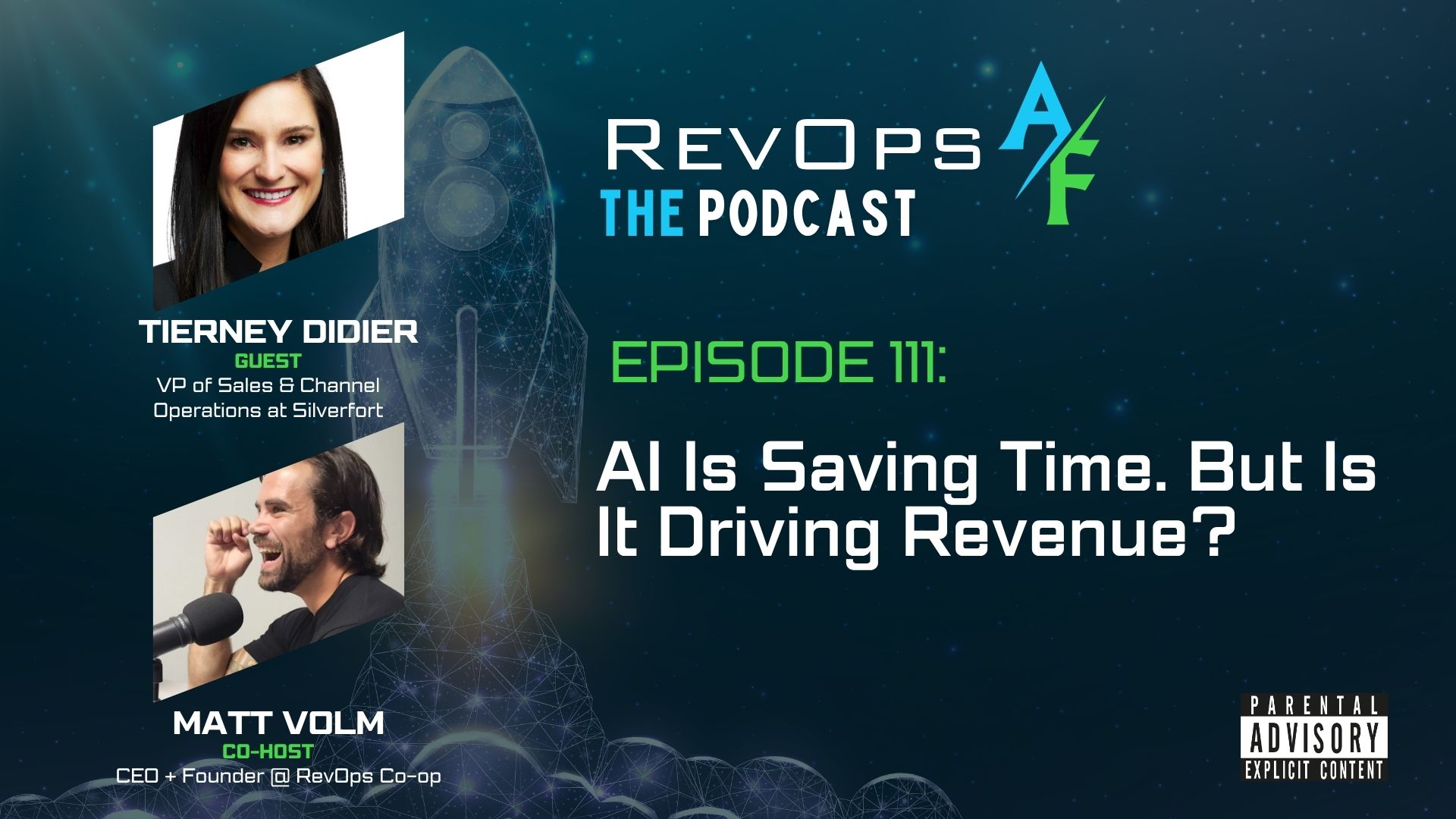
Episode 111: AI Is Saving Time. But Is It Driving Revenue?
AI is saving time in RevOps — but is it driving revenue? Tierney Didier of Silverfort breaks down what's actually working and what's still TBD.


Is your RevOps role about to evolve—or get replaced entirely? In a conversation that should make every revenue operations professional sit up and take notice, fractional CMO and Cannonball GTM co-founder Doug Bell joined host Camela Thompson to discuss the emergence of a new breed of professional: the Revenue Engineer. This isn't just another job title shuffle—it's a fundamental shift in how go-to-market teams will operate in an AI-driven world.
The conversation reveals a stark reality: while RevOps professionals have been maintaining increasingly complex tech stacks and managing data hygiene, a new category of professionals is flanking them entirely. These "go-to-market engineers" aren't trying to integrate your existing systems—they're building orchestration layers that bypass the brittleness of traditional revenue operations systems altogether.
Doug's perspective on the future of sales and marketing teams challenges conventional wisdom. While many assume that sales teams are shrinking due to product-led growth (PLG) and AI automation, he argues for a more nuanced view:
"Sales organizations get smaller but more muscular. I think SDR is going to start [being] more important. Not the current version, which is like hire to fire model where you're bringing these really junior people. I think it's going to be more and more difficult to drive demos and it's going to be more and more difficult to have really good sales conversations." — Doug Bell
This insight connects directly to what many RevOps professionals have observed: the traditional model of throwing junior SDRs at complex messaging and ICP challenges simply isn't sustainable. As Doug points out, asking 22-year-olds to figure out product-market fit and messaging problems while booking meetings has always been fundamentally flawed.
The Revenue Engineer role, as Doug describes it, stands on three critical foundations that traditional RevOps roles are struggling to address:
The first pillar involves mastering tools like Clay, N8N, and Zapier to create orchestration workflows that operate independently of existing tech stacks. These professionals are commanding salaries that have jumped from $85K to $200K as demand outstrips supply. They're not trying to fix your CRM integrations—they're building parallel systems that deliver results while your traditional stack remains brittle.
Unlike pure go-to-market engineers who can afford to work around existing systems, Revenue Engineers must eventually work within established tech stacks. This requirement forces them to develop skills that bridge the gap between innovative orchestration tools and legacy revenue operations systems. They can't simply build in isolation—they must integrate their innovations into the broader revenue infrastructure.
Perhaps most disruptively, Doug predicts that Revenue Engineers will absorb traditional demand generation functions. The skills required for email marketing, PPC, and paid social aren't insurmountable barriers—they're simply additional tools in a comprehensive toolkit.
"We believe very firmly that the current demand gen form and function is going to get absorbed by what we call revenue growth engineers. So think about it... you've got really good email marketers, got really great sort of PPC people, great paid social. Sometimes they can do all three, right? That's going to get absorbed by this go to market engineer position." — Doug Bell
This evolution represents a fundamental shift from specialized roles to full-stack revenue professionals who can orchestrate the entire buyer journey using AI-powered tools and methodologies.
Doug introduced the ERA maturity model (not a Taylor Swift reference, he assures us) that maps the evolution of AI-powered go-to-market capabilities:
Stage 1: Prompt Engineering - Where 90% of the market currently operates, using ChatGPT for single-use tasks and complex queries.
Stage 2: Orchestration - The Clay.com stage, where professionals build workflows that connect multiple AI tools and data sources.
Stage 3: Claude Code - The game-changing stage where professionals can build recursive code with integrated large language models that learn and adapt.
The most striking insight? Doug believes most professionals will skip Stage 2 entirely and jump directly to Stage 3 using Claude Code. This isn't traditional coding—it's conversational development where you can literally talk to the system to build, plan, design, and deploy solutions.
"Claude code changes everything... It doesn't just code, it plans and it talks to you and then it says the development, and then it does the design, and then you work together. And by the way, I don't even type, I just talk to it." — Doug Bell
One of the most actionable insights from the conversation involves moving beyond traditional Ideal Customer Profile (ICP) targeting to what Doug calls "pain-based segmentation." This approach uses publicly available data to identify "existential data points"—measurable factors that determine whether a business succeeds or fails.
Doug shared a compelling example from his work with equipment leasing companies. By analyzing public Department of Transportation and insurance records, his team discovered that equipment lessors with below 60% fleet utilization rates were bleeding cash, while those above 85% faced recapitalization decisions. This data-driven approach allowed them to create highly targeted campaigns with 0.92% pain ratings for the highest-priority prospects.
This methodology represents a significant evolution from traditional account-based marketing approaches, leveraging AI and public data to identify prospects at the exact moment they're experiencing acute business pain.
For current RevOps professionals wondering how to adapt, Doug offers both reassurance and a challenge. The foundational skills—project management, understanding system interrelationships, and data flow management—remain valuable. However, the application must expand dramatically.
"You already have the skills. It's just about learning these additional tools and it's okay to be called on the carpet. That's what Camela, you and I have been doing for a long time... It's just a big part of the change and I don't want to oversimplify it. It's really scary, but it's not that hard. You're just learning new tools, honestly." — Doug Bell
The key differentiator is developing an ownership mentality around pipeline generation, not just system maintenance. Revenue Engineers don't just manage the infrastructure—they're accountable for the results it produces.
Three external pressures are accelerating this transformation:
These forces combine to create an environment where traditional RevOps approaches—no matter how well-executed—may not be sufficient to compete.
The financial opportunity is significant but may not last forever. Current go-to-market engineers are seeing compensation jump from $85K to $200K, but Doug expects this to normalize as the talent pool expands, particularly with skilled professionals from Mexico, Central America, South America, and Egypt entering the market.
For RevOps professionals considering this transition, the window of opportunity is now. The skills gap is creating premium compensation, but early movers will have the advantage of establishing themselves before the market saturates.
For those ready to begin the transition, Doug recommends several starting points:
The conversation also highlighted the importance of understanding that this isn't just about learning new tools—it's about developing a new mindset around revenue generation that combines technical capability with strategic thinking.
Perhaps the most sobering moment in the conversation came when Doug addressed the stakes directly:
"The negative consequence is that you're going to be obsolete, to be honest with you. So you're either going to be RevOps, you're going to be a go-to market engineer, or you're going to be a revenue growth engineer." — Doug Bell
This isn't fear-mongering—it's a realistic assessment of how rapidly the landscape is changing. The professionals who adapt will find themselves in high-demand, well-compensated roles. Those who don't may find their traditional RevOps skills increasingly commoditized.
The conversation between Doug and Camela reveals a future where traditional RevOps boundaries dissolve in favor of comprehensive revenue engineering. The question isn't whether this change will happen—it's whether current RevOps professionals will lead the transformation or be left behind by it.
For those ready to evolve, the path forward is clear: embrace AI-powered tools, develop pain-based segmentation capabilities, and take ownership of revenue outcomes. The Revenue Engineer role isn't just the next evolution of RevOps—it's the future of how high-performing companies will drive predictable growth.
Check out our blog, join our community and subscribe to our YouTube Channel for more insights.