Podcast

October 9, 2026
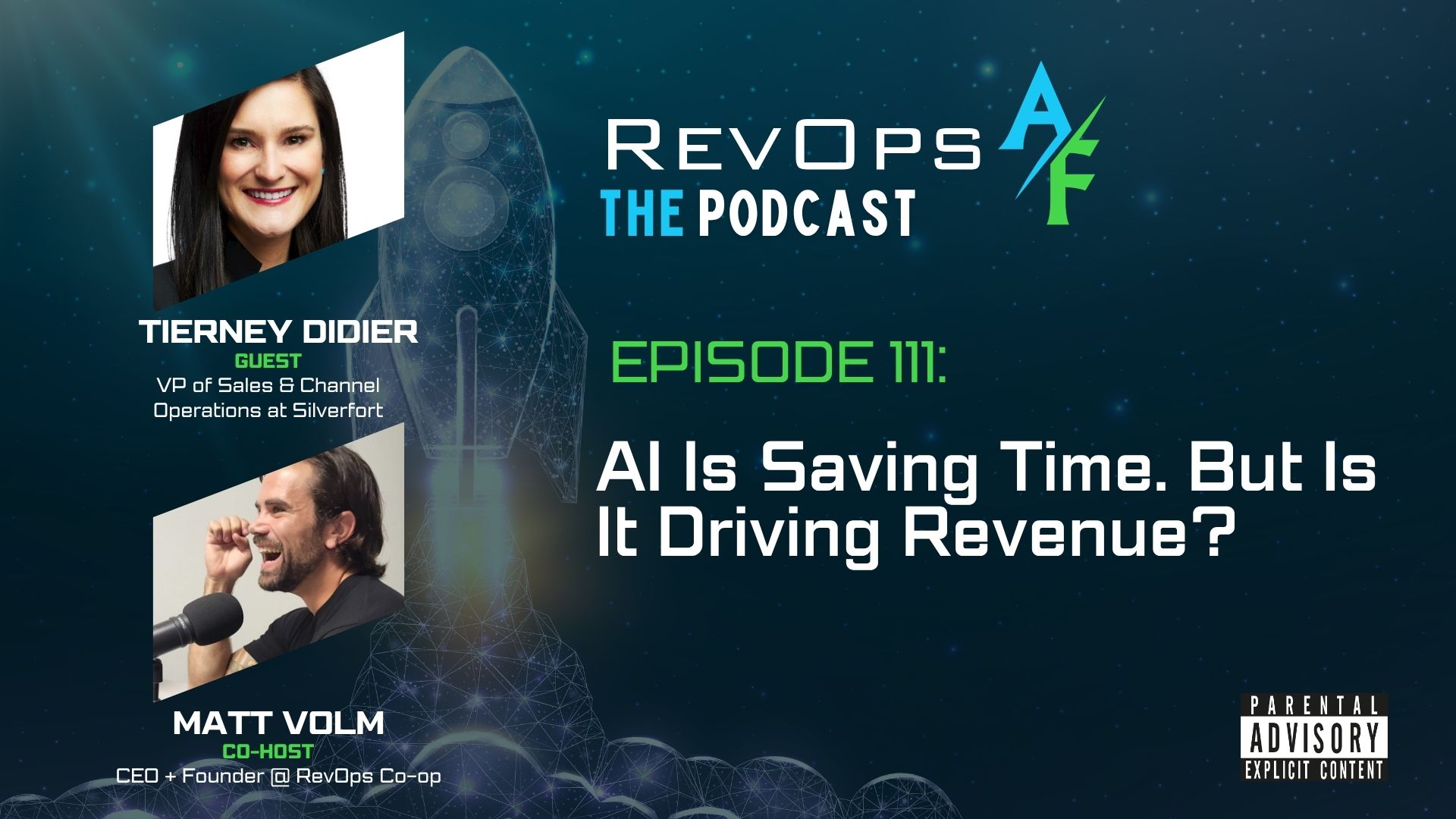
Episode 111: AI Is Saving Time. But Is It Driving Revenue?
AI is saving time in RevOps — but is it driving revenue? Tierney Didier of Silverfort breaks down what's actually working and what's still TBD.


The allure of Product-Led Growth (PLG) is undeniable. Who wouldn't want their product to sell itself, scale effortlessly, and drive predictable revenue without heavy sales involvement? But here's the harsh reality: most PLG dreams crash and burn before they even get off the ground.
In this eye-opening episode of the RevOpsAF podcast, co-host Camela Thompson sits down with Lauren Knight, a seasoned RevOps expert who's spent the last decade building go-to-market foundations for early-stage startups. Knight, whose work lies at the intersection of product data and revenue, doesn't mince words about why so many companies fail at PLG implementation.
"Product-led growth is really where the product sells itself. The product is driving both acquisition, activation, conversion, retention, and expansion. It's all truly product-led." - Lauren Knight
But here's where most companies get it wrong. PLG isn't just slapping a free trial on your existing product or building a signup flow. As Knight emphasizes, those are tactics, not strategy. True PLG means your product does the selling in place of a sales team—a fundamental shift that requires comprehensive process management and strategic thinking.
Thompson agrees, noting how executives often try to "shoehorn their product into it before it's ready." The result? A half-baked PLG motion that confuses customers and frustrates internal teams.
Knight identifies several critical warning signs that your product isn't ready for the PLG transition:
These challenges align with broader RevOps systems issues that many companies face when trying to scale their go-to-market operations.
One of the most critical aspects Knight discusses is the infrastructure required for successful PLG implementation. This isn't just about having the right tools—it's about creating an integrated ecosystem that captures and acts on customer data throughout the entire journey.
"You need to make sure you're capturing data all across that customer journey." - Lauren Knight
This includes:
This infrastructure challenge mirrors what many RevOps teams face when fixing tech bloat problems across their organizations.
Unlike traditional sales-led motions, PLG roadmaps are entirely driven by usage data.
"Your usage data really guides everything that you do." - Lauren Knight
This represents a significant cultural shift from sales-led companies.
Successful PLG companies operate more like early-stage startups: fast iterations, bite-sized feature releases, and constant experimentation. There needs to be "psychological safety around just being able to ship features that you might pull a couple weeks later."
This approach requires sophisticated analytics capabilities and the ability to quickly identify where users are dropping off, what features drive engagement, and which expansion opportunities are most promising.
Knight advocates for a hybrid approach rather than an all-or-nothing PLG strategy.
"I think a lot of companies benefit from more of this hybrid approach, which is using the PLG motion as an experiment." - Lauren Knight
This experimental mindset allows companies to test PLG viability within their specific industry and customer base before committing fully. It's similar to how successful RevOps teams approach territory design and management—starting with data-driven experiments before scaling successful approaches.
When Thompson asks about realistic timelines, Knight delivers a sobering reality check. Despite executive pressure for 90-day implementations, the actual timeline for proper PLG setup is six to nine months minimum.
"Just getting your systems and foundational work can be anywhere from like six to nine months to really have tested everything, make sure everything, you know, the data actually takes some time." - Lauren Knight
This timeline includes:
The extended timeline often surprises executives who underestimate the complexity involved, similar to challenges discussed in our analysis of RevOps consultant red and green flags.
One critical factor Knight highlights is the need for product team alignment. PLG requires fast, iterative development cycles and constant adaptation based on user data. If your product team is locked into rigid roadmaps or operates on six-to-12-month release cycles, PLG won't work.
"This particular motion has to be really fast, it has to be iterative. You have to constantly be adapting." - Lauren Knight
This agility requirement extends beyond just product development to encompass the entire go-to-market organization.
While not extensively covered in this episode, the conversation touches on how customer success evolves in PLG motions. Traditional customer onboarding strategies must be reimagined for self-service environments, with greater emphasis on in-product guidance and automated nurturing sequences.
For RevOps professionals considering PLG, Knight's insights offer several critical takeaways:
The conversation also reinforces the importance of RevOps as the connective tissue between product, sales, marketing, and customer success—a theme that resonates throughout our thought leadership content.
As PLG continues to evolve, RevOps professionals must balance the allure of product-led efficiency with the reality of implementation complexity. Knight's insights remind us that successful PLG isn't about following a playbook—it's about building the right foundation, gathering the right data, and making informed decisions based on what your customers actually need.
The companies that succeed with PLG will be those that approach it strategically, with proper infrastructure and realistic expectations. For RevOps leaders, this means focusing on the fundamentals: data integration, process optimization, and cross-functional alignment.
"It's a great motion if it works for your particular product." - Lauren Knight
The key is knowing whether it works—and having the patience to build it right.
Check out our blog, join our community and subscribe to our YouTube Channel for more insights.