Podcast

October 15, 2026
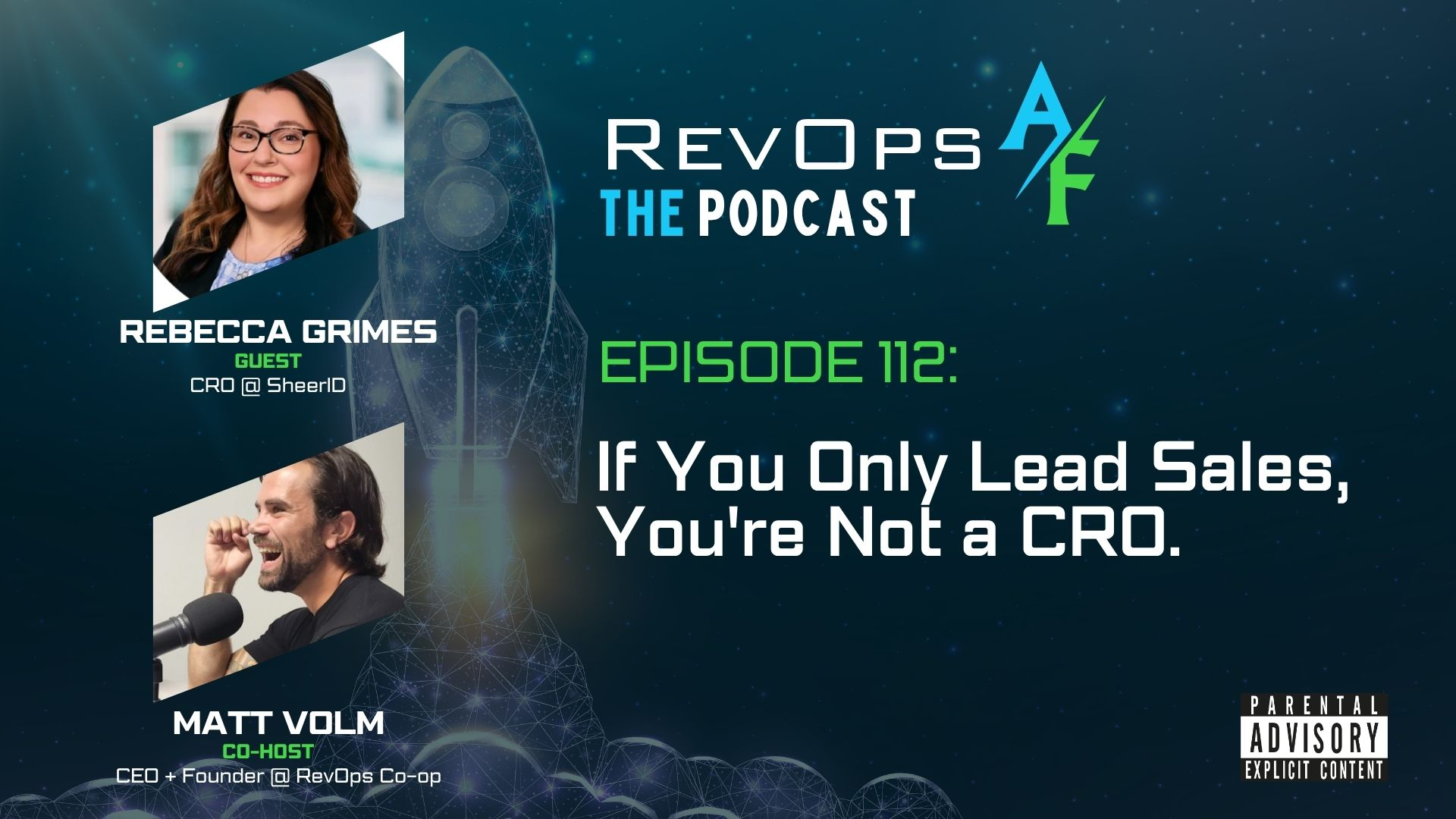
Episode 112: You're Not a CRO If You Only Lead Sales
SheerID CRO Rebecca Grimes makes the case that a CRO who only leads sales is really a CSO and explains what full-cycle revenue ownership looks like.


Most companies aren't losing revenue because they picked the wrong CRM. They're losing it because the right CRM was implemented wrong — or ignored entirely. The platform becomes a cost center instead of an asset, and six months later, someone in the executive suite is asking whether it's time to switch tools. It's usually the wrong question.
Camela Thompson sits down with Josh Larson, owner of DeltaRev, a RevOps agency specializing in HubSpot implementations and optimizations. Josh has been building revenue systems since 2013 — starting, as he tells it, with a drone business he ran in college where leads were piling up faster than any spreadsheet could handle. Since then, he's worked with hundreds of companies across industries to implement, optimize, and manage HubSpot accounts. What he's found across all of them is a familiar pattern: the technology rarely fails on its own terms. The failure is almost always operational.
The first thing Josh does when he comes into a new engagement is trace the lead lifecycle from the very top. Marketing gets the credit — or the blame — for everything that happens after a form submission, but in most organizations, the handoff between marketing capture and sales contact is where revenue quietly disappears.
"One, how are things being captured? And two, how fast are we getting in front of these people? Those are the biggest breaks operationally that I tend to see." — Josh Larson
The capture-and-routing problem has been documented extensively — Josh cites a Harvard Business Review study showing that responding to a lead within the first ten minutes yields a 350% increase in conversion rate — but most businesses are still routing leads to a shared inbox, then to a spreadsheet, then to whoever has bandwidth. The result is a gap measured not in minutes but in hours or days, and by then the window has largely closed.
The follow-up problem compounds the capture problem. Most sales teams make one or two contact attempts before quietly marking a lead as dead. The research Josh references points to eight to twelve touchpoints as the range where leads actually move forward. The gap between what teams do and what works is wide, and it's a gap that a properly configured CRM — with sequences, tasks, and automation — should close automatically. When it doesn't, it's usually because nobody configured it to do so in the first place.
Camela adds a related layer that gets overlooked even further upstream: UTM parameters and campaign tracking within the CRM itself. Marketing teams that rely exclusively on ad platform attribution are setting themselves up for a fight when someone asks for a revenue attribution report. The CRM and the ad platform will show wildly different numbers for the same population, and the resulting confusion erodes confidence in the data long before anyone asks why lead conversion is low. For a deeper look at how to build attribution practices that hold up under scrutiny, the RevOps Co-op blog covers why perfect attribution is a myth — and how to work with that reality productively.
If lead capture is where revenue leaks first, the sales-to-delivery handoff is where it leaks last — and at a much higher cost. Josh is direct about naming it as the breakdown with the biggest long-term consequences, both for customer retention and for enterprise value.
The problem is familiar to anyone who has sat in a post-close onboarding meeting: the customer was sold on a specific outcome during discovery, but the information gathered during that process didn't survive the handoff. The customer success or delivery team starts from scratch, the customer has to re-explain what they need, and the credibility gap that opens up in those first weeks is difficult to close.
"How do we make sure that it's seamless and all the information gathered during the discovery of the sales is actually handed off and they get what they were sold?" — Josh Larson
This connects to a broader theme that Camela returns to consistently: the handoff points in a revenue cycle are where RevOps has the highest potential impact, and they're also where RevOps is most often absent. Revenue operators who don't insert themselves into the onboarding process — who treat their mandate as ending when the deal closes — are leaving the most consequential part of the customer journey unexamined. Episode 38: Perfecting Team Handoffs goes deeper on the mechanics of designing handoff moments that don't create downstream damage.
Josh's philosophy on CRM implementation has a thesis, and it's worth naming directly: a correctly configured system that no one uses delivers exactly zero value. The temptation — especially for technically skilled administrators — is to get the software set up right and consider the project complete. The adoption problem is treated as someone else's responsibility.
"I look at is how can we build this so it is actually used? Because if it's not used and it's set up correctly, does it really give them value? Probably not." — Josh Larson
The implication for implementation strategy is significant. Before building anything, Josh maps how the business actually operates — not just how it should operate in theory — and then designs the system around that reality. Best practices that work technically but don't fit how a sales team actually moves through their day will be ignored, and ignored systems don't generate data, and systems without data can't be improved.
Camela extends this with a point that often surprises administrators who have been focused on enforcing CRM discipline: the goal isn't to force behavior into the CRM. The goal is to get accurate information into the CRM, however that happens. If a rep prefers to manage a conversation in Slack, the question is whether that interaction can be captured and surfaced in HubSpot — not whether the rep can be retrained to work differently. Episode 51: Change Management: From Pushback to Buy-In covers how to navigate exactly this kind of behavior-change challenge without creating resistance that kills adoption before it starts.
The most practical evolution Josh has seen in RevOps workflows is the move toward working around the CRM without compromising data quality inside it. The pattern he describes is increasingly common: use AI and integration tools to interact with the system through interfaces that feel natural to the team, while maintaining governance over what actually gets written to the record.
Josh's own agency runs a tool called Victor that sits inside Slack and connects to HubSpot, Apollo, and a range of other platforms. When a new lead comes in, the tool flags it with enrichment data from Apollo, surfaces context about the account, and prompts action — all without requiring anyone to open HubSpot. When client requests come in, it creates tickets and tasks automatically, assigns ownership, and keeps the project management board current. The CRM stays clean because the system is doing the work of capturing what would otherwise fall through the cracks.
"You can essentially work straight out of Slack or even Claude, and it can do exactly what you need it to do in HubSpot for you, which makes it super easy to use. Then you know everything is updated and correct, and the reporting will look a lot better." — Josh Larson
The data quality layer is where this gets meaningful at scale. Using a combination of Apollo for enrichment and Claude for processing, Josh's team has built workflows that can read an entire CRM database, identify records that don't match enrichment data, and queue them for cleanup — with human review before anything is changed. The output isn't just cleaner data; it's a database that executives can query directly, asking natural-language questions and getting dashboard-quality answers without waiting for a RevOps administrator to build a report. The condition that makes all of this work is that the data has to be clean and the governance has to be in place before the AI layer goes on top. The reporting is only as meaningful as the definitions behind it.
This connects directly to the "eat your vegetables" principle Camela invokes: account assignments, ownership rules, lifecycle stage definitions, and property governance have to exist before any intelligent system can act on them reliably. Episode 94: The Boring Work Behind Great AI covers why the foundational data work is always the prerequisite, never the afterthought.
The conversation turns to a question with practical stakes for anyone who has tried to hire outside expertise to fix a HubSpot implementation: how do you vet a consultant before you've seen their work?
Josh's list of red flags is specific enough to be useful. The first is capacity: a consultant with a small team and a large number of active clients is a consultant who will deprioritize your project. Ask how many clients they're actively working with and how the team is structured. The answer tells you more about delivery quality than any portfolio case study.
The second — and the one Josh flags as the failure pattern behind most consultant-hopping — is jumping to solutions before understanding the business.
"If you're being sold a book of goods that 'Hey, I'm gonna come in and fix it without looking at anything,' I would run away fast, because you're not gonna get anything fixed." — Josh Larson
Camela offers a specific example of what this looks like in practice: a marketing team that hired a consultant to build out their sales process without talking to a single member of the sales team. The system was technically correct. The sales team kept forecasting out of a spreadsheet and never touched HubSpot. The consultant's work was, in effect, invisible.
The third red flag is the absence of pushback. A consultant who says yes to everything — every feature request, every timeline, every scope addition — is selling execution, not expertise. What a good consultant brings is the ability to hear a business requirement and say, "That's what you asked for, but have you thought about this?" If that exchange never happens, you're paying someone to click buttons, not to solve problems. Episode 65: RevOps Consultant Red and Green Flags covers the full landscape of what separates a high-value engagement from an expensive mistake.
The counterpart red flag on the client side is just as real: executives who want a consultant to come in and solve everything without involving their own team. The system that gets built in that context will be technically complete and operationally useless. Stakeholder access isn't a courtesy — it's the condition under which good work becomes possible.
The question Camela poses near the close of the conversation is one that comes up in nearly every established company at some point: an executive looks at the CRM, decides it isn't working, and proposes migrating to something new. Josh's response is blunt.
"That mindset to me is a symptom of something much deeper than the system, than the software. Something is lacking where maybe there's not accountability on the sales team, maybe there's not visibility into some sort of mechanism in the business, and their gut instinct is because HubSpot manages that, it's gotta be HubSpot or it's gotta be the CRM." — Josh Larson
Camela's extension of this is equally direct: when you migrate to a new CRM, you bring the problems with you. Every major CRM requires clean data, clear definitions, and consistent adoption. If those things don't exist in the current system, they won't exist in the new one either. The migration becomes expensive, disruptive, and temporary. Six months later, the same executive is asking about the next platform.
The actual fix is the unglamorous work that was skipped the first time: governance frameworks, lifecycle stage definitions, property standards, automation logic, and the cross-functional alignment that makes all of it stick. It's also the change management work — explaining what the system does and why it matters, repeatedly and proactively, until the organization understands it well enough to use it. As Camela notes from her own experience, in-house RevOps professionals can spend up to 18 months in constant communication mode before executive trust reaches a sustainable level. Consultants often move faster, but only because they establish credibility through early, visible wins. Influencing Without Authority covers the dynamics of building that kind of organizational trust without a formal mandate to enforce it.
The bar Josh sets for a system that will still be in use in a year is specific: team buy-in, clear definitions shared across functions, governance that keeps data clean over time, and a direct line between using the tool and personal productivity for every person who touches it. The last condition is the hardest to establish and the most important. If a rep can see that HubSpot makes their day easier — that it surfaces the right leads at the right time, reduces the cognitive overhead of follow-up, and makes their pipeline visible without extra work — they'll use it without being told to. If they can't see that connection, no governance policy will make them.
Check out our blog, join our community and subscribe to our YouTube Channel for more insights.