Podcast

October 9, 2026
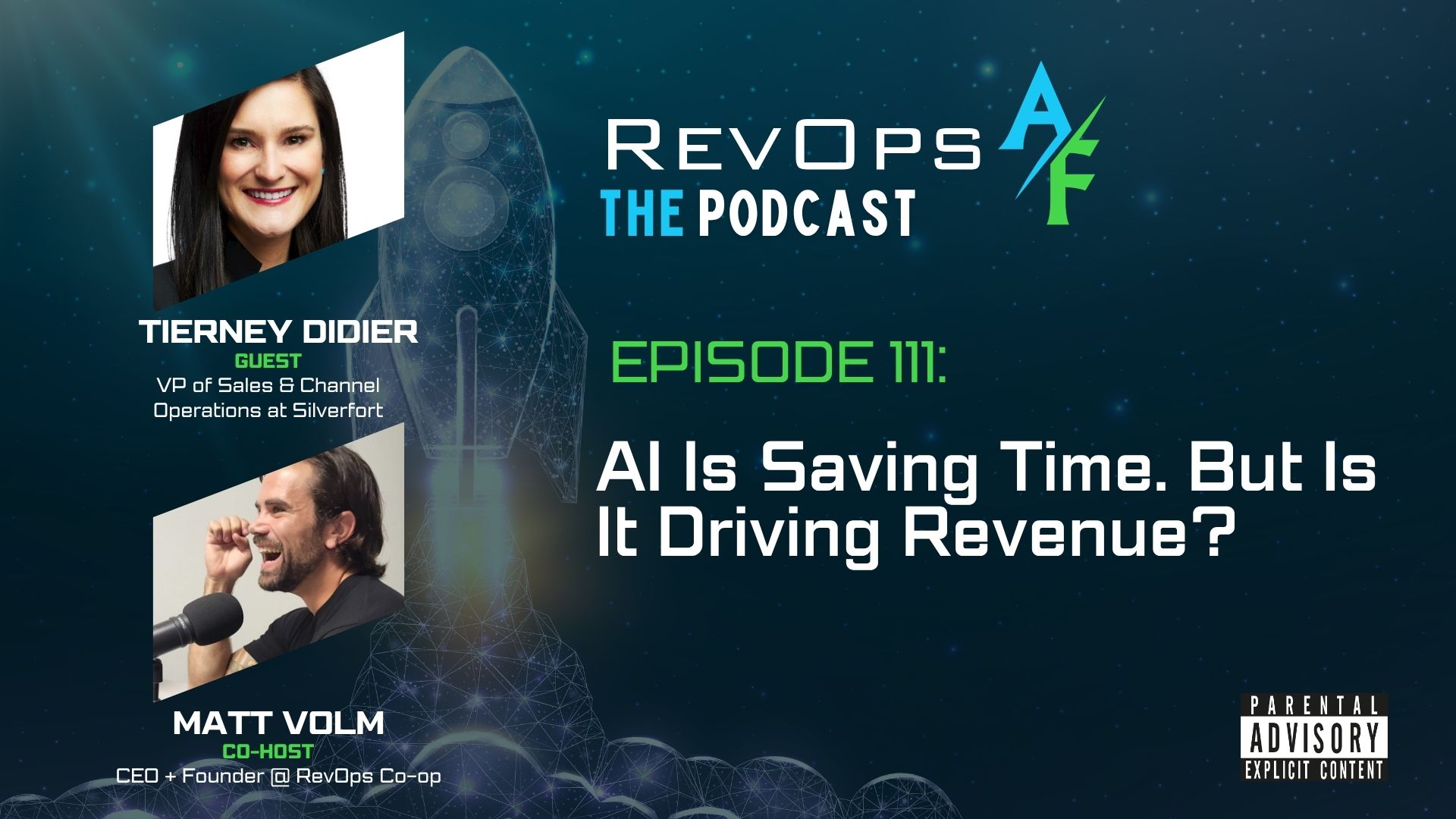
Episode 111: AI Is Saving Time. But Is It Driving Revenue?
AI is saving time in RevOps — but is it driving revenue? Tierney Didier of Silverfort breaks down what's actually working and what's still TBD.


Most RevOps conversations about data quality stay safely abstract — clean your CRM, deduplicate your records, don't let bad emails into your nurture sequences. What happens when the stakes get real? When a bad phone number doesn't just waste a few minutes of a rep's time but triggers a regulatory violation? When a mismatched voicemail could expose the company to a TCPA lawsuit? When your contact rate is the difference between millions of dollars in enrollments and millions of minutes of wasted agent time?
Jamie Noel, Senior Director of Revenue Operations at ClearOne Advantage, brings a perspective that most RevOps practitioners haven't encountered. Her path — from salesperson at Rock Financial (which became Quicken Loans, which became Rocket Mortgage) through call center leadership, legal business strategy, and debt settlement operations — has taken her to the sharp end of what bad data actually costs. She joined co-host Matthew Volm to talk through data hygiene as a revenue strategy, speed-to-lead measurement as it's rarely discussed, the consumer-side AI use cases B2B teams should be watching, and what it means to walk in as the first RevOps hire — again — and fix things from the ground up.
The instinct when someone says "data hygiene" is to picture a systems administrator running deduplication scripts on a CRM database. Jamie reframes this immediately. The problem isn't what's inside your system — it's what you let in, and what that costs you on the other side.
In the consumer financial services world, the scale of the problem is different from anything most B2B operators encounter. ClearOne Advantage's operation runs millions of minutes of phone time across sales and client lifecycle conversations, layered with automated SMS journeys, email sequences, and direct mail — all of it touching real consumers who have real legal protections around how they can be contacted.
"If you go into your CRM and you go Google it right now, you will find a lead with 888-888-8888 if you don't have a way to funnel that stuff out of your system. That is a waste of marketing spend, that is a waste of your sales or your BPOs, to be calling, 'cause they're never gonna pick up because it's bad data." — Jamie Noel
Under TCPA regulations, calling a number that's associated with the wrong person isn't just a missed connection. It's a legal exposure. Jamie calls this a "voicemail mismatch": you call one person's phone number (according to enrichment data), and someone else's voicemail picks up. This creates a regulatory risk on every subsequent attempt.
The fix isn't just cleaning data after the fact. It's building a data mart layer above the CRM that filters bad records before they ever enter the system — because once they're in, everything downstream suffers. Email deliverability degrades when you're sending to invalid addresses or texting landlines. Major carriers flag you when patterns of undeliverable contacts accumulate. And when your contact rate suffers, enrollment volume suffers. The chain from bad data to bad revenue isn't complicated — it's just rarely traced all the way through. For a deeper look at how data integrity connects to operational efficiency, Episode 63: Set It and Refine It: Clean Data, Auto-magically covers passive data logging approaches that reduce input errors before they compound.
Jamie has been the first RevOps hire more than once. The pattern she describes walking into is consistent: no clear ownership, no unified view of the funnel, and a set of metrics that are being tracked but not tracked correctly.
"There's a lack of ownership. So first you have to really be prepared to be the single neck to ring, because that's ultimately your job — you are the single neck to ring to hold marketing accountable for lead volume, lead quality, time of day of week, staffing, all of that from a revenue perspective." — Jamie Noel
Both times she came in as the first RevOps hire, the metric she fixed first was speed to lead. Not because it was the most glamorous problem, but because it was the anchor. Every other metric in the funnel depends on whether you're measuring it correctly — and speed to lead, it turns out, is almost never measured correctly.
The issue isn't whether organizations are tracking how fast they dial incoming leads. Most are. The issue is what goes in the denominator. If you include overnight leads from time zones that aren't legally dialable at the time they're received, you're measuring noise. If a California resident submits a lead at midnight local time, that lead can't legally be called at 8:00 AM Eastern. Including it in your speed-to-lead calculation poisons the metric.
"You gotta remove anything that's not dialable out of your denominator for speed to lead. 'Cause that's really where you're gonna set yourself apart from the competition." — Jamie Noel
The second lever she reached for was appointment integrity. If a client commits to a future call, hitting that appointment isn't just a courtesy — it's the first promise you've made them. Agents who consistently miss their booked appointments lose the lead. The rule: if you're not going to make the appointment, escalate it rather than letting it age out. The client committed. The team's job is to honor that.
This connects to a pattern that Episode 67: Why RevOps Roadmaps Fail — Breaking the Ticket Taker Mindset explores at length: operators who walk into chaos and try to fix everything at once tend to fix nothing. The most effective first RevOps hires find one anchor metric, fix the way it's measured, and build credibility from there.
One of the more underappreciated implications of good data hygiene is that it expands your strategic options. Most teams think of data quality as a problem to solve so that existing processes work better. Jamie thinks of it as the thing that tells you which process to use in the first place.
The logic works like this: if a consumer's phone number is invalid but their mailing address checks out, they shouldn't be on a dial cadence or an SMS journey. They should be in direct mail. If a valid number never picks up across dozens of attempts, but the consumer re-submits a lead seven days later — that's a hand-raising event. The cadence resets. The priority score climbs.
Jamie's team has developed consumer personas to operationalize these patterns. "Medical Bill Mary" always checks her mail. She's a direct mail candidate. "Tech-Savvy Tyler" doesn't have a physical mailbox — everything's on auto-pay. Text him. Offer chat. Meet him where he already is.
"You gotta meet in the right channel at the right time with the right agent. And if you can get all of that lined up, whether it's with data, understanding preferences, understanding client sentiment or intent, then you're bound to be successful." — Jamie Noel
The model gets more sophisticated from there. Variables like mortgage ownership versus renting, cell carrier, time-of-day response patterns, geographic area codes — all of these become features in a predictive model for lead intent and channel preference. The goal is to reduce the number of attempts required to reach a qualified conversation. Knowing that a particular consumer never picks up before 4:00 PM means you don't burn dials before 4:00 PM. That's not just efficiency. It's respect for the agent's time, the lead's attention, and the compliance clock that's running on every contact attempt.
The same philosophy applies across B2B contexts too — Episode 49: Why Customer Data Is a RevOps Priority covers how data-informed contact strategy creates compounding advantages across the full revenue lifecycle.
Jamie was an AI adopter before it became the expected talking point in every RevOps conversation. She built bots for her own scheduling before deploying AI at work — and the first place she deployed it professionally was the most obvious one: eliminating the 90-minute pre-meeting report-building ritual that was consuming her mornings.
"The hour and a half it would take me to pull reports for all contact strategies through all channels... I then could train somebody, or I could train a bot to do it for me, and instead of taking 90 minutes before an executive management meeting to pull all that data, it was done for me in 15 minutes." — Jamie Noel
That quality-of-life recapture is the entry point. The more interesting use cases are the ones she describes on the operational side — and they're directly transferable to B2B.
The clearest one: appointment confirmation. Before a scheduled call, an AI-powered bot dials out, confirms the appointment, and offers a reschedule option if the client can't make it. The payoff is immediate. Why deploy a human sales agent on an outbound dial to someone who may not answer because the appointment was never confirmed? Confirm first, then route. The conversion rate on confirmed appointments is categorically different from the conversion rate on cold-dialed scheduled slots.
The second use case is IVR (interactive voice response) and routing optimization. Simple yes/no decision points in a contact flow — "press 1 to accept, press 2 to decline" — don't require a live agent. A workflow handles the branch logic, captures the signal, and routes accordingly. The agent enters the conversation only when human judgment adds value.
Both of these use cases fit cleanly in B2B workflows. Use confirmation bots ahead of demo calls and AI-handled intake routing before discovery conversations. Reserve sales interaction time for the moments where human judgment matters, and automate everything upstream of that. Episode 88: Not Everything Is an Agent makes the complementary argument about where AI automation actually belongs versus where it gets over-applied.
The AI conversation in B2B RevOps tends to focus on text — transcript analysis, email summarization, CRM field population from call notes. Jamie's frame goes further: the text of what was said is only part of the signal. The way it was said carries equal weight.
She describes a scenario that most B2B operators will recognize: a vendor showed her a dashboard feature during a demo. She got visibly excited — asked detailed follow-up questions, spent twenty minutes riffing on a specific capability. The vendor noticed. They called back. They knew they had a buyer signal because the tools they were selling could detect it — tonality, engagement pattern, the shape of the conversation.
"They knew the buying signs because of what they were selling to me, and they weren't even selling. They were just showing." — Jamie Noel
The implication for B2B RevOps is direct. Conversation intelligence tools that analyze sentiment, tone, and objection patterns aren't just coaching assets — they're lead scoring inputs. If a prospect spends fifteen minutes drilling into a specific use case, that engagement is a signal. If a late-stage opportunity has a conversation where the buyer's energy drops, that's a signal too. The score on that opportunity should move.
The coaching dimension compounds this. A sales manager with a team of fifteen can only review so many call recordings in a week. AI that analyzes 100% of calls and surfaces the ones that need attention — a missed close attempt, an unhandled objection, a positive buying signal that wasn't followed up on — changes the coaching leverage ratio entirely. For operators thinking about how sales analytics and coaching tools connect, Sales Metrics: KPIs to Coaching Tools offers a useful framework for structuring what you measure and why.
Jamie's most striking observation comes at the end of the conversation, and it's about the direction of change rather than any specific tactic. She watched the mortgage industry move from face-to-face, human-intensive sales processes to fully digital, frictionless enrollment over the course of her career. At the time it seemed impossible. Now it's the baseline.
The same shift is happening in debt settlement — an industry where the conversation is emotionally fraught, often needs to happen privately, and historically required a trusted human voice on the other end. The insight her team has landed on: some clients don't want to have that conversation with a person. They're embarrassed. They don't want to do it at work, in front of their kids, anywhere they can be overheard. Digital enrollment isn't a compromise — for those clients, it's a better experience.
The B2B parallel she leaves implicit is worth naming explicitly. Buyers who don't want to talk to a rep before they're ready aren't lost leads. They're buyers who need a different channel. The instinct to force everyone through a human-gated motion — SDR outreach, discovery call, demo request — treats the channel as the strategy when it's actually just one option. Episode 6: Ops for Product-Led Growth covers how B2B teams have started building the infrastructure for exactly this kind of buyer-directed motion.
The counterpoint is equally worth holding: the same week these conversations are happening about digital-first, frictionless enrollment, B2B teams are experimenting with door-to-door sales and face-to-face prospecting — going more human, not less, precisely because everyone else went digital. Jamie's framing holds both: meet the client in the right channel at the right time. The channel isn't fixed. The data tells you which one to use.
Check out our blog, join our community and subscribe to our YouTube Channel for more insights.