Podcast

September 16, 2026
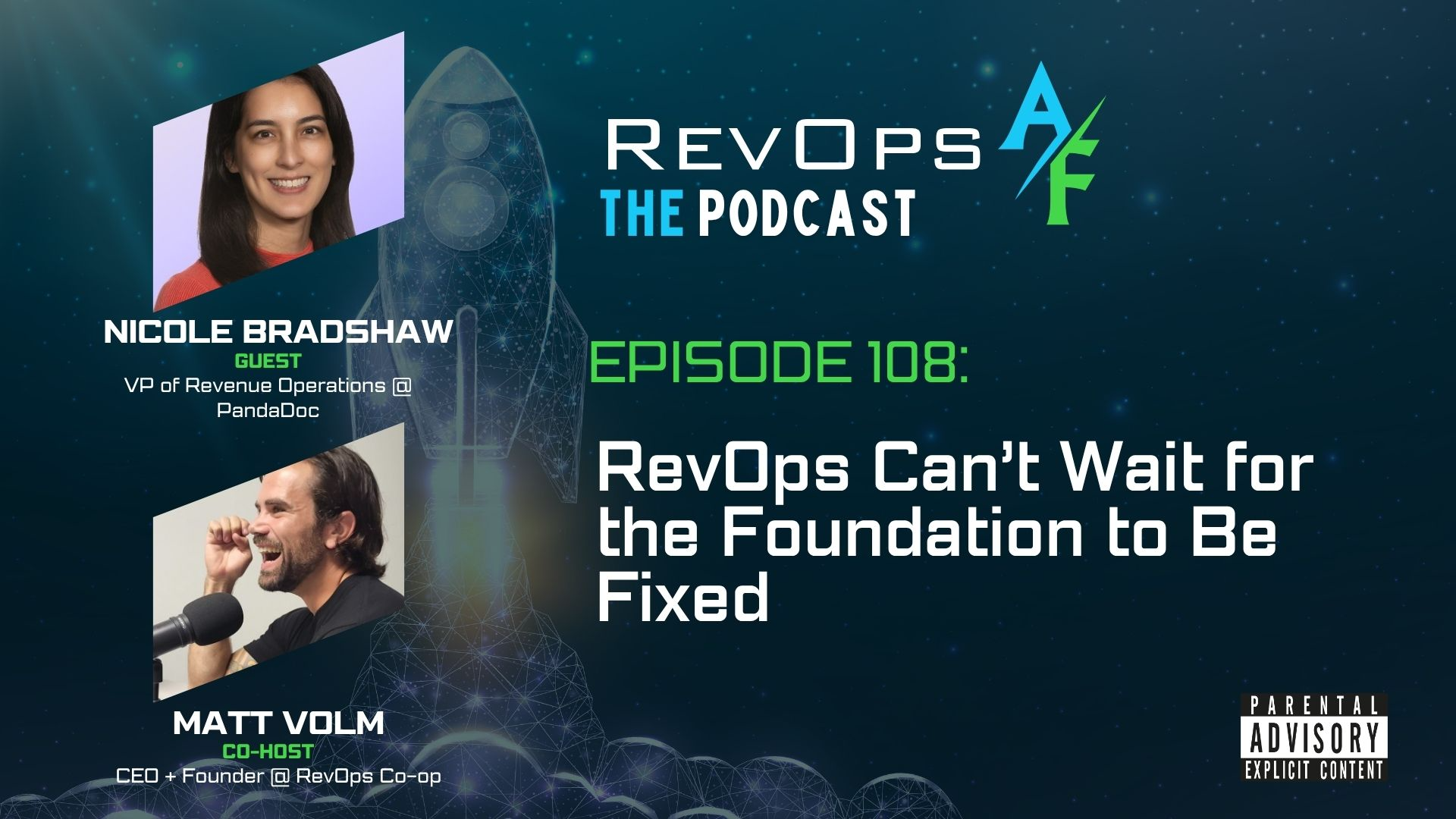
Episode 108: RevOps Can't Wait for the Foundation to Be Fixed
Nicole Bradshaw, VP of RevOps at PandaDoc, shares her framework for fixing broken GTM foundations without stalling what leadership is asking for.


Most RevOps conversations eventually land on the same territory: AI readiness, tech stack optimization, SQL proficiency, data quality. All legitimate. All worth discussing. But Jared Myatt, Senior Director of Revenue Operations at Integrate, thinks the field is missing something more fundamental — and harder to teach.
In this episode of RevOpsAF, Jared joins co-host Matthew Volm for a conversation that deliberately sidesteps the usual RevOps talking points. No AI frameworks, no stack consolidation debates. Just an honest look at the soft skills — humility, self-awareness, relationship-building, adaptability — that separate operators who plateau from operators who compound. Jared brings over 13 years at Integrate, where he's moved from account approvals to analyst to biz ops to running revenue operations across the organization. That tenure gives him a uniquely longitudinal perspective on how careers actually develop inside a company, and what it takes to keep expanding your scope when the organization isn't pushing you to do it.
Matthew frames the conversation with a deliberate challenge: forget AI, forget SQL, forget the obvious technical answers. What's the biggest skill gap in RevOps that people aren't talking about?
Jared doesn't hesitate.
"I think for me personally, it's humility mixed with self-awareness. Being able to know when you're wrong and pivot. Working in RevOps, we're very close to a lot of the internal processes, the technologies. We're the ones doing the building, and we're in the nitty-gritty every single day. So I think it's very easy to get attached to a lot of the stuff that's going on."
— Jared Myatt
The attachment problem is real, and it's worth sitting with. RevOps operators spend enormous amounts of time building systems, defining processes, selecting tools, and documenting logic. That investment creates expertise — and it creates blind spots. The more you've built something, the harder it is to acknowledge when it isn't working.
Jared's point about humility isn't about being passive or deferential. It's about having the self-awareness to separate your identity from your outputs. The tool evaluation you championed, the process you designed, the workflow you automated — none of those are you. Being able to look at something that isn't working and say, without defensiveness, "Let's reassess and try a different approach" is a skill most operators develop late, if at all.
Matthew adds his own frame on the failure question: the only real failure is the failure to learn something. That distinction matters more than it might first appear. If your assumptions turned out to be wrong, that's not a failure — it's a data point. If you changed direction after learning something new, that's not inconsistency — it's the job. The operators who struggle are the ones who tie their professional credibility to being right the first time, rather than being the person who helps the organization find the right answer.
This connects to a broader pattern that Episode 67: Why RevOps Roadmaps Fail explored: operators who define their work by the outputs in front of them — the queue, the ticket, the deliverable — rather than the business outcomes behind them, tend to stay reactive and get stuck. Humility is what opens the door to a more strategic orientation.
The abstract case for humility is easy to make. Jared makes it concrete with a story from his own experience.
His team was evaluating call recording software. He had done the work — multiple vendor conversations, a thorough evaluation, a compelling business case showing cost savings and feature parity with their existing solution. Leadership was convinced. The decision seemed made.
Then, well into the process, he discovered that two or three capabilities his business critically needed weren't supported by the vendor he'd been advocating for.
"I was very gung-ho, and everyone's on board, and now it's like we can't do these two or three things that are like critical for our business. We can't buy this software today. So that was one where I had to swallow my own ego and be like, 'Okay, this isn't gonna work for us. I'm gonna have to go back to senior leadership and present all of my findings and tell everyone what's what.'"— Jared Myatt
The instinct in that moment — the one almost every operator feels — is to dread the conversation. Everyone's going to be frustrated. It'll look like you wasted everyone's time. They'll question your judgment.
That's not what happened. Leadership's response was essentially: good catch, glad we didn't sign anything, we still have time before renewal. Gratitude, not frustration.
The gap between the anticipated reaction and the actual one is instructive. Senior leaders have generally seen enough failed projects to understand that catching a problem before committing to a contract is exactly what good operators do. The bad outcome isn't discovering a problem. The bad outcome is signing a contract and then discovering the problem.
Matthew's corollary to this: run at problems as fast as you can. Don't delay, don't minimize, don't hope it resolves itself. The faster you surface an issue, the more options everyone has. The longer you wait, the fewer. Building a strong business case before committing to a direction is part of this — but so is being willing to invalidate that case when new information surfaces.
The conversation shifts to a question operators at every level face: how do you get buy-in from executives and senior leaders when you need it?
Jared's framework is deliberately unglamorous. Three things.
First, show the data. If you're trying to make a case, lead with evidence. Concrete numbers are hard to argue with in a way that abstract recommendations aren't.
Second, be concise. Senior leaders operate at a pace that doesn't accommodate verbose presentations. Emails from CEOs and CFOs tend to be one sentence. When you're presenting to them, mirror that energy — get to the point, say what you need to say, and stop talking.
Third, get ahead of the questions. Before any conversation with leadership, think through what they're likely to ask, write those questions down, and answer them before they're asked. If they ask something you've already addressed, you've demonstrated preparation. If they ask something new, that's a signal they're engaged and interested.
"I always try to get ahead of any sort of questions that they might ask me, write them down and just answer them. And then just, when I'm presenting that stuff to them, just answering them right then and there. And if they have other questions, great. That means they're invested, they're interested, and they're in the conversation."
— Jared Myatt
Matthew adds a dimension that Jared names as a genuinely underrated skill: being comfortable with silence. When you've made your point, stop talking. Silence in an executive conversation doesn't mean you've said something wrong — it means they're thinking. The instinct to fill silence with more words is almost always counterproductive.
This is a learned behavior. Jared describes running forecast calls a decade ago at Integrate, with the CEO, CFO, head of sales, and head of marketing in the room, and feeling compelled to fill every pause. The advice he eventually got — let it breathe, count to six or seven — sounds simple and is genuinely difficult in the moment. The internal voice is loud. Learning to override it is part of becoming effective at executive communication.
For operators looking to build this skill more intentionally, influencing without authority is a discipline in its own right — one that's worth developing well before you need it in a high-stakes conversation.
A common frustration in RevOps: you get hired for one thing — CRM administration, analytics, systems — and the organization begins to see you only as that thing. The work expands, but the perception doesn't. You're still "the Salesforce person" even when you're doing considerably more.
Jared's prescription for breaking out of that box is relational before it's strategic.
"Make it a point to have conversations with a lot of different people in different departments, and just start asking questions. Understand the whole business. Talk to someone in customer success and be like, 'Hey, can you just run me through your day for 30 minutes? What are the things that drive you nuts? What is the stuff that's working? What do you wish could be better?' Talk to a salesperson. Pick a sales rep, pick a CSM, talk to an accountant."— Jared Myatt
The sequence matters here. The goal of those early conversations isn't to pitch solutions or demonstrate expertise. It's to gather information and build a genuine understanding of how the business actually operates across functions. That understanding then becomes the foundation for a perspective — a point of view about what could be better and how.
That perspective gets shared with your manager. A thoughtful manager will recognize what you're doing and find ways to give you room to act on it. If they don't — that's also useful information about the environment you're in.
The broader principle behind this advice is that career growth in RevOps rarely comes from waiting for someone to notice what you're capable of. As Jared puts it plainly: most people are thinking about themselves. They're not thinking about how to make your career better. That's your job.
Matthew extends this into something worth naming explicitly: the relationship-building Jared describes isn't just good for your current role. The customer success manager you have a 30-minute conversation with today might be a VP of CS in three years. The sales rep you check in with might eventually be running a team. Those early, low-expectation conversations compound over time in ways that are impossible to plan for and genuinely valuable. This is precisely the kind of pattern that Episode 99: What Executives Actually Want From RevOps explores — operators who build relationships and organizational fluency across functions are the ones who get traction when it counts.
The luck framing Matthew introduces is worth taking seriously too. He describes moments in his own career that felt lucky in retrospect — a random connection that led to a referral, a conversation that led to an opportunity. His argument: yes, it was luck, but you have to exist to be lucky. You can increase your surface area for lucky outcomes by having more conversations, making more connections, and putting yourself in more situations. Jared's advice to talk to people across the org is, in practice, a luck-surface-area strategy.
This also connects to what Episode 74: Influence Without Authority: The RevOps Way captures about how RevOps practitioners build organizational credibility — not through hierarchy, but through relationships and demonstrated understanding of the problems other functions are trying to solve.
The episode closes with Matthew noting what might actually be a first: an entire RevOps podcast that doesn't mention AI until the final minutes. Jared's response to the AI-world-what-should-operators-do question is deliberately un-flashy.
"Just keep learning. Keep your mind open. Things change like crazy. Even five years ago, before this whole AI boom. Things are always going to change, and you just have to be adaptable. Be open to learning constantly. Be open to changing things. Be open to building a lot of relationships. Build relationships across a breadth of different departments across your org, and I think if you're able to do that, you'll be good to go."
— Jared Myatt
It would be easy to dismiss this as general life advice. It's more specific than it appears. The operators who struggle when conditions change — when a new technology arrives, when the org restructures, when priorities shift — are often the ones who optimized for depth in one area rather than breadth in relationships and learning. They became the best possible version of the person they were, and then the thing they were best at changed.
The ones who navigate those changes well tend to have exactly what Jared describes: genuine curiosity, a habit of continuous learning, and a network of relationships across the organization that gives them context, allies, and options. None of those things are reducible to a certification or a tool. They're built over time, through the kinds of behaviors Jared has been describing across the entire conversation.
For operators thinking about how to grow a RevOps career, the technical skills are necessary but not sufficient. The ceiling, more often than not, is set by the soft skills — the ones nobody teaches.
Check out our blog, join our community and subscribe to our YouTube Channel for more insights.
Learn more about how HG Insights helps revenue operators build smarter go-to-market strategies with decision-grade intelligence. Visit hginsights.com.
Our average member has more than 5 years of RevOps experience. That means you’ll have real-time access to seasoned professionals. All we ask is that you’re generous with your knowledge in return.