Podcast

September 23, 2026
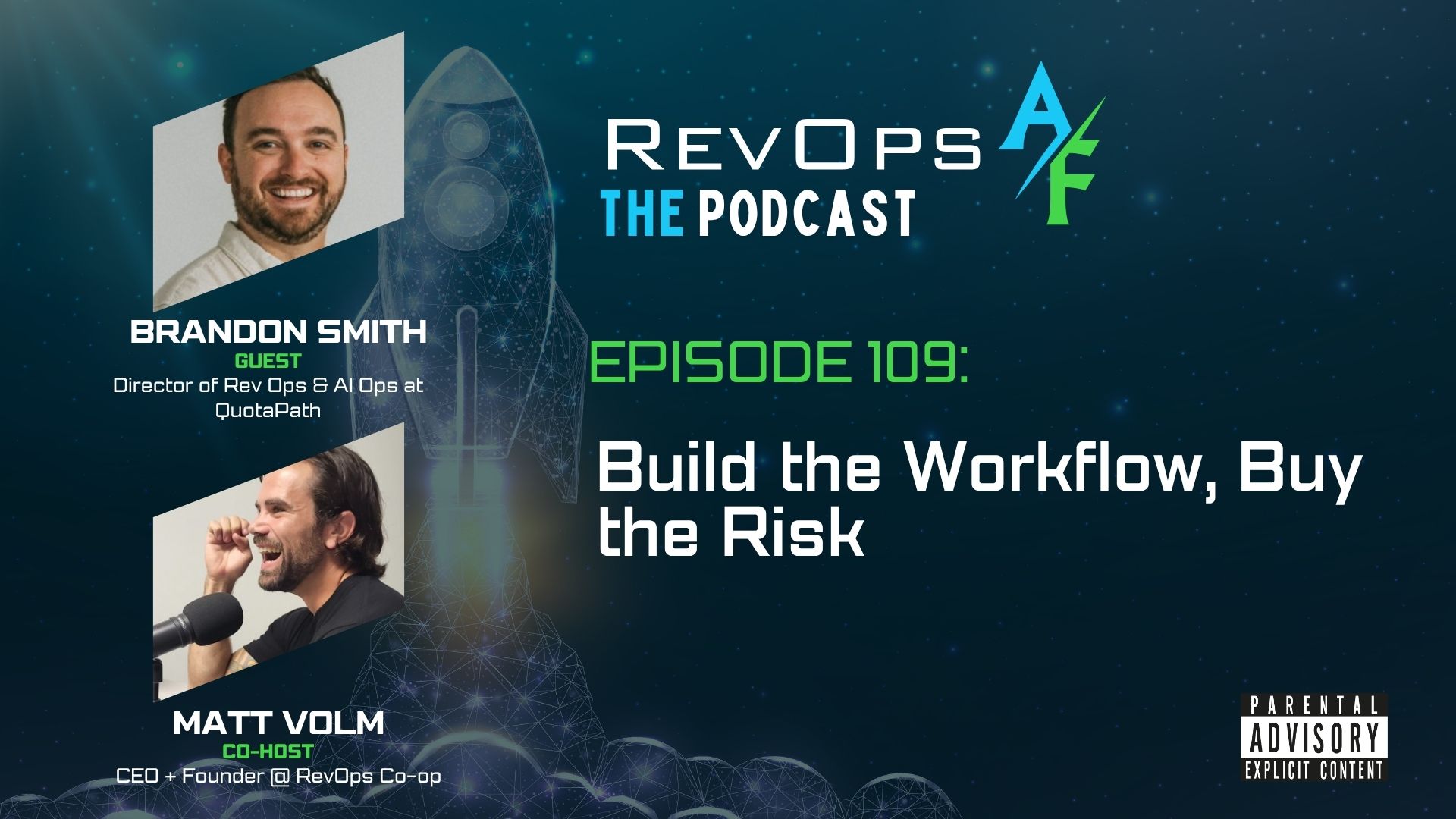
Episode 109: Build the Workflow, Buy the Risk
Brandon Smith of QuotaPath breaks down the build vs. buy decision for RevOps teams — including when AI-built tools make sense and when to pay the vendor.


Most revenue leaders know growth is slowing before they know why. The instinct — almost universal — is to look at sales. Are the reps closing? Are they prospecting enough? Do they need new training, new tools, new comp structures? It's a reasonable instinct. It's also usually wrong.
In this episode of RevOpsAF, Ian Myszenski, VP of Revenue Operations at Zappi, joins co-host Matthew Volm to dig into one of the most persistent and damaging misdiagnoses in go-to-market: confusing the place where problems show up with the place where problems originate. Ian brings over two decades of revenue operations experience across some of the most recognizable names in tech — Google, Pinterest, Zillow, and now Zappi — including a stint running an inside sales team that carried $250 million in quota. His perspective on CROs, commercial system design, and the unique superpower RevOps brings to executive leadership is worth the full hour.
Ian's framing is direct: sales doesn't create most revenue problems. It inherits them.
Product-market fit issues, pricing misalignment, the wrong customer segments, a repositioning that hasn't landed — all of these problems exist upstream. But they only become measurable when a seller has to close a deal against them. Until then, they're invisible. Once they hit the sales floor, everyone sees them.
"Sales is really the place where every upstream problem or difficulty truly becomes visible and measurable. From your product team to your pricing strategy to your marketing strategy, you could have misalignments there, and you're not gonna really know until the rubber hits the road where the seller has to close that deal."
— Ian Myszenski
Matthew echoed this with a concrete example from his own startup days: meetings were booking at the expected rate, conversion was tanking, and the easy read was sales execution. The actual problem was product. The value proposition was compelling enough to get the meeting. What they were selling once in the room wasn't. The instinct to fire or retrain the sales team would have solved nothing — and delayed the real diagnosis by months.
The metaphor Ian uses is precise: sales is the smoke alarm, not the fire. Treating the alarm as the problem means the fire keeps burning.
Before diagnosing a growth problem, Ian starts somewhere most revenue operators skip: do we actually have a right to win in the markets we're pursuing?
The question isn't rhetorical. It's a grounding exercise that forces a hard look at whether the product or offering is genuinely differentiated — whether it's solving a real customer problem better, faster, or differently than the alternatives. A "me too" product that competes primarily on price isn't a growth problem. It's a strategy problem. And no amount of sales optimization will fix a strategy problem.
"Do you have something that is different from the competitors out there or substitutes out there that make you better, faster, or in worst-case scenario, cheaper than the other solutions?"
— Ian Myszenski
Getting close to the customer is how you pressure-test this. Ian is specific about what that looks like in practice: cohort-level analysis to see where you're actually winning versus where you expected to win, direct customer interviews (including getting RevOps into those meetings), and Gong call reviews when in-person access isn't available. Long-tenured customers reveal why you've been retained. New logos reveal what alternatives they considered and why they chose you. Both are essential inputs that no dashboard can replicate.
This kind of customer-grounded analysis connects directly to the broader theme explored in Episode 49: Why Customer Data Is a RevOps Priority — the idea that RevOps has both the access and the obligation to treat customer signal as a strategic asset, not just a reporting input.
When growth stalls, the natural human tendency is to anchor on the thing you know best and start optimizing it. Ian's framework deliberately resists that pull.
He starts at the top: does the current reality map to what the annual or multi-year plan assumed? Where did the plan expect growth to come from — which segments, which products, which regions — and are those actually the places where growth is happening? This is a simple analytics exercise, but it's one most teams skip in favor of jumping straight to execution fixes.
From there, the diagnostic narrows:
The sequencing matters. Execution is where most organizations start because it's the most visible and the most familiar. It's also where you're most likely to make expensive, morale-damaging decisions — new hires, restructures, leadership changes — that don't address the actual problem.
"I think so many folks in RevOps will go straight to execution. And even CEOs will be like, 'obviously the sales team isn't doing their job, let's go fix that.' And it's like, no, you need someone who's neutral to step back and say, 'Okay, let's just pause for a minute and say, are we winning where we expect to win?'"
— Ian Myszenski
Once the problem is located, the harder work begins: framing the solution options, identifying what investment is required, and facilitating the executive conversation that leads to an actual decision. Ian is deliberate about his role in that moment. RevOps doesn't make the call. RevOps frames the conversation, surfaces two or three options, and creates the conditions for leaders to decide well.
The title inflation problem in revenue leadership is real, and Ian doesn't sugarcoat it. Having a chief revenue officer (CRO) title doesn't make someone a CRO. What makes someone a CRO is accountability for the full commercial system — not just the sales organization.
Matthew put it plainly: revenue is the top line of a financial statement. It's not just new business. It's expansion, upsell, retention, and renewal. A leader who's only optimizing new business pipeline isn't responsible for revenue. They're responsible for sales. That's a legitimate and important job — it just shouldn't come with the CRO label.
"The philosophical difference is the head of sales is focused on optimizing the sales organization, which is important, and you need someone to do that. But the CRO should really be thinking across the company with a coherent and sustainable commercial system for driving that revenue."
— Ian Myszenski
The gaps become visible fast. A sales-only CRO will feel friction in CFO and CMO conversations almost immediately, because "how do we grow 25% next year" requires thinking about segment expansion, product investment, and marketing strategy — not just sales quota attainment. The leaders who navigate this well are the ones who can make uncomfortable decisions across functions rather than optimizing the one function they came from.
Ian's example from his DoubleClick days illustrates the distinction well. A product decision forced the removal of a targeting feature that had been actively sold to clients for six months — meaning real revenue would need to be written down. A sales-only leader's instinct in that moment is to protect the number and manage the customer relationship. The CRO in the room, Sean Downey (now President of Google America), did something different: he accepted the short-term hit, framed the privacy rationale as a positive for customer brands, and turned a revenue miss into a positioning moment. That's not sales optimization. That's commercial system leadership.
Ian has reported into a chief revenue officer, a company president, a COO, and currently a CFO. The common thread across all of those structures, he argues, isn't the specific title — it's the neutrality the reporting line creates.
RevOps needs to be positioned where it can surface uncomfortable truths without career consequences. If revenue operations reports into the sales leader, the data story will be under constant pressure to favor the sales narrative. The same is true of any single-function reporting line. Episode 23: What CROs Really Want From Their RevOps Teams explored this from the other side — what happens when the CRO-RevOps relationship works — but the precondition for that relationship working is exactly what Ian describes: RevOps that isn't beholden to any single function.
His preferred structure: RevOps reports to the CEO and operates as a neutral partner to all commercial functions. Where that's not feasible, the CFO reporting line Ian currently operates under creates a useful version of the same dynamic — analytical credibility, genuine neutrality on the data, and enough organizational standing to push back on narratives that don't match the numbers.
The risk with CFO-reporting RevOps, as Matthew flagged, is losing the qualitative understanding of go-to-market. Ian's counter is that this is a function of experience, not structure. A seasoned RevOps leader can bring the "why" behind conversion rates and pipeline velocity to a CFO conversation. A newer RevOps leader in the same reporting line might struggle to hold that context. The lesson isn't that CFO reporting is wrong — it's that the RevOps leader's depth of commercial experience determines whether the reporting line works.
Ian makes a point that's worth sitting with for any senior revenue operator thinking about what comes next: RevOps is better preparation for commercial leadership than most people in commercial leadership realize.
The skill that transfers most directly is the ability to make trade-off decisions across functions — to hold the needs of marketing, sales, product, and customer success simultaneously, and make choices that are best for the business rather than best for any single team. That's not a skill you develop by leading one function. It's one RevOps practitioners develop by necessity, often without fully recognizing it.
Ian's examples are concrete: Mary Ellen Coe, who led product sales strategy and revenue operations at Google, now leads YouTube. Maggie Holz, who led RevOps at a prior company, is now a president at Indeed. These aren't exceptions — they're a pattern. Revenue operators who understand how the full commercial system works, who have been in the room for hard decisions, and who can frame options and facilitate executive conversations without being captured by any single function are natural candidates for CRO, COO, and general management roles.
For operators earlier in the career arc, Ian's recommendation is pointed: get some frontline selling experience before moving into senior RevOps leadership. Not because RevOps requires it structurally, but because the credibility it creates in conversations about revenue execution is hard to replicate any other way. This connects to the broader career growth conversation in Episode 102: The RevOps Skills Nobody Teaches — the idea that the capabilities that differentiate senior RevOps leaders are often the ones that never appear in a job description.
The rise of AI and systems automation, Ian argues, accelerates this opportunity rather than threatening it. The operators who understand how to connect insights to people to decisions — at scale, across functions, with data integrity — are exactly the people who will be most valuable as commercial operations becomes more systems-driven. Episode 97: Everybody Has AI. Nobody Owns It. explored the governance and coordination challenges that come with that shift; Ian's point is that RevOps practitioners are uniquely positioned to lead through it.
Check out our blog, join our community, and subscribe to our YouTube Channel for more insights.