Podcast

October 1, 2026
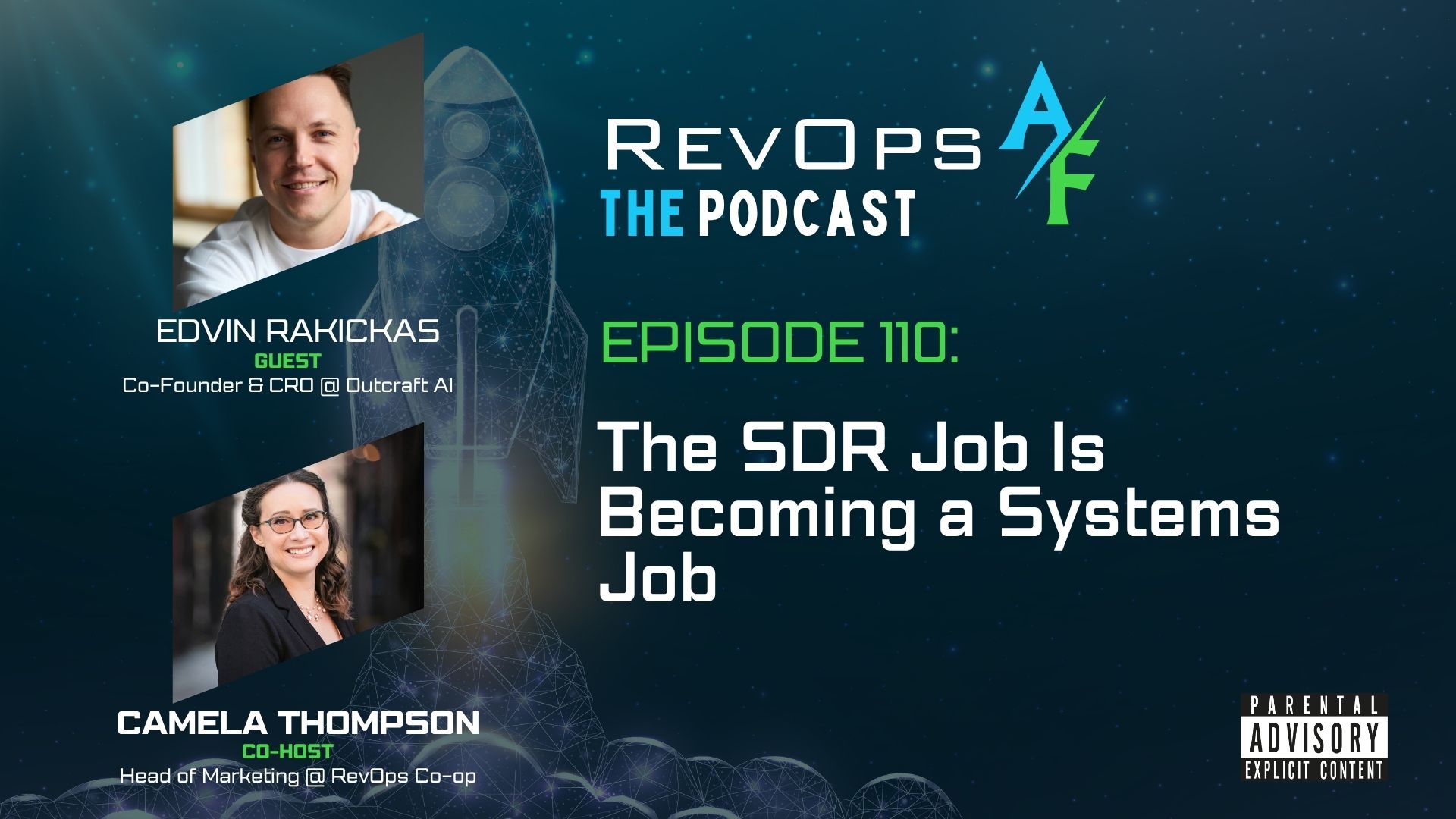
Episode 110: The SDR Job Is Becoming a Systems Job
AI is reshaping the SDR role from activity-based to systems-based. Outcraft AI co-founder Edvin Rakickas on what actually breaks in AI outbound.


Most sales organizations built their outbound motion on a straightforward premise: hire junior people, give them a script, and measure activity. The assumption was that volume would eventually convert into pipeline. What that model never accounted for was the follow-up problem — the gap between a lead showing interest and a sales team actually doing the work to convert it.
Edvin Rakickas, Co-Founder of Outcraft AI, has spent years sitting at the intersection of that gap. As the founder of a lead generation agency sending roughly five million cold emails per month across five hundred LinkedIn accounts, Rakickas didn't build AI outreach tools because the technology was exciting — he built them because his clients kept telling him his leads were bad when the real problem was their follow-up. Co-host Camela Thompson joins him for a conversation that cuts through the hype and gets into what actually breaks down when companies try to use AI for outbound and inbound sales motion — and what it takes to make it work.
The rush to apply large language models to cold outbound was almost immediate. The logic made sense on the surface: outbound is high-volume, repetitive, and language-dependent — exactly the kind of task early AI tools were supposed to handle. What followed was a wave of poorly calibrated experiments.
Rakickas was among the early adopters. The problem wasn't the ambition — it was the timing. Early models were inconsistent, prone to hallucination, and produced text that recipients could identify as AI-generated almost immediately. The quality gap was felt before anyone could articulate why.
"People could feel it straight from the beginning that something is not right. It's not like fully human language." — Edvin Rakickas
That initial wave of burned experiments left a lot of companies skeptical. But the technology kept improving, and the gap between AI-generated and human-generated text has narrowed to the point where it's no longer detectable in most cases. Rakickas notes that Outcraft ran a survey showing ninety-six percent of people couldn't identify they were speaking with an AI during a voice call.
The implication for RevOps teams is direct: if your organization tried AI-assisted outbound in 2022 or 2023 and abandoned it, the failure was almost certainly a timing problem, not a strategic one. Episode 57: Outbound at a Crossroads covers how the deliverability and quality landscape has shifted — the tools that exist today are not the tools that burned the early adopters.
Rakickas's origin story for Outcraft is worth examining carefully, because it reframes a debate that RevOps teams have been having for years: when pipeline doesn't convert, where does the blame belong?
His lead generation agency was producing enterprise-level leads — companies above five hundred employees, focused on American and Canadian markets. Clients would call within a day or two of receiving those leads and complain that the quality was poor. When Rakickas went into their CRMs to investigate, he found something consistent: a single follow-up email sent a day after the initial contact, and then nothing.
"I go into the CRM, they respond to my lead like a day after I submit something with one email and that's it. No multi follow-ups, no nurturing, no chasing." — Edvin Rakickas
This is a pattern that surfaces in 9 Easy Fixes for Better Pipeline Hygiene and connects to a broader failure mode in B2B sales: the assumption that a lead who doesn't respond immediately is a bad lead. The data doesn't support that assumption. Rakickas found that some of his most valuable responses came after ten or more follow-ups — not because prospects were being worn down, but because they were genuinely busy and the persistence signaled credibility.
"I get so many replies after the tenth time following up with them saying, 'Oh, sorry, I was busy with the other things, but I really love the persistence. My sales team does not do that.'" — Edvin Rakickas
The psychological barrier is real. Following up ten times with no response is uncomfortable for most salespeople. AI doesn't have that problem. It can execute the sequence without hesitation, in the right order, with the right message for each stage. That's not a gimmick — it's a structural advantage that human-run SDR teams are unlikely to replicate consistently at scale.
Thompson brings a practitioner's perspective to the pre-deployment question, and it's one of the more useful frames in the conversation: the technology is only as good as the data and context fed into it.
A recurring pattern in RevOps implementation is the aspirational ideal customer profile (ICP) — a detailed, well-articulated description of who marketing wants to reach — that doesn't map to the data actually living in the CRM. Marketing knows the ICP in theory. The system holds maybe a quarter of the data points needed to identify those accounts. The gap between the two is where campaigns go wrong before they even launch.
This connects directly to the question of segmentation. Thompson raises a specific example: a list that contains both vendors and potential customers, sent through the same nurture sequence. Those two audiences have different needs, different contexts, and different objections. Treating them identically burns goodwill and produces misleading conversion data. Scale Faster With a Healthier Marketing-to-Sales Handoff covers how misaligned handoffs compound exactly this kind of problem downstream.
Rakickas's answer to the data quality problem is two-pronged. First, enrichment tools — Clay being the most commonly used in his workflow — can fill gaps in prospect data before sequences are launched. Second, AI agents can be configured to ask qualifying questions early in the conversation, gathering context in real time rather than requiring it to be pre-loaded. The system adapts its approach based on what the prospect reveals.
"AI is extremely good at adapting its style of selling, real-time to the questions they are getting from prospects." — Edvin Rakickas
The practical implication: RevOps teams don't need perfect data to start. They need enough data to get started, a mechanism for identifying what's missing, and a process for filling those gaps over time. Waiting for the ideal data state before deploying is a way of never deploying.
One of the more counterintuitive positions in the conversation is Rakickas's argument against waiting until everything is ready before deploying AI-assisted outreach. This is particularly relevant for early-stage companies, where the ICP isn't fully validated, the product's use cases aren't completely mapped, and the content library is thin.
Thompson frames the concern accurately: tiny companies that don't yet have a repository of "here are the customers that work well with us" are in a precarious position when a tool needs that context to function. If the AI can't answer questions about the product because the information simply isn't documented anywhere, the tool will fail — not because the technology is bad, but because it's been asked to work from an empty knowledge base.
Rakickas's response is practical rather than dismissive. Modern platforms can ingest large volumes of unstructured information — he cites around one million words in Outcraft's knowledge base — and the AI is capable of locating relevant context within that information without requiring it to be perfectly organized. The implication is that imperfect documentation is better than no documentation.
"You cannot be too perfectionist straight from the beginning. You just need to do things. Nothing is gonna be perfect. You can try making it perfect, but it's probably gonna take you many months, sometimes even years, and at the end you don't even start in a timely manner." — Edvin Rakickas
The more useful frame for early-stage companies is monitoring. If the AI is fielding questions it can't answer well, those gaps are visible in the conversation logs and transcripts. Each failure is a documentation task — add the missing information to the knowledge base, and the system handles it better the next time. This is the same learning loop a human SDR goes through; the AI just makes the gaps more visible and the corrections more scalable.
This also connects to a point worth naming explicitly: It's Time to Catch Up, RevOps: Your Cold Prospecting Motion Is Broken argues that the default of waiting for more resources before improving outbound is itself a revenue risk. The compounding cost of doing nothing is harder to see than the upfront cost of deploying something imperfect.
The Omnisend case study is the most concrete data point in the conversation, and it's worth examining beyond the headline number. A team of eight SDRs was reduced to one — not because the company decided to cut headcount as a cost measure, but because the remaining person's role transformed into something more valuable: owning the AI system, reviewing call transcripts, identifying edge cases, and improving the sales process over time.
The other seven didn't disappear — they moved toward higher-value work, including helping close deals and supporting sales leadership. The shift is from transactional to analytical. The work that AI has taken over is the repetitive, high-volume follow-up that SDRs were always underutilized to do. The work that remains requires judgment, context, and creativity.
Thompson names the broader pattern directly: the old model of hiring the most junior person possible to execute a script was always a mismatch between the cognitive demand of the job and the experience of the person doing it. Early-stage SDRs were being asked to represent complex products to sophisticated buyers with no business context and no institutional knowledge. AI executing the transactional parts of that job doesn't lower the quality of the interaction — in many cases, it raises it, because the follow-up is consistent, the timing is calibrated, and the message doesn't vary based on how the rep is feeling that day.
The person who stays is the one who can evaluate what the system is doing and improve it. That's a systems-thinking role, not a sales-activity role. For RevOps teams, the organizational implication is significant: the capability that needs to be hired for and developed is no longer "can this person make fifty calls a day" — it's "can this person understand, govern, and improve a revenue system." The 5 RevOps Career Tracks: Finding Your Perfect Role offers a useful frame for thinking about where this kind of systems-governance work fits within the broader RevOps function.
The final section of the conversation addresses the practical question of vendor evaluation — a topic that matters more in the AI tooling space than almost anywhere else, because the quality variance between platforms is extreme and the stakes of a bad selection are high.
Rakickas's framing is useful: treat the evaluation process the way you would treat hiring a salesperson. Map out every scenario that person would need to handle, and ask the vendor how the tool handles each one. Lead handoffs when something escalates. Behavior when a prospect asks an unexpected question. Compliance handling for SMS and phone in regulated regions. What happens when the AI doesn't know the answer.
"As much as possible I think you need to look at it in a way that if you're doing this job as yourself, right? You probably need to list down all of the things that you're doing, all of these nuances, and try to ask the software provider, how would we do in this situation?" — Edvin Rakickas
The conversation intelligence layer is an underappreciated feature of well-built platforms. Rakickas describes Outcraft's reporting capability: after a campaign, the system surfaces patterns across conversations — what percentage of prospects raised price concerns, how many cited a competitor, how many didn't understand the product. This is data that a human SDR team generates but rarely captures systematically. When it's captured, it's gold for marketing and product teams — but only if someone owns the process of surfacing and distributing it.
Thompson makes the coordination point explicit: if one department owns the AI outreach tool and another owns the insights it generates, the intelligence doesn't move. RevOps is well-positioned to own that bridge — not just deploying the system, but ensuring that what it learns reaches the people who need it.
For teams doing the vendor evaluation work, Fixing the Tech Bloat Problem Without Making Enemies and 5 Best Practices for Purchasing Software are useful companions. The AI tooling space has a churn problem — platforms that look strong in a demo and underdeliver in production — and due diligence before commitment is worth the time investment.
Check out our blog, join our community and subscribe to our YouTube Channel for more insights.