Podcast

September 16, 2026
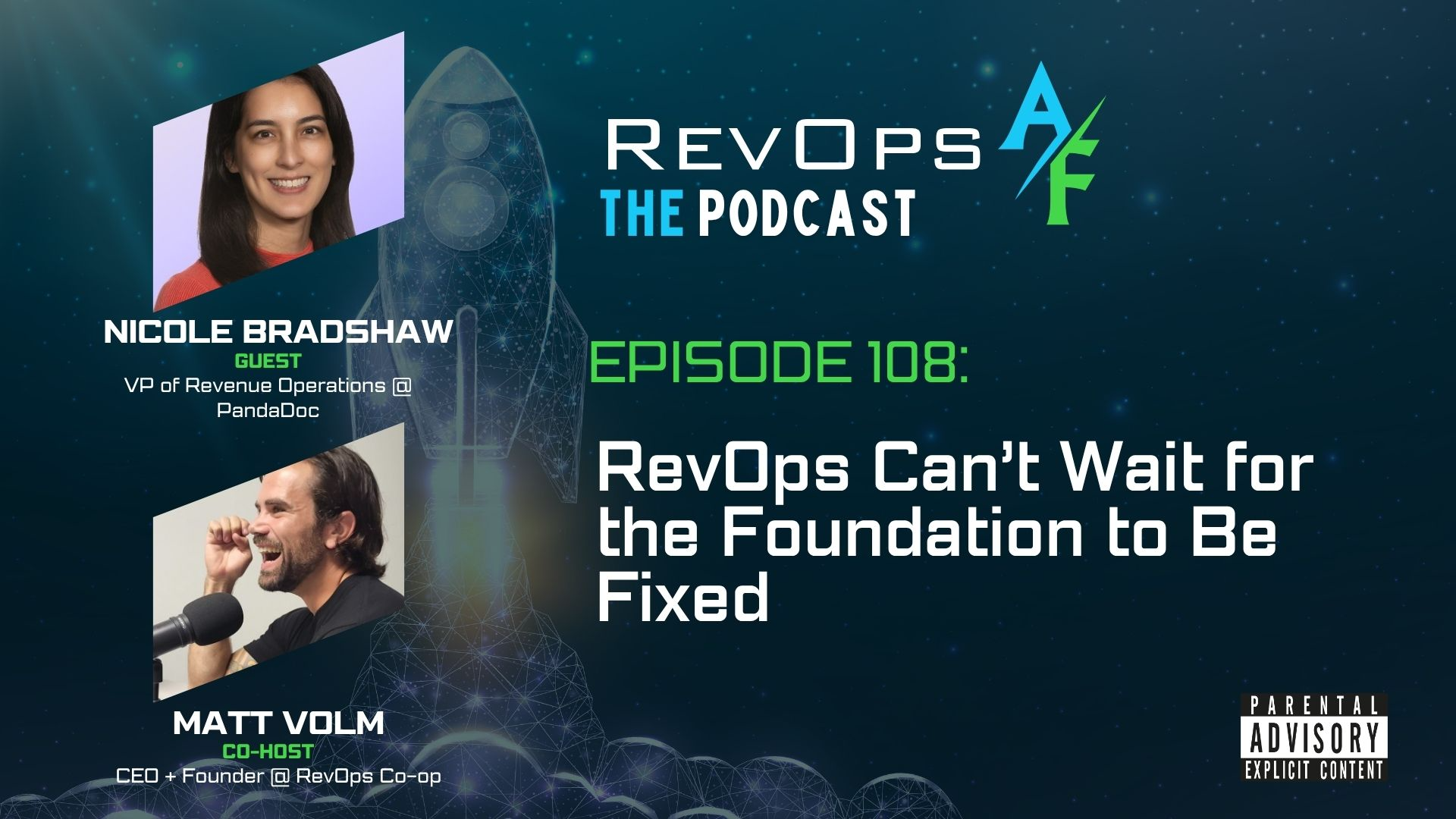
Episode 108: RevOps Can't Wait for the Foundation to Be Fixed
Nicole Bradshaw, VP of RevOps at PandaDoc, shares her framework for fixing broken GTM foundations without stalling what leadership is asking for.


Most RevOps leaders have been in the same impossible meeting. Leadership wants AI-powered lead scoring, automated outreach, and intelligent territory planning — yesterday. You, meanwhile, know that the funnel definitions are inconsistent, the HubSpot-Salesforce sync has a timing gap that's quietly tanking conversion rates, and the data those AI models would run on hasn't been meaningfully cleaned in two years. The instinct is to pump the brakes. In practice, that instinct will get you nowhere.
Nicole Bradshaw, VP of Revenue Operations at PandaDoc, joined Matthew Volm to talk through what she's learned across multiple roles — at PE-backed companies, recently IPO'd organizations, and Series D startups — about how to actually do both: deliver on what leadership is asking for, and fix the foundational problems that will eventually blow up everything they're asking for. The conversation centers on a framework she's developed for sequencing RevOps work without either stalling on infrastructure or abandoning it entirely.
Her background is worth knowing, because it shapes how she thinks. Before RevOps, Nicole spent time in government intelligence analysis — work she describes as consuming as much information as possible, identifying patterns, and determining what those patterns mean and what should be done about them. "That is what I think about RevOps," she said. The discipline of making structured sense out of messy, incomplete information carried forward.
Early in her career, Nicole's instinct when walking into a broken system was to stop and fix it. If leadership wanted to run campaigns through a flawed funnel, she'd say: wait. Let's address the infrastructure first, then build on top of it. The response she got was consistent: that's not what we're asking for.
"My leaders were like, 'That sounds great, but that's not the thing that I'm asking for, and so please prioritize accordingly.'" — Nicole Bradshaw
The lesson she drew wasn't that the infrastructure concerns were wrong. They weren't. It's that the framing was wrong. Presenting foundational work as a prerequisite for delivering on business priorities reads to stakeholders as delay. Presenting it as the thing that will 10X the business priorities they've already committed to — while continuing to deliver on those priorities in parallel — is an entirely different conversation.
This is the central argument of the episode: flying the plane and building it aren't alternatives. They're a sequencing problem. The question isn't which one you do. It's how you manage the work so neither gets dropped.
Nicole has walked into enough organizations to have a working hypothesis about what she'll find before she gets there. Not every problem, but a reliable set of three.
The first is the sales and marketing funnel. Whenever a company isn't hitting its numbers, the funnel is where the conversation starts — and almost always where the actual problems are buried. The challenge is that "the funnel's broken" is not a problem statement. It's a symptom. The real work of RevOps is to get beneath that and define what specifically is broken, who has which piece of the problem, and what fixing it will actually require.
The second is rules of engagement. Nicole is particularly direct about how much damage lives in the gray area here. Accountability on results is impossible if it's not clear who owns what. The ambiguity isn't just an organizational inconvenience — it has direct, measurable effects on business performance that most companies underestimate.
The third is end-to-end data strategy. This one cuts across every function and every stage of the customer lifecycle, from acquisition through retention and expansion. And here's what's worth sitting with: Nicole has been at startups, mid-size companies, and large companies, and in her assessment, nobody has this beautifully figured out. That's not a reason to despair — it's a reason to show up with a plan rather than assuming the data problem belongs to someone else.
These three show up across company stages and GTM models. For a broader look at how RevOps responsibilities shift as organizations scale, Episode 13: What Should RevOps Look Like as a Company Scales? is worth revisiting.
Nicole's sequencing framework has three distinct buckets — and she's careful to note they are mutually exclusive, not a continuum.
Fires are acute, bottom-line problems that need resolution within hours. Leads aren't being delivered. A sync is broken and reps don't have the data they need to work accounts. These don't get scheduled into a sprint — they get fixed now, and a consistent portion of RevOps capacity should always be reserved for them.
Quick wins are different in character. They're problems that have often existed for a while, are relatively low-effort to address, and can demonstrate meaningful impact quickly. Nicole distinguishes these sharply from fires: fires are urgent, quick wins are impactful. A quick win might be identifying that a specific lead path has a timing gap between systems that's extending time to first touch and suppressing conversion — something fixable in a sprint that shows up in the data within weeks.
"The quick wins are like, 'We know we haven't really been following up as quickly or as consistently as we would like to. We can make a pretty big impact on our conversion rates and our velocity if we provide a little bit of additional oversight.'" — Nicole Bradshaw
End-to-end fixes are the foundational rebuilds that no one wants to wait six months for and that can't be done responsibly in a week. These are where Nicole's early-career instinct — start from scratch, build it right — actually belongs. But they only get funded by credibility established through the fires and quick wins that came first.
"Committing to putting out the fires as they arise and delivering some quick wins to get buy-in and credibility on the impact that this infrastructural fix is gonna drive for the business is really the way that I've sequenced this." — Nicole Bradshaw
One practical mechanism she uses for end-to-end fixes: phase them into 90-day checkpoints rather than presenting them as a single six-month project. Same work, same outcome — but stakeholders get regular proof that things are moving, which keeps the political will alive long enough to actually finish.
The thinking here connects to a broader challenge RevOps leaders consistently face around influencing without authority. Sequencing isn't just a project management decision — it's a trust-building strategy.
Nicole is direct about where she sees AI fitting into this framework — and equally direct about where it doesn't fit.
The thing most organizations are doing wrong is treating AI as a destination rather than a resource that interacts with the quality of inputs you give it. She walked into an organization that was highly motivated to deploy AI-driven tools — intelligent lead scoring, customized outreach — and her honest assessment was that the model confidence was low because the underlying data and funnel definitions hadn't been stabilized. The answer wasn't to stop the AI initiative. It was to run it in parallel with the foundational work, with an explicit commitment to iterate as that foundation improved.
"Rather than pump the brakes on that AI initiative, it was, okay, let's keep this going. We'll plan on iterating as we work through essentially the sales and marketing funnel definitions, the business processes, the data definitions... and what all of that looks like helps improve our AI models." — Nicole Bradshaw
The sequencing logic applies to AI specifically in two ways. First, AI is remarkably well-suited for the quick-win layer of the framework — data visibility that used to take months now takes hours, frontline tooling that used to require ongoing RevOps capacity to build and monitor can be automated. That frees human capacity for consultative work that actually requires judgment.
Second, and this is the argument Nicole is more emphatic about: RevOps needs to use AI to solve its own problems before it can effectively use AI to solve the organization's problems. Permissioning, book-of-business management, compliance monitoring — these are tasks that consume disproportionate RevOps capacity relative to their business impact. Automating them with AI doesn't just save time; it changes what RevOps teams have available to think about. Episode 101: RevOps Should Build for Itself First makes exactly this case, and it's the right companion to this conversation.
"AI is coming for your job, but that's a good thing, because that means that your job gets to evolve. You get to do things that RevOps folks honestly love to do. We like to be consultative. We love to connect the dots and figure out what it means for how we should make decisions as a business." — Nicole Bradshaw
This connects to the broader case for AI readiness that the RevOps community has been grappling with — the notion that understanding why most revenue stacks aren't ready for AI starts with getting your own operations clean enough to actually benefit from it.
This is where Nicole goes further than most practitioners are willing to go publicly, and it's the part of the conversation worth holding carefully.
Her concern isn't over-reliance on AI in the abstract. It's something more specific: the race to AI adoption is creating a generation of operators who can build AI-powered workflows but can't evaluate whether the conclusions those workflows produce are correct.
"I will literally receive analytics or I'll receive tooling and it's, 'Look, we enabled this AI.' I'm like, 'Oh, this analytical conclusion is not right. It's making assumptions that aren't true for our business.'" — Nicole Bradshaw
The problem she's describing isn't AI hallucination in isolation — it's that when operators lack the foundational judgment to catch hallucinations, they pass those errors forward. And an analytical conclusion that sounds plausible but doesn't match the underlying data is arguably more dangerous than a clearly broken output, because it's more likely to go unchecked.
Her framing of what good looks like is instructive: she doesn't want AI to make her less busy. She wants it to make her better. The distinction matters. An AI tool that removes a task from your plate without teaching you anything about the problem that task was addressing doesn't compound your expertise — it just outsources it. And expertise that isn't developed is expertise you won't have when the AI's output is wrong and you need to catch it.
The parallel here to foundational data work isn't incidental. The same habit of mind that asks "what specifically is broken in our funnel, and why?" is the one that looks at an AI-generated analytical conclusion and asks "does this actually follow from the data it's using?" Developing that muscle requires doing the work manually at some point, even if automation eventually handles the execution.
For a grounded look at how AI fits into RevOps when the fundamentals are in place, Episode 94: The Boring Work Behind Great AI addresses exactly this tension.
There's a thread running through everything Nicole described that's worth naming explicitly: none of this works without a stakeholder narrative.
The framework isn't just a project management system. It's a communication architecture. When you present an end-to-end fix to leadership, you need to have already earned credibility through visible wins. When you ask for six months to rebuild the funnel, you need to have already shown what a quick win looks like and what it produced. And when you're running parallel tracks — flying the plane and building it — you need to be able to show, at regular checkpoints, that both tracks are actually moving.
One mechanism Nicole uses is OKRs. She's deliberate about making foundational RevOps work visible in her team's objectives — not because it forces stakeholders to care about it, but because it creates a shared language for what the work is and what it unlocks.
"I wanna show it in my OKRs and then show what happens next that's unlocked as a result of this. So really here's what we're doing and here's what we get as a result of it in addition." — Nicole Bradshaw
This is the most underrated skill in the framework. RevOps leaders who are excellent at sequencing but poor at narrating the work tend to lose political will right around month four of a six-month rebuild. The wins are real, but they're invisible unless you've built the cadence to make them visible. For more on building the organizational credibility to make this work, Episode 99: What Executives Actually Want From RevOps covers the executive communication side of that challenge directly.
"The funnel's broken" is not a problem statement. When stakeholders tell you something is broken, that's the beginning of the diagnostic, not the end. RevOps is uniquely positioned to quantify which of the six to twelve underlying problems has the highest impact and deserves to be sequenced first.
Fires and quick wins are mutually exclusive buckets, not a spectrum. Fires require immediate response (hours, not days). Quick wins are high-impact, relatively low-effort improvements that build credibility for larger foundational work. Conflating them leads to mispricing both.
End-to-end fixes only get funded by credibility you earned earlier. No stakeholder will sign on for a six-month rebuild before they've seen evidence that the team can deliver visible impact. The fires and quick wins aren't a detour — they're the prerequisite.
Phase long projects into 90-day checkpoints. A six-month rebuild loses political will around month four. The same work phased into two 90-day intervals creates regular re-commitment moments and makes the progress visible in a way that sustains stakeholder buy-in.
AI is most useful at the quick-win layer before it's useful at the foundational layer. Use AI to free up RevOps capacity through automation of high-volume, low-judgment tasks. Then redirect that capacity toward the consultative, stakeholder-facing, judgment-intensive work that actually changes the foundation.
The ability to evaluate AI outputs is not automatic. Speed to AI adoption without the underlying analytical judgment to catch bad outputs creates a new category of operational risk. The goal is not to use AI instead of developing expertise — it's to develop expertise in partnership with AI.
Check out our blog, join our community and subscribe to our YouTube Channel for more insights.
This episode is brought to you by HG Insights. If your RevOps team is still guessing at ICP fit, market sizing, or account prioritization, HG Insights gives you real technographic data, spend intelligence, and market signals to stop playing data detective and start operating with actual intelligence. Check them out at hginsights.com.
Our average member has more than 5 years of RevOps experience. That means you’ll have real-time access to seasoned professionals. All we ask is that you’re generous with your knowledge in return.