Podcast

October 9, 2026
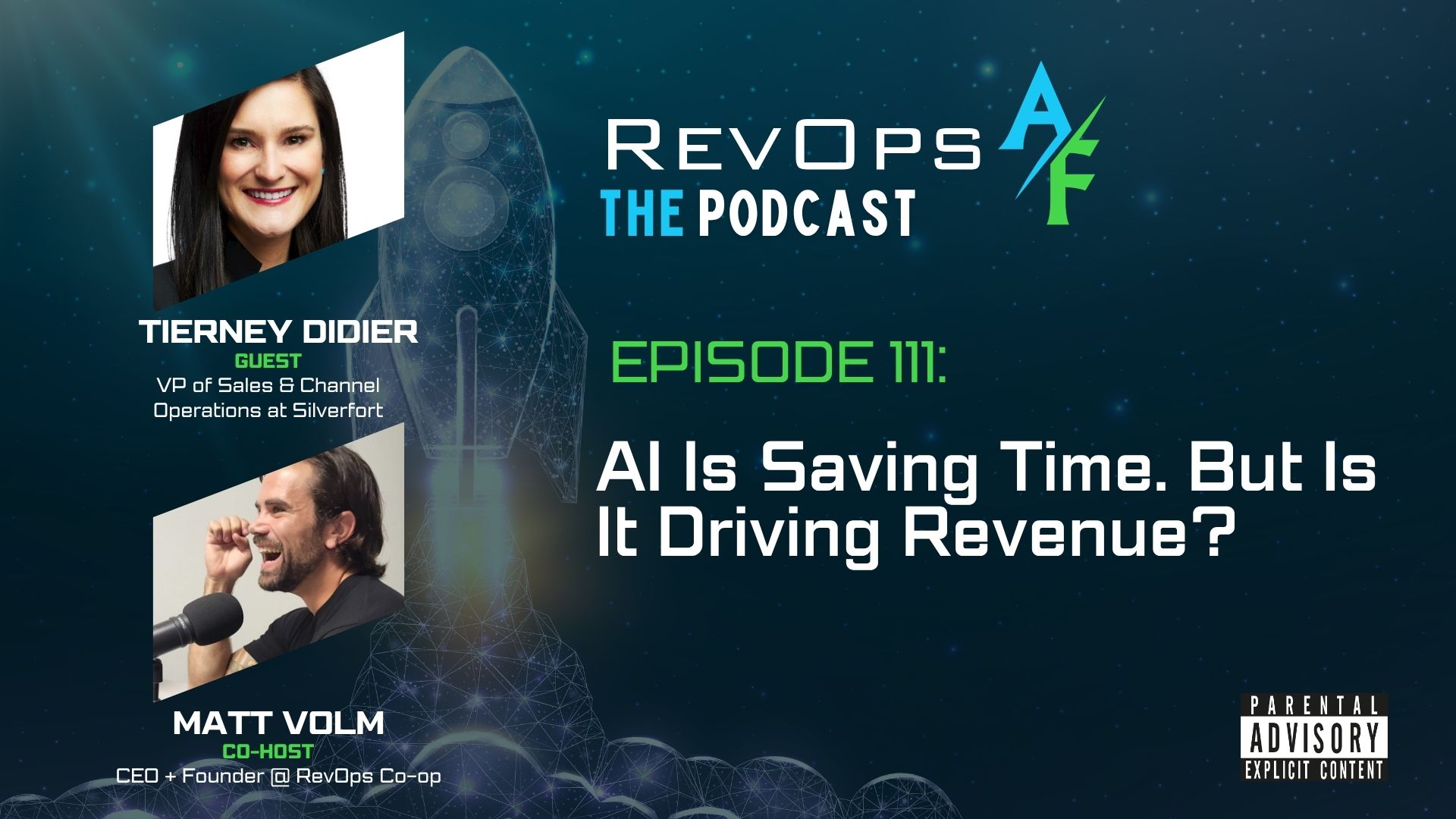
Episode 111: AI Is Saving Time. But Is It Driving Revenue?
AI is saving time in RevOps — but is it driving revenue? Tierney Didier of Silverfort breaks down what's actually working and what's still TBD.


The promise of AI-driven efficiency is everywhere in revenue operations right now — in board decks, in vendor pitches, in breathless LinkedIn posts about replacing entire teams over a weekend. The more important question, the one that actually matters for practitioners trying to run a real go-to-market motion, is whether any of those efficiency gains are showing up where they need to: in pipeline, in quota attainment, in revenue.
Matthew Volm sits down with Tierney Didier, VP of Sales and Channel Operations at Silverfort, to work through that question from the ground level. Tierney brings an unusual vantage point: eight years as an individual contributor in sales before pivoting into operations — first at Salesforce, then Twilio, then LivePerson, and now nearly three years at Silverfort, where she leads sales and channel operations, deal desk, sales strategy, and a customer-facing renewals team. She knows what a sales floor looks like from both sides, and that perspective shapes everything about how she thinks about deploying AI.
The honest answer she gives is not the one LinkedIn would have you believe. AI is producing real wins — but they're ops-side wins for now, and the revenue impact is still a few quarters away from being measurable. What separates teams that are building something useful from those watering plants in the rain, as she puts it, is the discipline to be intentional before building anything at all.
The first thing Tierney is direct about is timing. When asked whether AI is producing measurable gains, she doesn't reach for an easy answer.
"I still think it's early to determine. It's still very early. When we track win rate, if we were just to look at it at a quarter, that's not giving us the full picture." — Tierney Didier
Silverfort runs nine-month sales cycles. If AI is helping reps get into the field more and work pipeline more efficiently, that improvement won't show up in a single quarter's win rate. The math simply doesn't work on that timeline. This is worth naming explicitly, because the mismatch between AI's actual feedback loop and the timelines most executives are expecting is one of the more structurally under-discussed problems in the space right now.
That said, Tierney is clear that real efficiency gains are happening — they're just happening on the ops side of the house first. Teams are getting time back. Manual work is being eliminated. The question is how long before that translates into go-to-market impact, and the honest answer is: probably six months to a year before you can see it clearly in the numbers.
The most concrete example Tierney shares is also the most illustrative of where AI is genuinely delivering — and why the gains are real without being dramatic.
Silverfort uses ZoomInfo as a source of truth for account enrichment, but the data is imperfect. Previously, that meant human validators spending significant time manually checking employee counts, industry classifications, and other firmographic details — essentially Googling their way through discrepancies before accounts got assigned to the wrong reps.
"We have an agent that is looking at 10Ks, just doing research, and then that agent is surfacing where there's discrepancies and then can go in and update it. And that way we're not waiting till after something's already been assigned to a rep and we're pulling it back." — Tierney Didier
The agent runs overnight. The human who previously spent their days on this work now does other things. Tierney frames this simply: "It's basically getting me a free headcount." That's not a flashy outcome. It's also exactly what useful AI looks like in practice — not replacing a role, but reclaiming capacity that was being consumed by low-judgment, high-volume work.
This is the same logic RevOps teams are increasingly applying across data management and enrichment workflows: the goal isn't to eliminate the human, it's to redirect the human toward work that requires judgment.
The build-versus-buy conversation has changed fundamentally, and Tierney's framing of how she thinks about it now reflects a meaningful shift in what's actually possible.
She's not anti-vendor. Silverfort still uses Salesforce, still has a Salesforce admin, and still buys tools that would be genuinely difficult to replicate. But the discovery process has changed. Where she used to evaluate a tool for what it does, she now evaluates it for what else she can get from it.
"Is there a backend that I can also leverage for building something homegrown? That's how my mind shifted. And understanding the lift — there are a couple point solutions that I'm like, we can build that internally." — Tierney Didier
The example she gives: rather than buying a standalone content surfacing tool like Highspot, her team built a homegrown version. Rather than routing reps out of Salesforce and into another tool, they built an engagement panel that surfaces information from multiple systems directly inside Salesforce.
The practical implication is that the question RevOps leaders should now be asking in every vendor evaluation is not just "does this solve the problem?" but "can I use the infrastructure here to eliminate an adjacent point solution?" For more on how to approach tech stack decisions with that kind of rigor, Episode 37: The Ins and Outs of Tech Stack Consolidation covers the consolidation framework in depth.
She's also candid that AI has changed the internal workflow around building. Her Salesforce admin moves faster than before. Mockups that used to take days get done in minutes with Claude. The alignment conversations are shorter because people can see what you're describing rather than imagine it. These aren't headline outcomes, but they're real compounding gains in how a team operates.
One of the more grounding moments in the conversation is when Tierney describes the enablement bears — a homegrown real-time coaching tool that sends reps post-call feedback when they talked too much, asked only closed-ended questions, or paused too long. Good idea. Relatively easy to build. And then it quietly stopped working.
"I followed up with an AVP. I'm like, 'Hey, did you see this?' And they're like, 'Oh no, I didn't see it.' And I'm like, 'Oh.' I don't think I would've known that if I didn't ask." — Tierney Didier
This is the maintenance reality that build-versus-buy enthusiasts tend to skip over. When you buy a tool, you have a CSM, you have usage dashboards, you have someone whose job is to tell you when adoption is falling off. When you build something homegrown, you have none of that unless you build it yourself. There is no control panel that tells you when a notification is no longer being delivered.
The implication she draws from this is correct: building is not the hard part anymore. The hard part is the operational infrastructure around the thing you built — the monitoring, the feedback loops, the change management, the documentation. As Tierney puts it, the goal isn't just doing more. "We need to be preparing the controls to make sure that the things that we're building are maintained, and they're performing as we expected, and that we're seeing results from them."
For RevOps teams thinking through the full lifecycle of internal builds, Episode 109: Build the Workflow, Buy the Risk is worth pairing with this conversation — it covers the blast radius framework for evaluating what's actually worth building versus buying in more structural detail.
The question of whether AI is actually eliminating headcount gets a careful answer from Tierney, and it's more grounded than what circulates on LinkedIn.
At Silverfort, she's not seeing headcount reductions. What she's seeing is recaptured capacity — people freed from low-value work who are now available for higher-value work, of which there is no shortage.
"There's never been a shortage of work in RevOps, in my opinion. Never. And so we're able now to alleviate the building the decks, showing data, making things look pretty and some of the time to launch — but there's still no shortage of work." — Tierney Didier
The logical end state she describes is real: as AI handles more of the mechanical work, the people who remain in RevOps will be doing more strategic, judgment-intensive work. Eventually, teams may stay flat while absorbing more business complexity, or grow more slowly than they would have previously. But the "fire your whole ops team and replace them with agents" framing isn't what she's observing.
What she is observing is that job security in RevOps comes from being the trusted advisor — the person who understands how the business actually operates, who knows what the field needs, and who can navigate between the technical possibilities and the go-to-market reality. That role does not go away because AI can run a data enrichment agent overnight.
Episode 99: What Executives Actually Want From RevOps covers the trusted advisor posture in more depth — specifically how RevOps leaders can position their teams to be indispensable rather than expendable as AI reshapes what work looks like.
Matthew pushes on whether AI efficiency is actually changing how companies set expectations on the frontline — higher quotas for reps, bigger books for CSMs — and Tierney's answer is measured.
She's not seeing it yet. But the logic is sound, and she's tracking it.
"If we start to see that, then we can increase that. But I'm not seeing that today. It's also how are they fueled from marketing, from channel — that top-of-funnel piece needs to happen as well, even though the rep is hopefully in the field more." — Tierney Didier
The framing worth internalizing here is that rep efficiency is only one variable in the quota equation. If AI helps a rep spend less time on CRM administration and more time in front of prospects, that only drives higher attainment if there's also enough pipeline to work. The top-of-funnel piece — where AI is also being applied, but more unevenly — has to keep pace. If it doesn't, the efficiency gains on the rep side don't translate into revenue gains. They translate into reps who are less busy but not more successful.
She's also clear about the consistency layer: rolling out AI tools without maintaining a consistent sales process underneath them makes it impossible to measure what's actually improving. The baseline has to be stable, or you can't attribute changes to anything. This is the process management discipline that predates AI and doesn't go away because of it.
The question of which roles AI will most impact gets a reframe from Tierney that's more useful than the role-level predictions that dominate most of these conversations.
Her view: it's not about which roles disappear. It's about which tasks within roles get automated or augmented. And the tasks she thinks are most durable — and most distinctly human — are the ones that involve reading the room, navigating internal politics, and making decisions that require organizational context.
"Robots are not gonna read people's minds. And there still needs to be someone saying, 'No, this is what we need to deliver. This is what they care about. This is not gonna work. This is going to work.' Project managing it between multiple different teams and making sure we're aligned on rollout plans — I think there's just so much of that that happens in a revenue operations team that I just don't see that being able to go away." — Tierney Didier
The parallel she doesn't quite state but implies: cold calling hasn't gone away. It's evolved. Reps can make more calls now than they ever could before, and the tools have changed how they make them, but the fundamental motion — a human reaching out to another human to start a relationship — hasn't been replaced. The same principle likely applies to most of what happens inside a revenue operations team.
For more on how AI is reshaping outbound specifically, Episode 110: The SDR Job Is Becoming a Systems Job covers what that evolution looks like in practice.
The tasks AI will absorb in RevOps — pulling together annual planning data, generating rollout documentation, building draft presentations, triggering reminders in project boards — are real and meaningful. The time they free up should flow into the work that requires a person: the tiger team conversations, the field alignment sessions, the judgment calls that no agent can make because they require organizational context that isn't in any system.
Check out our blog, join our community and subscribe to our YouTube Channel for more insights.