Podcast

October 15, 2026
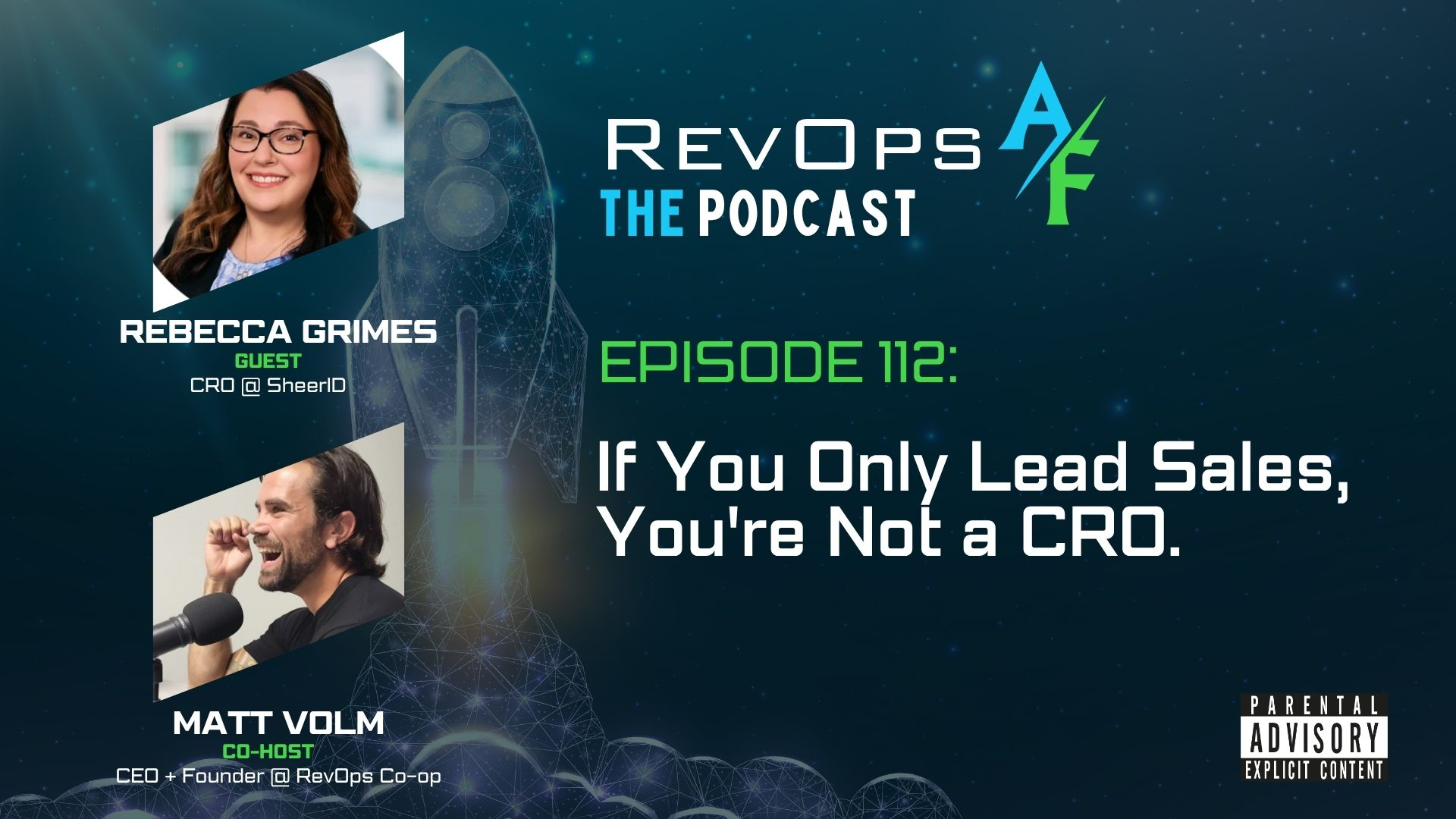
Episode 112: You're Not a CRO If You Only Lead Sales
SheerID CRO Rebecca Grimes makes the case that a CRO who only leads sales is really a CSO and explains what full-cycle revenue ownership looks like.


The title of Chief Revenue Officer is one of the most commonly misapplied in B2B. Ask a room of revenue leaders who owns the full customer lifecycle, and the honest answer in most organizations is: nobody does. Sales owns the pipeline. Marketing owns the top of funnel. Customer success inherits whoever makes it through. And somewhere in between, a CRO title gets handed to the person who runs the number from qualified opportunity to closed won — a scope that, by any rigorous accounting definition, is really just sales.
Matthew Volm sits down with Rebecca Grimes, Chief Revenue Officer at SheerID, to challenge that definition head-on. Rebecca's path to the CRO seat is genuinely unusual: she started her career as a crime reporter, pivoted into marketing, made a deliberate move into sales to understand why momentum wasn't being realized, and eventually concluded that owning the full revenue lifecycle — marketing, sales, customer success, and revenue operations, under one roof — was the only way to run a business she believed in. She's done it now across multiple organizations, and she's not going back.
The conversation covers what full-cycle revenue ownership actually means in practice, why customer success is systematically undervalued in most go-to-market structures, what separates great RevOps leaders from the ones who are still mostly managing Salesforce, and where AI fits into the revenue function over the next five years.
The conventional CRO scope — inherit a lead from marketing, close the deal, hand off to customer success — misses the point of the title. Revenue isn't just what closes. It's what compounds. And compounding requires continuity across every stage of the customer relationship.
Rebecca's framing is direct: full lifecycle revenue ownership starts at first awareness and runs through year five and beyond. Every function that touches the customer is in scope: product marketing (which she keeps inside her org specifically to stay close to the customer), demand generation, brand, solutions consulting, SDR, account executives, global accounts and partnerships, onboarding, implementation, professional services, customer support, and customer success management. Revenue operations sits at the center of all of it.
The practical implication isn't just organizational. It changes how the entire team thinks about what a deal is. When one revenue team owns the outcome from first contact through renewal, the incentives stop being misaligned.
"Our number one rule is we are one revenue team. We all own revenue, and we have a responsibility to the health of the revenue that we are producing." — Rebecca Grimes
That shared responsibility extends to the uncomfortable decisions. Rebecca describes a recent material deal that closed as an off-cycle upsell — one where she chose to record it as one-time revenue rather than ARR, despite the short-term pressure to count it differently.
"As much as I wanted to record it as ARR, it didn't make sense because I don't have a high level of confidence that at their renewal in five months, that's actually gonna be up, increased and committed to revenue." — Rebecca Grimes
The willingness to make that call — to prioritize revenue quality over revenue optics — is only possible when the CRO owns the outcome past close. If the incentive stops at closed won, that discipline disappears.
One of the most persistent revenue leaks in B2B organizations isn't churn or expansion failure — it's deals that should never have been closed in the first place. Rebecca is direct about where this starts: in marketing, where excitement about pipeline coverage can push leads forward that don't actually fit the ideal customer profile (ICP).
The sequence is familiar. Marketing generates interest, hands it to sales, and depending on how pipeline-hungry the team is, an account executive might work a deal that doesn't have the right fit, growth potential, or alignment to the product's capabilities. The deal closes. And then customer success inherits the mess.
"You throw it over the wall to the customer success organization that has to really pick up those pieces and figure out how to transform that potentially non-great fit into something that looks like a long-term customer." — Rebecca Grimes
This is the downstream cost of misaligned ICP decisions made upstream — and it's a cost that only becomes visible after the champagne has been popped. When one team owns the outcome through the first renewal, the calculus changes. Saying no to a bad-fit deal is no longer an act of heroism. It's just good business.
Rebecca's approach extends this accountability into the post-sale structure. Account executives at SheerID stay involved with accounts for eighteen months — and potentially longer for accounts still in a hypergrowth phase. The incentive is partially financial (clawbacks apply if the account doesn't make it through first renewal), but the deeper logic is continuity. The person who convinced a customer to buy is the person most equipped to ensure what was promised gets delivered.
"I made this customer choose us, and now I wanna make sure that they are successful — not only because, if they don't make it through their first renewal, there are financial consequences in the form of a clawback to me." — Rebecca Grimes
This structure is closely connected to what the RevOps Co-op community consistently surfaces as a core tension: how to manage the sales-to-customer-success handoff without losing the institutional knowledge that made the deal close in the first place.
Matthew raises a tension that most revenue leaders recognize but few address structurally: customer success tends to get treated as either the third priority or an afterthought, when the math of the business actually demands the opposite. If churn is outpacing new logo acquisition, no amount of sales heroics fixes the underlying problem.
Rebecca doesn't hedge on this.
"If we're churning more customers than we're bringing in, we're not in a growth stage." — Rebecca Grimes
Her time allocation reflects the reprioritization. By her own accounting, she splits her executive focus roughly sixty to customer success, forty to sales — a deliberate inversion of the typical CRO attention pattern. The reason isn't just retention math. It's intelligence.
"I learn more about how to be better at acquiring new customers by sitting alongside our existing customers and understanding why they originally sought our services and why they've stayed with us through the years and why they've grown with us." — Rebecca Grimes
This is the non-obvious return on customer success investment that rarely makes it into revenue planning conversations. Time spent with existing customers isn't just retention work — it's the best market research available. When a sales team hears directly how a customer describes the value they've received, in their own words, that language becomes the raw material for better prospecting, sharper messaging, and more resonant discovery conversations.
Matthew makes the parallel explicit: the difference between a seller who says "here's how we can solve your problem" and one who says "a customer just like you had this exact problem — here's what happened" is the difference between a pitch and a proof point. The proof points live in customer conversations that most revenue organizations aren't systematically mining.
That's why enablement, done well, has to be built on real customer intelligence — not just playbook templates. Rebecca is explicit that enablement at SheerID is no longer sales enablement. It's revenue enablement, built from recorded calls on both sides of the customer lifecycle, from wins and losses alike, from expansion motions and early renewals. And it's individualized, not broadcast.
"Enablement isn't training. It is thoughtful analysis of the skill gaps that we have, understanding what we're doing well, who needs coaching, and having that be very bespoke and personalized down to the individual inside our organizations." — Rebecca Grimes
Matthew asked Rebecca which function she told the board was most critical to her success as CRO. The answer was her RevOps leader — specifically Kara Lister, who has followed Rebecca across three organizations.
The reason isn't loyalty. It's the nature of what RevOps does when it's functioning well: it provides the objectivity that every other function is too close to its own work to supply. Marketing believes in its pipeline. Sales believes in its deals. Customer success believes in its relationships. RevOps operates from the data.
"There's an objectivity that revenue operations brings to the table in terms of likelihood to close, sales stages, and the defined criteria for success within those." — Rebecca Grimes
In practice, that objectivity shows up in two directions. On the sales side, it's the ability to look at a deal that the team is excited about and surface the four blockers that suggest the timeline is wrong — and to recommend reallocating onboarding resources accordingly. On the marketing side, it's the ability to identify a cohort of inbound leads that, based on historical data, should be qualified in or out quickly, because they take as long to close as opportunities worth five times as much.
Both of those moves are impossible to make without a RevOps function that has full visibility across the funnel — not just one slice of it. This is the structural implication of Rebecca's model: RevOps at SheerID is organized around the customer lifecycle, not by function. Two professionals cover the funnel from awareness through first renewal and from first renewal through ongoing retention, respectively — not in the traditional silos of sales ops, marketing ops, and CS ops.
The parallel to what good CRM governance actually requires is direct: a siloed RevOps structure produces the same fragmentation at the system level that a siloed go-to-market structure produces at the revenue level. You can't build a unified view of the customer if the people responsible for that view are organized in a way that prevents them from seeing it whole.
Rebecca is also clear-eyed about what RevOps is not — and what it used to be.
"When I managed revenue operations, it was Salesforce administration and tool administration and reporting. It wasn't a level of intelligence in the way that it operates today." — Rebecca Grimes
The evolution from system administration to revenue intelligence is the same story RevOps practitioners keep returning to: the function has grown in strategic scope, but the organizational structures and executive understanding of RevOps haven't always kept pace. Rebecca's framing — RevOps as the most important function she needs to have confidence in — is a useful counter-example to the organizations that still treat it as a CRM ticketing function.
For RevOps practitioners looking to understand what it takes to earn that level of trust, the pattern Rebecca describes is instructive: proactively surfacing data before it's requested, challenging ideas on merit rather than deferring to seniority, and translating a CRO's instinct into the fifteen operational steps actually required to execute it.
Rebecca closes with a caveat that deserves equal weight to everything that preceded it: not every organization needs this model, and not every organization is ready for it.
The structural alignment she describes — marketing, sales, customer success, and RevOps reporting to one leader — is a function of organizational maturity, go-to-market motion, and leadership context. There are different GTM structures where this consolidation doesn't make sense, and there are companies where the right answer is better alignment across independently reporting functions rather than a single unified org.
The more transferable principle is the one RevOps practitioners can act on regardless of org structure: RevOps can be the forcing function that starts breaking down the silos even when a single CRO doesn't own everything.
"RevOps can be that forcing function to start to break down these silos. I love what I get to do every day, and like I mentioned at the beginning I don't envision a world where I don't do this, but I don't know that this is right for every organization because there are different go-to-market motions that might require different models. But the collaboration and the alignment is absolutely critical to have, even if you don't have a leader like myself inside your organization." — Rebecca Grimes
This is the version of the argument that's actionable for most listeners: the goal isn't to immediately restructure the revenue org. It's to start operating as though you already own the outcome across the full lifecycle — sharing data across functions, building feedback loops between CS and sales, investing in customer conversations as a source of commercial intelligence, and using RevOps as the connective tissue that keeps the entire engine coherent.
The question of what CROs actually need from RevOps — and what RevOps leaders need to understand to meet that standard — runs through everything Rebecca describes. The answers aren't abstract. They're in the structure she's built, the metrics she tracks, and the decisions she's willing to make even when they cost her short-term ARR.
The final thread of the conversation turns to where AI fits into the revenue function over the next five years. Rebecca's view is calibrated and grounded in her own experience of adoption: eighteen months ago, she was in a room where half the sales leaders raised their hand to say they used AI every hour. She was not one of them — and she describes that moment as a catalyst to accelerate her own adoption fast.
Her outlook on where AI is heading is neither maximalist nor dismissive. AI is already transforming the front end of the sales process: research synthesis, account discovery, earnings call summaries, prospect trend analysis. The hours that used to go into manually reading through reports to find talking points for a prospect meeting are being compressed into minutes.
"I think we are in a position where there is lots of information to consume, sometimes too much information to consume, and AI is really helping synthesize that information into digestible, actionable steps for us." — Rebecca Grimes
But the thing AI can't synthesize is judgment — and specifically, the human judgment required to build and sustain a commercial relationship through complexity, ambiguity, and change. Rebecca draws a sharp line here.
"It's never going to replace human judgment and an interpretation of what that actually means and how to process that and turn that into a relationship that is sustained beyond your current LTV." — Rebecca Grimes
Her vision for where this heads in five years is less about AI replacing revenue roles and more about AI handling the operational substrate — scheduling, prep, monitoring, time-to-value tracking — so that the humans in the revenue function can concentrate on the work that actually requires them: listening, interpreting, building trust, and making judgment calls on complex deals.
The point Matthew adds is worth noting: the "AI-powered" and "AI-native" marketing language that currently saturates the market is going through the same maturation cycle that "cloud-based" did a decade ago. Nobody markets their software as cloud-based anymore. It just is. Rebecca's shorthand for the same principle:
"It is literally table stakes, and it should be just assumed." — Rebecca Grimes
The implication for revenue leaders is to stop treating AI as a differentiator to be announced and start treating it as infrastructure to be deployed — asking not "are we using AI?" but "what specifically are we using it for, and is it actually accelerating the outcomes that matter?" That framing connects directly to the broader question of whether AI efficiency is actually translating to revenue impact — the conversation the RevOps community keeps returning to.
Check out our blog, join our community and subscribe to our YouTube Channel for more insights.