Podcast

October 30, 2026
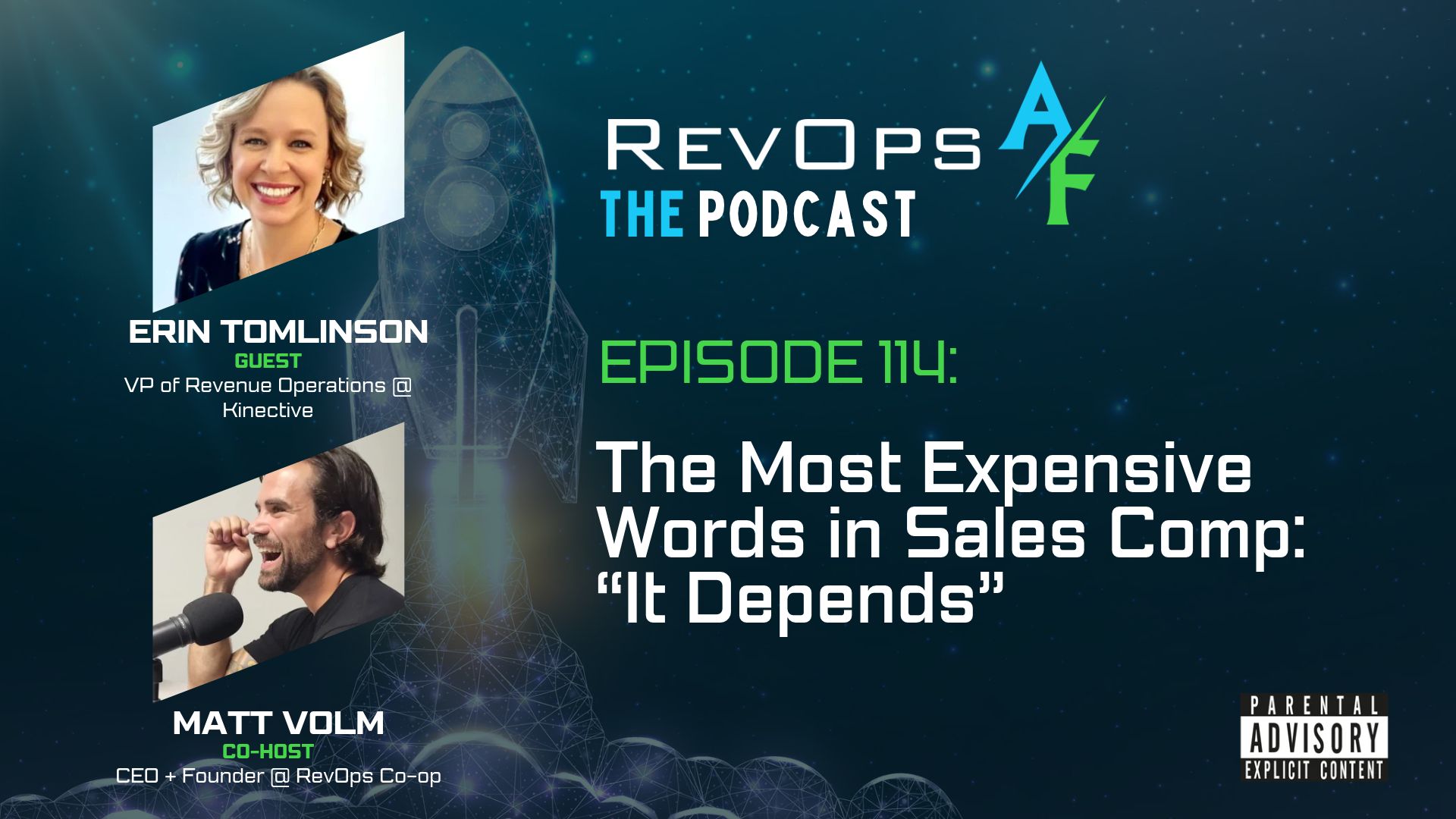
Episode 114: The Compensation Plan Nobody Actually Documents
Erin Tomlinson, VP of RevOps at Kinective, breaks down comp exceptions, bluebird deals, transparency, and where AI fits in comp plan design.


Sales compensation looks deceptively simple from the outside. People sell things, they get paid a portion of what they sell, and then life goes on.
That illusion dissolves when a rep gets promoted mid-year, a bluebird deal lands in someone's lap, or an acquisition reshuffles territories without warning. Those unaccounted-for exceptions become very expensive problems.
Matthew Volm sits down with Erin Tomlinson, VP of Revenue Operations at Kinective, to work through what actually happens when compensation design meets operational reality. Erin brings an unusual vantage point: 25-plus years in technology, split between sales management at Dell Technologies and RevOps and enablement leadership at a string of startups and mid-size companies across healthcare, event ticketing, and fintech. She has spent time on both sides of the compensation conversation — as a sales manager who lived and died by the plan, and as the RevOps leader who has to build, administer, document, and defend it.
The conversation covers exception management, the bluebird problem, what transparency in compensation actually looks like in practice, and where AI is changing the work (and where it isn't). It is a practitioner-level conversation grounded in the specific, often unglamorous problems that RevOps leaders face every time a new comp cycle kicks off.
The surface-level complaint about compensation complexity is usually about the number of levers in the plan. But Erin's framing of the real problem cuts a little deeper: it is not just about complexity — it is about the number of stakeholders who care about the outcome, each for a different reason.
"You've got obviously the sellers and the sales managers who rely on the plan to drive the results and motivate people. Finance cares a lot about compensation plans 'cause obviously they want predictability and to manage cost and just to make sure we're deploying our resources effectively. And then HR cares because they wanna make sure things are fair and equitable and consistent from person to person." — Erin Tomlinson
That multi-stakeholder reality is not unique to compensation, but it is particularly charged here because the thing being designed directly determines what goes into people's paychecks. When Finance is optimizing for cost control, Sales is optimizing for motivation, and HR is optimizing for consistency, the plan has to somehow satisfy all three simultaneously. Most plans satisfy none of them completely, which is how you end up with exceptions.
There is a second layer to the complexity problem: the plan's mechanics and the business's reality often drift apart over the course of a year. Kinective acquired six companies in a single year — a fact that couldn't have been anticipated when the comp plan was written in January. Acquisitions, promotions, territory shifts, and new initiatives all create scenarios the original plan didn't account for. The question is not whether exceptions will happen, but whether the organization has built enough structure around the plan to handle them consistently when they do.
The most consistent pattern in how compensation exceptions proliferate is not that plans are too complex — it is that plans don't anticipate what's predictably unpredictable. Some things are genuinely impossible to foresee. Others are entirely foreseeable, and the failure to address them in writing creates unnecessary friction every single time they come up.
Erin's clearest example from her current role involves territory transitions. When reps get promoted or accounts move at the start of a new year, someone with an 18-month enterprise deal in progress suddenly faces an ambiguous question: whose pipeline is it?
"Our sales cycles are long. When you're selling enterprise deals, especially into finance banks and credit unions, it's slow-moving. And if you're like, 'Okay, we're switching everything on January 1st,' and there's no structure about what happens with your open pipeline, that creates a lot of drama internally, right?" — Erin Tomlinson
The fix was a 90-day transition window, written into the plan, giving the outgoing rep one quarter to close their carryover deals before the account flips to the new owner. The result was a significant reduction in exceptions, not because the underlying situation changed, but because everyone knew in advance how it would be handled.
This is the documentation principle at its most straightforward — and it is one that applies well beyond compensation. As Matthew noted, documentation is often the last thing RevOps wants to do, which means it's frequently the thing that doesn't get done. But a well-documented plan is also one that can be extended, amended, and audited. As Erin put it, AI has made this faster: it can stress-test a plan's language against scenarios you might not have thought to consider, flagging gaps before they become arguments.
If you're thinking through how to build a process that actually holds, compensation documentation is one of the highest-leverage places to start.
One of the most revealing moments in any compensation conversation is when a large, unexpected check arrives and someone in leadership quietly wonders whether the rep really earned it. This is the bluebird problem — and left unaddressed, it creates exactly the kind of retroactive exception-making that damages trust fastest.
Erin's description of what happens without a clear bluebird definition is familiar to anyone who has run RevOps in a sales environment:
"Every time one of those situations happened, it became a conversation and what do we do scenario, and I always felt very uncomfortable with that 'cause I'm like, 'The rules are… They're here. Maybe we don't have enough rules, but you can't change them midstream.'" — Erin Tomlinson
The solution Kinective implemented this year was definitional: a bluebird is an opportunity where the rep did not have a significant sales effort, it came in through a partner or was handed down by an executive leader, and it was ready to close. Clear criteria, written into the plan. When a deal meets those criteria, there is a cap on the amount that counts toward bookings and quota. The decision about whether something qualifies is escalated — it requires the CEO and CFO to sign off, not just a sales manager's judgment call. That escalation itself is meaningful: it takes the classification out of the day-to-day and makes it a deliberate, visible decision.
As Erin noted, there have been almost no bluebird situations this year — not because the deals haven't come in, but because the rules are clear enough that the classification isn't contested before it's made.
This connects to a broader principle that Matthew echoed from his own experience in finance: the instinct to question a large commission check usually comes from being removed from the day-to-day reality of how the deal actually got to the finish line. As Erin put it directly: an executive who jumps into a deal at the last moment and helps close it has provided real value — but "you don't realize necessarily how much work led up to that final moment where you could come in and be a hero."
For more on navigating these tricky design decisions, 4 Tricky AE Comp Policies to Define ASAP walks through the types of gray-area clauses that cause the most downstream friction.
Who exactly owns compensation design matters because it shapes how exceptions and disputes get resolved. Erin's opinion is that sales leadership and RevOps should own the overarching structure, with Finance and HR in a supporting and approval role rather than a design role.
"Sales and RevOps typically knows what is gonna motivate the frontline and what is not. And typically we're also building our strategy around what are the big initiatives that we're driving, and so we wanna make sure that the plan aligns to those things that we know we need to do to hit our goals." — Erin Tomlinson
She has been in organizations where a dedicated compensation team holds the design authority, and while the support is valuable, the outcomes tend to be weaker. The people closest to the GTM motion understand what will and won't change rep behavior. That knowledge needs to live at the center of the design process.
The misconceptions each stakeholder brings to the table are equally instructive. Finance's most common one is that the plan is over-incentivizing — throwing money at too many things. That concern is legitimate, but it can tip into an overcorrection that removes the motivational value of the plan entirely. If the reps don't see a clear upside, the plan doesn't drive behavior; it just sets a floor. The balance between cost control and motivation is not a problem that Finance is well-positioned to solve alone.
HR's concern is consistency — making sure that ramp structures and promotion decisions are applied the same way across every new hire or role change. That is a real and important concern. The failure mode is when HR's consistency lens is applied without understanding the underlying sales rationale, producing a one-size-fits-all ramp that doesn't match the reality of different roles. The solution is tight alignment before the plan goes out, not after a rep notices the discrepancy.
Sales leadership's misconception is the most consequential one, because it tends to show up at the end: "Did they really earn this?" The answer to that question should never be decided in the moment. If the plan doesn't have a clear answer, the plan has a gap that needs to be addressed before the next cycle, not by retroactively adjusting what someone gets paid.
The question of how much transparency belongs in a compensation plan is one where reasonable people disagree — but Erin's position is notably clear: more transparency, not less.
"I tend to be more transparent than maybe some 'cause I do think it's important people understand the why behind things. Otherwise they'll make up their own why, and it's usually something that's 'Oh, you're just trying to pay me less,' or something like that, right?" — Erin Tomlinson
The practical expression of this at Kinective is publishing the full rate table across all roles. Every rep can see what every other role gets paid on every product. Because the plans are percentage-of-revenue based rather than OTE, this doesn't expose individual salary information — but it does eliminate the perception that some roles are getting a hidden advantage on certain products. The result, in Erin's experience, has been less internal competition and fewer conversations about whether the plan is fair.
There is a useful floor constraint on the transparency principle, though — one Matthew surfaced from his own experience. More information is not always the same as better-understood information. A plan document that covers every scenario in exhaustive detail can overwhelm reps to the point where they stop reading it. The goal is clarity, not completeness for its own sake. Transparency about the why (why are we incentivizing this product differently this year, why did we introduce a bluebird cap) tends to be more useful than transparency about every mechanical detail of the calculation.
What transparency consistently does achieve: it creates a forcing function for RevOps to make sure the math is right. If reps can see how their commission check was calculated, they will find errors. That is a feature, not a bug. The alternative — a calculation that no one scrutinizes — is a much more expensive problem when it surfaces. Showing your work, as the post on compensation plan lessons learned covers in depth, is also one of the fastest ways to build credibility with both the sales team and with finance.
The most honest answer to "where is AI taking compensation management?" is: it is changing the time cost of the work, not the judgment requirement. Erin is direct about both sides of that.
On the time-saving side, AI has materially changed the process of writing compensation plan documents — a task that is time-consuming, legally consequential, and easy to get wrong. Feeding the business context into an AI tool and having it help stress-test the language, surface edge cases, and make the document work across legal, HR, rep, and finance audiences is genuinely faster than doing all of that manually. Kinective recently implemented an enterprise AI solution, and Erin's early use of it for territory and quota analysis has been equally promising: analyzing white space, looking back at multi-year performance data, checking OTEs against market benchmarks. All of this is research that previously required either dedicated headcount or significant time from other departments.
"A lot of this research I've had to rely on other departments to do for me, and now I feel like I have things at my fingertips and can do a lot more of it myself, which I think helps bring stronger recommendations to the table that are more defensible both to sales leadership and to finance especially." — Erin Tomlinson
The part AI doesn't change is the judgment layer. Whether a rep's territory is right-sized, whether a bluebird policy is fair, whether the OTE structure will actually motivate the right behaviors — those decisions depend on knowing the team, knowing the history, and understanding what the business needs to accomplish in the coming year. A well-prompted AI can generate documentation for a bad comp plan just as easily as a good one.
The analogy Erin offers is worth sitting with: working with AI is less like having a tool and more like having an extra person on the team you can delegate work to while doing your own thing. The output is more robust. But someone still has to know what good looks like, and someone still has to validate the result. For RevOps practitioners thinking about what AI-ready revenue systems should actually do, compensation is a strong test case: the data inputs, business rules, and judgment calls that make comp work well are exactly the kind of context AI needs provided by a human — and exactly the kind of context it can't generate on its own.
This echoes what Episode 111: AI Is Saving Time. But Is It Driving Revenue? explores more broadly: the efficiency gains from AI are real, but the question of whether that efficiency translates into better outcomes depends entirely on what judgment is being applied to the output.
The most honest moment in any comp conversation is when the practitioner names the thing they haven't figured out yet. Erin's answer to "what would you eliminate tomorrow?" goes there directly.
"Our organization is adding on new companies a lot, and so we've had to figure out how to share deals as these new companies join the plan. And figuring out how to split things has been a really, a big challenge right now. So that's the one I'm trying to tackle for next year is I know finance doesn't want to spend the same dollar twice but the reps don't wanna feel like they're splitting things either." — Erin Tomlinson
This is the deal-splitting problem in its most complex form: a growing multi-entity organization where reps from different legacy companies are now working the same accounts, and the comp infrastructure hasn't caught up to the org structure. Finance's constraint is real — paying full commission twice on the same deal isn't viable. Reps' concern is equally real — if they're doing meaningful work on a deal and getting a partial credit for it, the plan is dis-incentivizing collaboration rather than driving it.
The deeper goal behind solving this isn't financial engineering — it's cultural. Getting reps to internalize a shared goal rather than competing over ownership of credit is a comp design problem, an enablement problem, and a management problem simultaneously. The comp plan can set the structural conditions; it can't do the work alone. How sales, marketing, and customer success operations fit into a RevOps structure is one lens on how those cross-functional dynamics play out when incentives are misaligned at the design level.
Erin put out a direct invitation: if listeners have solved the deal-splitting problem in a multi-entity, acquisition-heavy environment, she wants to hear from you.
Check out our blog, join our community and subscribe to our YouTube Channel for more insights.