Podcast

November 12, 2026
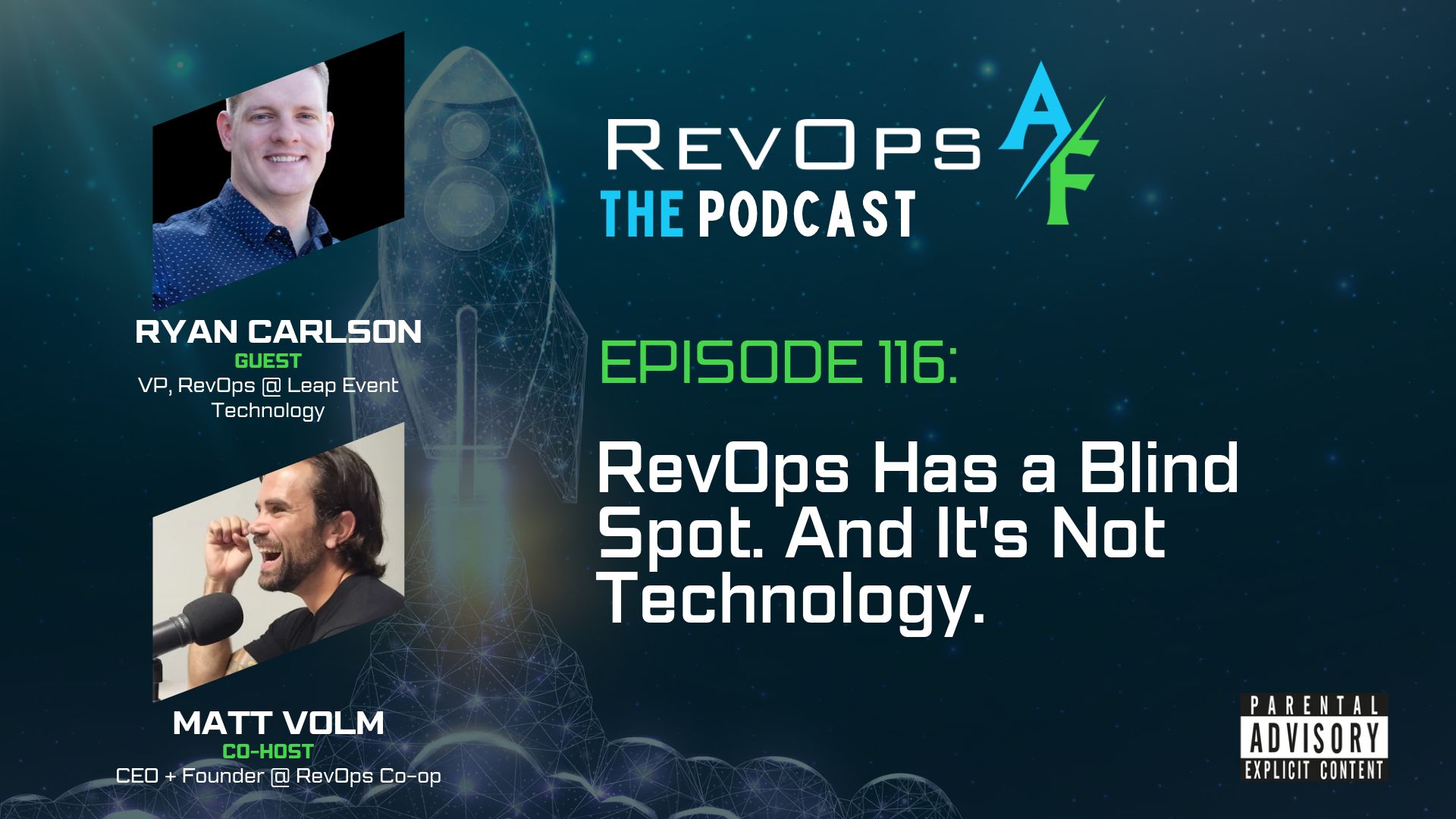
Episode 116: The RevOps Reality Check — Do You Actually Know Where You Stand?
Ryan Carlson built the RevOps Index to answer one question: do you actually know where you stand? The gaps he's found might surprise you.


Most RevOps teams are busy. Tickets are closing, dashboards are shipping, and the queue never quite empties. The harder question — the one most teams don't have a clean answer to — is whether any of that activity reflects genuine operational health, or just throughput dressed up as progress.
Matthew Volm sits down with Ryan Carlson, VP of Revenue Operations at Leap Event Technology, founder of RevOps Index, and co-founder of InsiteGM, to work through that question from first principles. Ryan's path into RevOps is genuinely unusual: he built his first revenue operations function inside the NHL front office for the Detroit Red Wings, spent years working through roughly 120 CRM implementations with professional sports organizations, and carried that practitioner rigor into the broader B2B world. That background — equal parts data infrastructure, organizational communication, and high-stakes decision support — shapes everything about how he thinks about operational maturity and what it actually means to know where you stand.
The conversation covers why most RevOps teams can't honestly assess themselves, what the data from the RevOps Index reveals about where the real gaps tend to live, why strategic standing and executive readiness consistently outrank tooling as the weakest categories, and how to turn a diagnostic into an action plan that people will actually use.
There's a structural reason RevOps teams struggle to gauge their own maturity, and it goes beyond the usual "you don't know what you don't know" framing. Ryan names four specific dynamics that make honest self-assessment unusually difficult in this function.
The first is the absence of a neutral reference point. When someone steps into a new RevOps role, the benchmark they reach for is almost always personal — the last team they were on, the last company they came from, the practitioners they follow online. That reference point may be useful, but it's rarely calibrated to anything broader.
The second is what Ryan calls an inherent conflict of interest: the people most qualified to evaluate the RevOps function are the people who built it. Objectivity is structurally compromised before the assessment even begins.
The third dynamic — partial excellence masking real weakness — is worth sitting with. RevOps touches so many parts of an organization that strong performance in a few areas can produce a decent overall average, even when significant gaps go unaddressed. The aggregate looks fine. The underlying problems don't surface until something breaks.
"Most RevOps functions don't fail because of complex problems. They fail because no one has named the simple ones out loud clearly enough to fix them." — Ryan Carlson
The fourth dynamic is the one that came up repeatedly at RevOpsAF San Francisco: responsiveness reads as health. A team closing tickets quickly looks productive. It may be. But throughput and strategic impact are not the same thing, and conflating them is one of the most common ways RevOps organizations get stuck — as this episode on breaking the ticket-taker mindset explores.
The RevOps Index, available free at revopsindex.com, is a 46-question diagnostic across nine categories designed to give practitioners an honest read of where their function stands — and, more importantly, what to do about it.
The design philosophy behind the tool is worth understanding, because it explains why the output looks different from most assessments practitioners have seen. Ryan's core constraint when building it was that no score should ever be delivered without immediately telling the user what to go do next.
"There should never be a score that's given out without immediately saying, 'Okay, this is what you should go do about it.'" — Ryan Carlson
The Index serves two distinct audiences. The first is someone early in their RevOps career — a junior practitioner, or an experienced operator moving into the function for the first time — who needs a starting point and a plan they can begin implementing. The second is a seasoned RevOps leader who simply needs a neutral benchmark they can't generate themselves. The problem underneath both use cases is identical: there is always more work than time to do it, and the hard part isn't finding the work. It's knowing which work actually moves the needle.
The tool produces a detailed PDF report with full diagnostic detail, an Excel action plan that prioritizes every identified issue and estimates effort, and — notably — specific AI prompts users can take directly into tools like Claude to begin addressing each item. There's no login and no personally identifiable information collected, by design. The intent was to remove every possible barrier between the assessment and actual action, particularly for practitioners who might otherwise hesitate to share company information with an unfamiliar platform.
One of the more striking findings from the RevOps Index data so far is what isn't showing up as the primary weakness. Given how often RevOps conversations center on tooling — the right CRM, the right MAP, the right stack — it would be reasonable to expect technology gaps to dominate the results. They don't.
"It's not the tooling that actually comes back as the most common weak category. The most common weakest categories have been strategic standing and executive readiness." — Ryan Carlson
Strategic standing covers how well a RevOps team communicates — up, down, sideways, and laterally across the organization. It's the difference between being treated as an internal vendor of reports and dashboards versus being recognized as a trusted strategic partner whose perspective is sought out before decisions are made. The CEO perspective on what RevOps brings to the table maps closely to what Ryan is describing here: the value of the function is real, but it only gets recognized when it's communicated in terms the business understands.
Executive readiness is the more urgent version of the same problem. In private equity-backed environments especially — which is where Ryan has spent significant time — the expectation is that RevOps can answer board-level questions on demand. Not in a week. Not after a data pull. At the drop of a hat. That readiness requires a specific kind of data structure and communication discipline that most RevOps functions haven't explicitly built toward.
The pattern connects directly to what executives actually want from RevOps teams: not more dashboards, but the ability to translate operational data into business impact in real time, without the intermediate steps that only an operator would understand.
Ryan's framework for navigating the gap between operational detail and executive communication is deceptively simple. It comes from his father: when you're presenting up, ask yourself whether you're telling somebody what time it is, or telling them how to make the watch.
The distinction matters because RevOps practitioners are, by disposition, builders. They're in the details. They care about the integrations, the data structures, the flows — the things they crafted — and that's not a flaw. But it becomes a liability when the audience on the other side of the conversation has no context for those details and doesn't need any. What a marketing leader, sales leader, CEO, or board member needs to know is whether what RevOps is doing is growing revenue or improving the bottom line. If the answer to their question can't be tied back to one of those two things, the communication has failed — regardless of how technically accurate it is.
This isn't a critique of RevOps practitioners. It's a recognition that the communication skill required to translate operational work into business impact is a distinct competency, one that doesn't develop automatically from doing the work well. It has to be practiced deliberately — something Ryan is direct about from his own experience: "It is something that you need to practice and not just wing as you're going into these conversations with people."
The RevOps soft skills conversation from Episode 102 covers this territory in depth — the gap between technical capability and the communication and influence skills that actually determine whether that capability gets recognized and acted on.
Ryan offers a second framework for the related problem of operators who fix things too fast. His father is also a pilot by hobby, and the flight lesson he describes translates cleanly into RevOps.
When an engine cuts out mid-flight, the trained response is not to immediately get the plane on the ground. The trained response is ABC: Airspeed (how long can I glide before I need to land?), Best Field (what's the optimal landing spot?), and Call (who do I communicate with, and how?). The underlying principle is that you have more time than you think. A plane doesn't fall out of the sky — it glides on its glide path. Responding to that pressure as if the plane is about to drop is what gets pilots in trouble.
"RevOps operators, we have to be really careful not to immediately try to get that plane on the ground when a problem arises. Because you will only be speeding up to being the first person at the scene of your own accident." — Ryan Carlson
The application to RevOps is direct. The tendency to see a problem and immediately fix it — to put a finger in the dam — is natural and often well-intentioned. But it skips the strategic layer: What's the best resolution here? What are the implications? Who needs to know, and how should they hear it? Moving slowly enough to answer those questions before acting is not procrastination. It's the thing that separates reactive execution from strategic operations.
For practitioners building out prioritization muscles, the keys to prioritization in RevOps covers how to structure that decision-making in practice.
One design decision in the RevOps Index worth examining is the choice to surface practitioner-created content — specific pieces from real operators who have worked through specific problems — rather than a generalized best practices list. Ryan is deliberate about why.
Best practices, in his view, are only useful where they're actually applicable. A best practice delivered without context for why it matters or how to implement it in a specific situation is just noise. The gap between knowing a best practice exists and knowing what to do with it in your organization is where most frameworks break down. The influencing without authority challenge in RevOps is a good example: the principle is widely understood, but execution looks completely different depending on team structure, company stage, and stakeholder relationships.
The Index addresses this by running identified issues against a database of practitioner content — using semantic matching to surface the pieces most relevant to what a specific user is actually struggling with. When a gap in pipeline integrity shows up in someone's diagnostic report, the system looks for practitioner content that addresses that exact category and links to it directly. The result is content that arrives in context, at the moment when the user has already established that it's relevant to them.
The approach also surfaces community knowledge in a way that generic lists don't. Rather than pointing people toward authoritative-but-impersonal sources, the Index surfaces work from operators inside the RevOps Co-op community — people who have faced the same problems and written about how they solved them. This connects to the broader case for why operators should build for themselves first: the practitioners closest to the work often produce the most actionable guidance.
The question of how to translate a diagnostic into actual movement is one Ryan built the Index's output structure around. The principle is progressive commitment: give someone the most compressed, actionable version of the results first, and make each additional layer available for those who want to go deeper.
The highest-level output is three priority actions, delivered as the report loads. Three — not nine, not twenty — because the goal is momentum, not comprehensiveness. If a practitioner only ever acts on those three things, they're better off than they were before. That framing matters: the tool is designed around the assumption that some action is always better than perfect analysis followed by no action.
For those who go deeper, the full action plan breaks items into 24-hour actions, 30-day actions, 60-day actions, and a 90-day plan. The sequencing is by leverage, not severity — meaning the items surfaced first are the ones most likely to actually move things, not simply the most urgent fires. This distinction is worth internalizing. Urgency and leverage are not the same metric, and optimizing for urgency alone is one of the patterns that keeps RevOps teams in reactive mode.
There's also a financial benchmarking layer available through 15 optional additional questions, designed to help practitioners quantify RevOps ROI — one of the most persistently difficult problems in the function. The output from that layer can be shared with executive teams directly, giving RevOps leaders something concrete to present when asked to justify the function's impact.
The assessment is repeatable. Users can retake it after implementing changes and track how scores shift over time, turning what might otherwise be a one-time exercise into an ongoing instrument for demonstrating progress.
No conversation with Ryan Carlson would be complete without the data quality story that is both a cautionary tale and an inadvertent argument for every governance framework RevOps has ever tried to sell internally.
A professional sports team — unnamed, for reasons that will become obvious — ran a direct mail campaign that pulled last names from the CRM and printed them on a personalized jersey for the mailer. The last name appeared above a number on the jersey, exactly as it would on a real uniform. The campaign was sent to a lookalike audience built from season ticket holder data.
The CRM data was not clean.
"I think my favorite two were MF'er Jones — and that was in full display on the jersey — and then the Beef Baron. I don't know who the Beef Baron is or what they're hawking or if they're even selling meat, but the Beef Baron, that was my favorite harmless one." — Ryan Carlson
The campaign worked, as it turned out. But the following season involved a significantly more careful audit of the data before anything personalized went out the door. The practical lesson for RevOps practitioners is one that data management frameworks have been making for years: the downstream consequences of dirty data are always more visible — and more embarrassing — than the upstream work required to prevent them. The Beef Baron is an extreme example. Most organizations experience the same dynamic at a quieter register, in forecast numbers that don't hold up, in lead routing that sends the wrong rep to the wrong account, or in attribution that tells a story the business can't defend.
Check out our blog, join our community and subscribe to our YouTube Channel for more insights.