Podcast

October 15, 2026
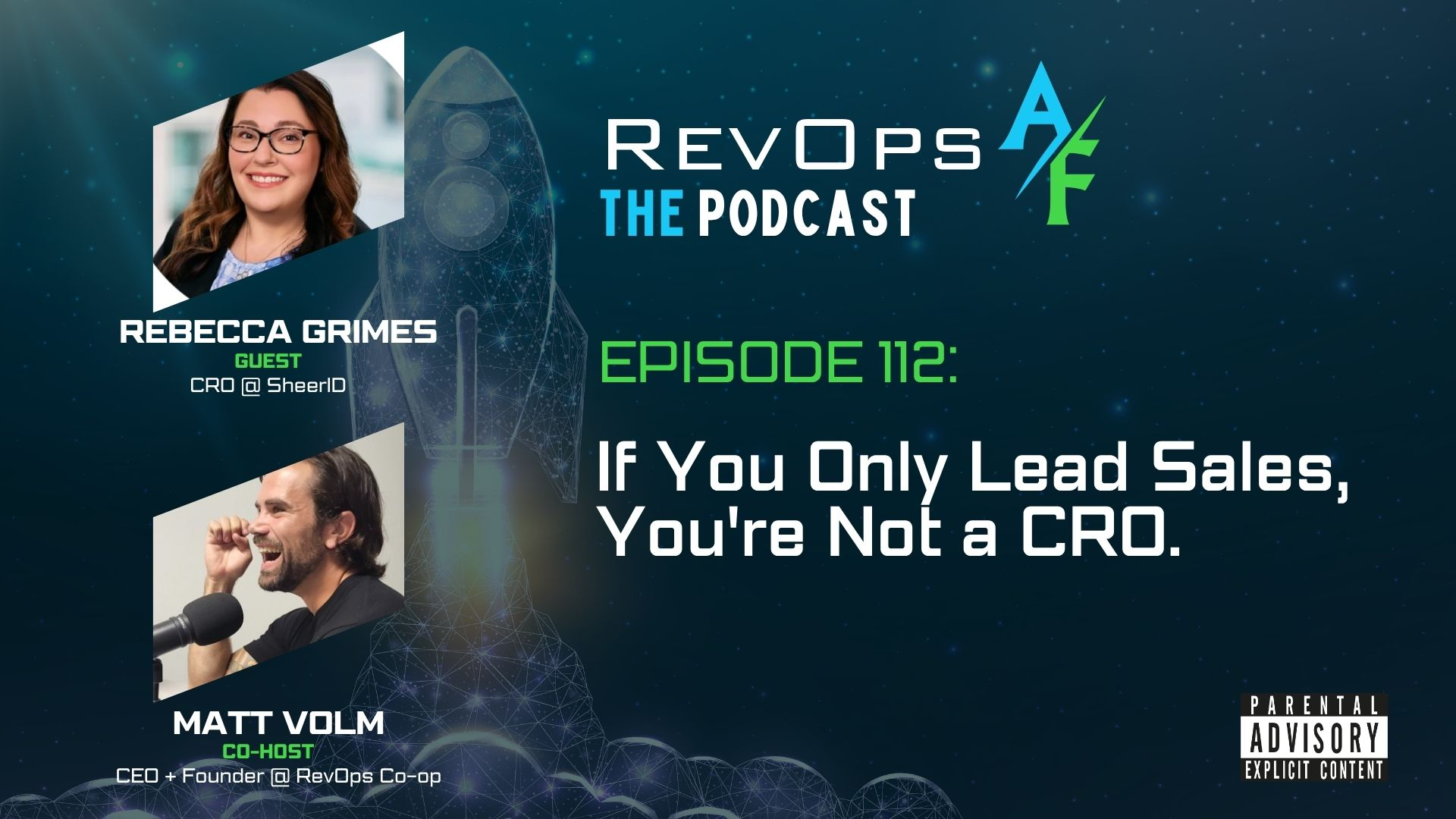
Episode 112: You're Not a CRO If You Only Lead Sales
SheerID CRO Rebecca Grimes makes the case that a CRO who only leads sales is really a CSO and explains what full-cycle revenue ownership looks like.


One hundred episodes in, and the question at the center of this one is as fundamental as it gets: what does it actually mean to build a high-performing revenue organization, and what role does RevOps play in making it happen?
In this episode of RevOpsAF, Andrew Cooper, VP of Revenue Operations at Yooz, joins co-host Matthew Volm for a conversation that is deliberately grounded in lived experience. Andrew's path to RevOps ran through corporate development and financial analysis at Zayo Group, then through building a business operations function from scratch at Syn Seven — from solo RevOps hire to a full unit spanning RevOps, customer operations, support ops, CRM management, and internal project management. He is currently at Yooz, leading revenue operations for the US business in the AP automation and fintech space, where he also oversees the company's SDR and BDR function. The conversation spans operational excellence, change management, AI, and — in a final moment that says more about creative go-to-market thinking than any strategy deck could — why Yooz went back to door-to-door sales.
"Operational excellence" is one of those phrases that sounds cool but is hard to define.
"Operational excellence to me is not a check mark. It's something you're always building, and it has to become part of your DNA and part of your culture."
— Andrew Cooper
He breaks it into three components. First: do what you say you're going to do. Build the plan, deliver on it consistently, and when you miss, don't look away. Second: understand why you missed. Transparency with stakeholders about the nature of a shortfall is not a sign of weakness — it's the operating system working correctly. Third: build the trust and accountability across marketing, sales, and customer success that allows people to raise their hand when things go wrong and actually make the necessary changes.
Andrew is direct that high-growth environments are not the same as operationally excellent ones. He has worked inside both, and the distinction matters: "I've been a part of high-growth cultures too that didn't have a lot of operational excellence. We left a lot on the cutting room floor because we weren't consistently looking at what we thought the key levers of our go-to-market engine were."
The operational excellence conversation connects naturally to a broader RevOps question the community has been wrestling with for years: what does it look like when RevOps operates strategically rather than reactively? Episode 67: Why RevOps Roadmaps Fail — Breaking the Ticket Taker Mindset explores the organizational dynamics of that shift in detail.
One of the more useful framings Andrew offers is why RevOps is uniquely positioned — not just to support a high-performance culture, but to actively create it. The argument is simple: nobody else in the revenue organization has the same combination of data access, system visibility, and cross-functional line of sight.
"If I were to raise my hand if we had an issue in marketing — we were missing our ICP in some capacity, the data's showing a negative trend — I'm not just sharing that trend to my marketing leader and saying, 'Hey, do something to flip this trend.' What's the new strategy here? It's bringing in a conversation and having a workshop around, okay, this is the trend we've seen. This is when it started. Let's work backwards."
— Andrew Cooper
This is the distinction between RevOps as a reporting function and RevOps as an operating system. The former surfaces information; the latter facilitates action. Andrew goes further: when RevOps rolls out process changes, enrichment updates, or CRM adjustments, each of those moments is also an opportunity to model the behavior the organization needs. Raise your hand when the iteration doesn't work. Explain why the change was made. Show the team — not just leadership — how it improves their day.
"Building a high-performance culture doesn't start with a massive quarter-long planning exercise and then an all-hands call," he says. "It happens in that weekly execution. It happens in your interfacing with frontline employees."
This connects to a recurring theme in how RevOps earns influence without authority — which, for most revenue operations practitioners, is the only kind of authority they have.
Asked for tactical advice on turning around an underperforming revenue org, Andrew leads with diagnosis before prescription. The first question is always: where in the funnel is the breakdown? Is it a leads problem, a pipeline problem, a closing problem, or a retention problem? That answer shapes everything else.
But the tactical framework he describes is less about tools and more about people — specifically, about building champions on the front lines rather than working exclusively through managers and executives.
"Who are the reps on the front lines that are wanting to perform, know that maybe they're struggling and are willing to try something different? Find those folks in your organization that you can work with — AEs, SDRs, CSMs — that once you get through kind of your first 45 days, you've found your gap, you've recommended a change, you've rolled it out to the team. Work with those champions directly."
— Andrew Cooper
The second piece is recognition — and specifically, recognizing change early, before the big results show up. Andrew references the book The Switch as a resource he returns to on change management. The principle is consistent with the research: if the only signal the front line receives is silence until results improve, adoption will be fragile. When someone converts a lead more efficiently with new scripting, when a deal closes faster because of a tighter pre-sales handoff, name it publicly. Give the person the credit. The rest of the team will follow.
The change management challenge in RevOps is not new, but Andrew's emphasis on front-line champions as the vehicle for durable change is a useful reframe of what is often framed as a top-down problem.
The most candid section of the conversation comes when Andrew describes where he has personally gotten change management wrong. The setup is a comp plan and configure-price-quote (CPQ) change at a previous company, made to address a churn problem — customers were signing during promotional periods and churning out before implementation could take hold.
The change worked by the numbers. Customer retention improved. Sales held. But six months in, the front-line reps were close to revolting.
"I didn't spend enough time with those reps explaining why it's important we position it this way, how that sets up fewer escalations for them in implementation, fewer escalations for them when someone's into support. And it took me about six months for that all to come to a head — but it boiled up with so much frustration that we almost had reps wanting to mutiny the new process."
— Andrew Cooper
The lesson is not about communication tactics — it's about frame of reference. "The data story we tell, the system stories we tell are always good for the company," he says. "But if I'm actually an AE on the front lines or I'm an SDR on the front lines — why does that matter to me?"
This is a harder problem than it appears. When RevOps is one degree removed from the front line, it is easy to default to company-level framing without realizing it. The practitioners who avoid this most effectively are the ones who can genuinely context-switch: the message for the CRO is not the same message for the field rep, and conflating the two is where large rollouts go sideways. Explaining the why — and explaining it in terms of what gets easier for the person doing the work — is not a soft skill. It is the mechanism by which RevOps projects either stick or don't. The blog on best practices for change management covers some of the structural side of this, but Andrew's framing is more human: make sure the person in front of you understands what's in it for them, not just what's in it for the org.
Andrew's take on AI is characteristically direct: use it to eliminate the work that doesn't require judgment, and don't let it touch the work that does.
The framing he keeps returning to is "taste" — a word that functions here as shorthand for the contextual judgment, perspective, and strategic reasoning that makes RevOps recommendations worth taking seriously. Weekly reporting packages, forecast summaries, deal desk reviews, pipeline trend analysis — these are all places where AI can dramatically accelerate the work of surfacing context. But the recommendation that comes out the other side still has to carry a person's fingerprints.
"I want AI to surface as much of the context as I can, and then I wanna be able to apply my judgment, my reasoning, my taste to that context and make those recommendations, make those insights. I never ship data that's just something from an AI agent."
— Andrew Cooper
He applies the same logic to the sales motion. The goal is maximizing the time reps, CSMs, and implementation teams spend in front of customers — talking through real problems, building trust, doing the work that requires a human on the other end. CRM entry, company research, pre-call prep: AI handles it. The relationship doesn't.
The caution he surfaces is worth noting: "Pushing out a lot of automation without maintaining some of that taste or some of that perspective is — I think it just shifts the problem. It's a different kind of messy CRM if you just have a bunch of AI enrichment and a bunch of clay workflows that don't properly set up your reps with the context they need."
This is a more significant point than it might appear. AI-generated mess is still mess — it just looks different. Episode 88: Not Everything Is an Agent explores the governance dimension of exactly this problem: when to deploy AI automation and when restraint is the more operationally sound choice.
The final exchange in the conversation is the one that probably sticks longest. Asked to share the most unhinged go-to-market thing he's been part of, Andrew describes a move so counterintuitive it circles back around to obvious: Yooz started doing door-to-door sales again.
The context matters. Yooz sells into companies that may not be as tech-forward as the typical SaaS prospect — dealerships, construction companies, businesses that still work best when someone physically shows up. The team realized their market visit strategy could extend to cold drop-ins. No appointments. Just knock on the door.
"That has been a nice little something we would have never thought of," Andrew says. "It's like that's ancient history, and now we're going back to knocking on dealerships, knocking on construction companies' doors."
The broader principle he draws from it: don't let "we tried that before" permanently retire an idea. Sometimes the timing wasn't right. Sometimes the company wasn't ready. Sometimes a go-to-market motion that felt obsolete is exactly the right move for a specific segment at a specific moment. "I wouldn't let those old ideas just sit on the shelf. Sometimes it's fun to dust off something like going door to door without an appointment and just dropping in on a business."
It is a fitting note for a 100th episode: the most creative go-to-market move is sometimes the oldest one.
Check out our blog, join our community and subscribe to our YouTube Channel for more insights.