Podcast

October 1, 2026
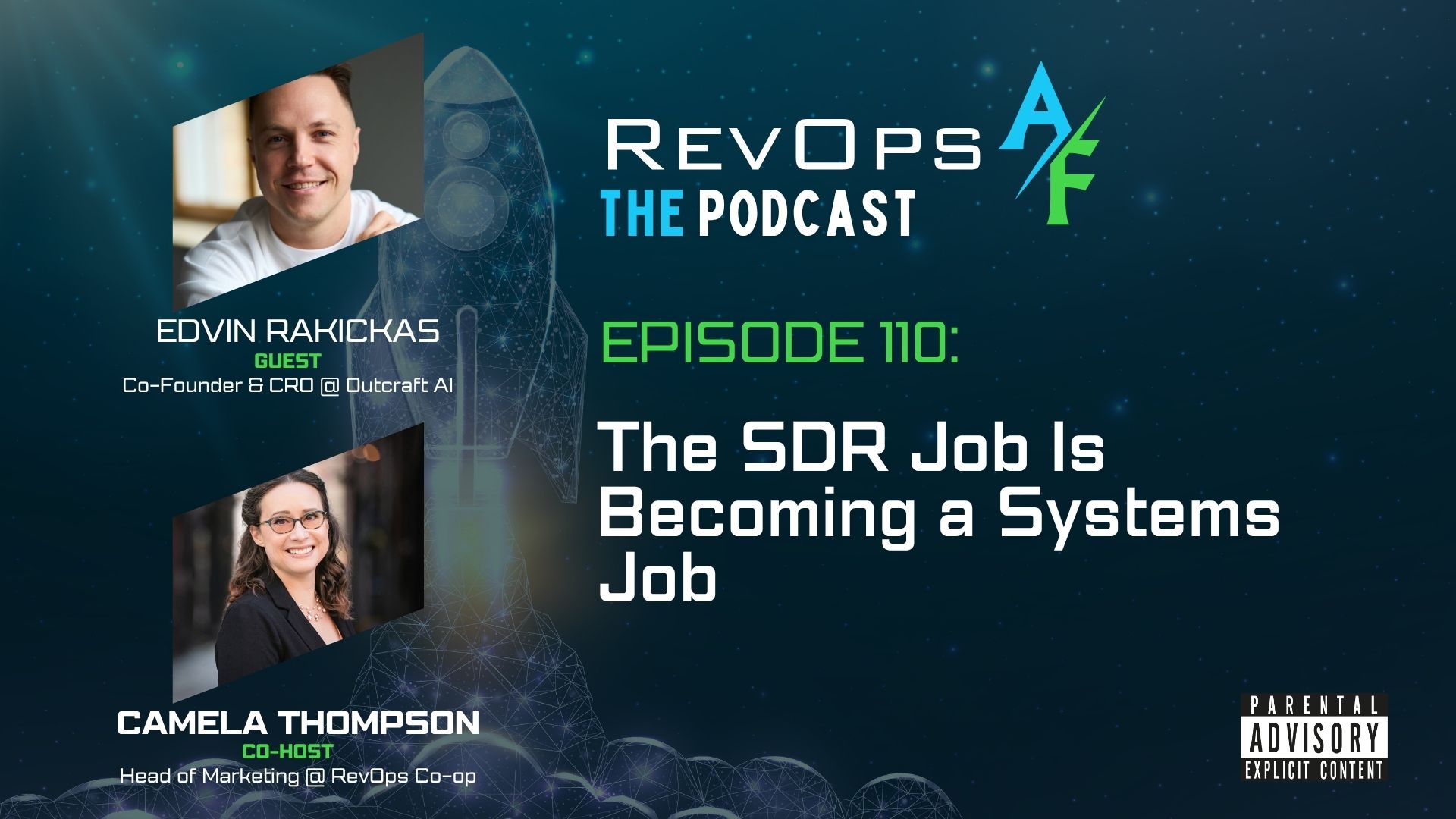
Episode 110: The SDR Job Is Becoming a Systems Job
AI is reshaping the SDR role from activity-based to systems-based. Outcraft AI co-founder Edvin Rakickas on what actually breaks in AI outbound.


Most companies have an AI mandate. Almost none of them have an AI strategy. That gap — between board-level pressure to "do AI" and the messy operational reality of actually doing it — is where RevOps practitioners are living right now, and it's one of the more exhausting places to be.
In this episode of RevOpsAF, Taft Love, founder of Iceberg RevOps, joins co-host Camela Thompson for a conversation that is refreshingly free of hype. Taft brings an unusual background to the table — former police detective, federal white-collar crime investigator, and SWAT team member before a pivot into tech through an SDR role at a San Francisco startup — and that instinct for structured problem-solving under pressure shows up clearly in how he thinks about AI adoption. The conversation covers executive expectations, the build-versus-buy decision, the foundational work that actually has to happen before AI delivers anything, and what it looks like when small teams get it right.
There is a specific kind of executive AI ask that RevOps practitioners across the industry are fielding right now. It comes from the top, it references the board, and it contains almost no actionable information. Taft is direct that this is the norm rather than the exception.
"From the executive level down, which is really where a healthy initiative needs to start, I'm seeing a lack of clarity. This vague mandate to do things with AI. Our board wants AI, we need to do AI — not a lot of information flowing down about what that actually means." — Taft Love
Embedded in that vague mandate, Taft argues, is a specific assumption that tends to drive AI strategy in the wrong direction: that AI's primary value is replacing people and reducing headcount. The problem isn't that this assumption is ethically wrong — it's that it's operationally wrong. It leads teams to look for the wrong things in the wrong places, and it sets up AI initiatives for failure before they start.
The reframe Taft offers is simple but consequential: AI doesn't replace people or roles. AI replaces jobs to do.
This shift in frame — from "which role can AI eliminate" to "which jobs to do don't require human judgment" — is the first and most important move Taft makes with executives who want help getting AI into their business.
The distinction matters because it changes what you're looking for. Roles are bundles of many different types of work, some of which require judgment and some of which don't. AI is extraordinarily good at the latter and currently unreliable at the former. A role-replacement frame causes organizations to either overestimate AI's capabilities (trying to replace judgment work) or miss obvious wins (not auditing which tasks inside a role are genuinely rote).
Taft describes a discovery call that illustrates what rote work actually looks like in practice: a client's monthly client report was assembled by passing a document sequentially through three people, each adding their section, before someone collated the whole thing. When Taft pulled on the thread, it turned out each person was going to their time-tracking system, re-reading the daily notes they'd left themselves, and distilling those into bullet points for the report.
"Great. Job to do that doesn't require humans — that time should be given back to humans for judgment work." — Taft Love
The principle Taft reaches for here connects to what he describes as someone's paradox — the observation that more efficient technology tends to increase consumption, not decrease it. History has consistently proven wrong the assumption that efficiency gains mean fewer people doing less work. His read is that AI will follow the same pattern: a period of displacement followed by more people doing different, higher-judgment things with AI as a tool.
This connects to a theme that runs through Episode 88: Not Everything Is an Agent — the idea that the work genuinely at risk from AI is work that operators shouldn't be doing anyway, and that the strategic and judgment work becomes more valuable, not less.
The gap between "AI should be able to do this" and "AI is actually doing this reliably" is, in Taft's experience, far larger than most people expect. He describes this concretely through what Iceberg built to solve its own project management problem.
The problem was familiar: client call notes weren't making it into the project management system consistently. If someone called in sick, another team member couldn't step into their projects without going back to clients for context. That's a failure mode with real consequences — and a standard that, by Taft's own admission, the team had historically failed to meet.
The solution they built is a multi-agent pipeline: an agent that ingests every client call and matches it to the right client; an agent that reviews the call, strips out small talk, and segments it into sections; an agent that reads those sections for what Iceberg calls commitments and creates commitment records; and then — critically — an agent that searches a vectorized database of all previous calls and all existing Asana tasks to determine whether a commitment is genuinely new before suggesting the creation of a task.
"The gap between this idea that oh, AI should be able to do that, and building something where AI is actually fruitful is way bigger than people think." — Taft Love
The deduplication step is where the system earned its complexity. Without it, every call that referenced an ongoing project would generate a new duplicate task. Getting that right required careful thought about how agents search, how context gets embedded in vectorized records, and how the system surfaces its reasoning to a human before acting. The agent sends a Slack message to the responsible person summarizing the call and proposing any new tasks — a human confirmation step that keeps the system honest.
The result is a virtuous cycle: because the system adds deep context to every task, future searches are more accurate, which means the deduplication logic gets better over time, which means the context continues to compound. But Taft is clear that this was not a weekend vibe-coding project.
The project management system Taft built is a useful anchor for the build-versus-buy conversation, because it illustrates where building makes sense: the capability didn't exist commercially, the team had the bandwidth and skills to build it, and the value to the business was high enough to justify the maintenance burden.
Most AI decisions aren't that clean. Taft's framework for evaluating the rest: what you're buying from a commercial vendor is not capability — it's stability.
"It's not capability, it's stability. And I think people underestimate and really don't understand the true cost of ownership of a complex application when, especially when you don't control all the inputs." — Taft Love
The analogy he reaches for is a product company deciding whether to build its own integrations to calendar providers or buy an API from a vendor whose entire job is maintaining those integrations. You're not buying the feature — you're buying the reliability of the feature across API changes, platform updates, and edge cases you'll never anticipate. That calculation now applies directly to AI.
The exception Taft points to is business intelligence. He replaced roughly $18,000 in annual spend — including a South American engineering team that helped maintain SQL queries — with a Claude-based setup that he maintains himself and uses more than the previous solution. His reasoning: BI tools don't actually give you stability, because you're constantly editing queries anyway. If you have to maintain technical complexity regardless, and you have the skill to verify what the AI is producing, the calculus shifts.
That last condition matters. Camela's point here is worth sitting with: experience and competency in query languages and similar technical skills remain essential specifically because they let you catch what the AI gets wrong. An expert reviewing a Claude conversation will often find places where the output is subtly incorrect in ways a non-expert wouldn't catch. The skill requirement doesn't disappear — it shifts from execution to review. For more on this dynamic, Episode 86: Adapt or Die? RevOps in the Age of AI covers similar ground around what technical fluency actually needs to look like for RevOps practitioners working with AI tools.
Taft's answer to "what does the foundational work actually look like?" lands in familiar territory for anyone who has worked through an AI pilot that underdelivered: data quality, clean ownership, and clear structure.
"Whatever data or context you give to a model is the ground truth to that model. So first, you need clean data, clear ownership. AI reasoning on top of chaos just is the epitome of garbage in, garbage out." — Taft Love
The Rain Man analogy Taft offers is sharp: AI can tell you how many toothpicks fell on the floor with eerie precision, and then tell you a candy bar costs $100. The confidence is consistent across both answers. The accuracy is not. When AI is operating on decades of inconsistently entered human data, wrong answers are delivered with the same assurance as right ones — and there's no human in the loop to squint at the output and say "that's not right."
This connects to a theme that appears repeatedly across the RevOps community's experience with AI. Episode 50: Thinking of AI? Think Data First makes the same argument: AI doesn't shortcut the foundational data work — it makes that work more important, because the human error-correction layer gets thinner as automation increases. The blog post Why Most Revenue Stacks Aren't Ready for AI (And What That's Costing You) walks through what that readiness actually looks like in practice.
Beyond data, Taft identifies four organizational patterns that consistently block AI transformation at small companies — patterns that are worth naming explicitly because they're easy to diagnose in others and easy to miss in your own organization.
No commitment to any course of action long enough to see if it works. Small startups in particular tend toward constant strategy pivots, which means no initiative — AI or otherwise — ever gets far enough to generate meaningful signal.
All testing and architecture happens in production. When there's no staging environment and no structure for thinking through edge cases before building, AI initiatives create compounding instability rather than efficiency.
No framework for what the team will and won't do. Without clear prioritization, RevOps practitioners stay in permanent firefighting mode, which makes sustained AI work essentially impossible. This connects directly to the prioritization frameworks discussed in Episode 36: The Keys to Prioritization in RevOps.
Inability to delegate sufficiently to get out of the critical path. This one is particularly costly. Taft estimates roughly half of Iceberg's engagements stall for days or weeks at a time because an executive wants to be in every loop but doesn't have bandwidth to provide feedback. The executive becomes a bottleneck without participating in the work.
When an executive comes to Taft and says "we need an AI strategy," his response is structured around three things.
First: agree on outcomes. Not aspirational outcomes that sound good in a board deck, but outcomes that the people who actually understand the technology agree are achievable. Getting this on paper forces the vagueness out of the mandate and creates something measurable.
Second: design a framework that the team can operate within. Without structure, experimentation produces duplicative, inconsistent results — Taft's example of a Chili Piper rep who built something that their own product already did better captures the failure mode precisely. Innovation genuinely does come from the people doing the work, not from the top. But without guardrails, that innovation goes in every direction at once.
Third: give people latitude to experiment within that framework, and make noise about what's working.
"I'm a big believer in wide latitude and iron boundaries. So plenty of latitude. 'Look, here are the three tools you can use. We'll pay for you to go learn.'" — Taft Love
The Chili Piper example is instructive: they offered every team member $2,000 to spend on AI courses of their choice. Almost nobody used the budget. But everybody experimented, and a few people built genuinely useful things that the team now uses. The budget wasn't the point — the permission structure and the signal that leadership cared was.
The companies Taft sees succeeding with AI aren't the ones with the most sophisticated tools. They're the ones who built the organizational discipline to coordinate across teams, commit to decisions, and maintain structure — and then layered AI on top of that foundation. They're the ones whose reps show up to calls with pre-built scorecards and context pulled from ten data sources, and whose follow-up and outbound automation is useful rather than spammy.
Taft mentioned that Iceberg is building and releasing free tools for the RevOps community. The most recent — built in collaboration with Tiffany Gonzalez, who ran RevOps at both Microsoft and Amazon — is an AI-powered revenue systems analyst: a set of agents that combs through CRM metadata and data (processed in-browser, not stored) to generate an audit report covering where a company sits on the operational maturity spectrum and which projects should be prioritized.
The tool is a lightweight version of what Iceberg delivers through its paid engagements, made available free in exchange for contact information for follow-up marketing. Taft posts about these tools and demos them on LinkedIn.
Check out our blog, join our community and subscribe to our YouTube Channel for more insights.