Podcast

October 15, 2026
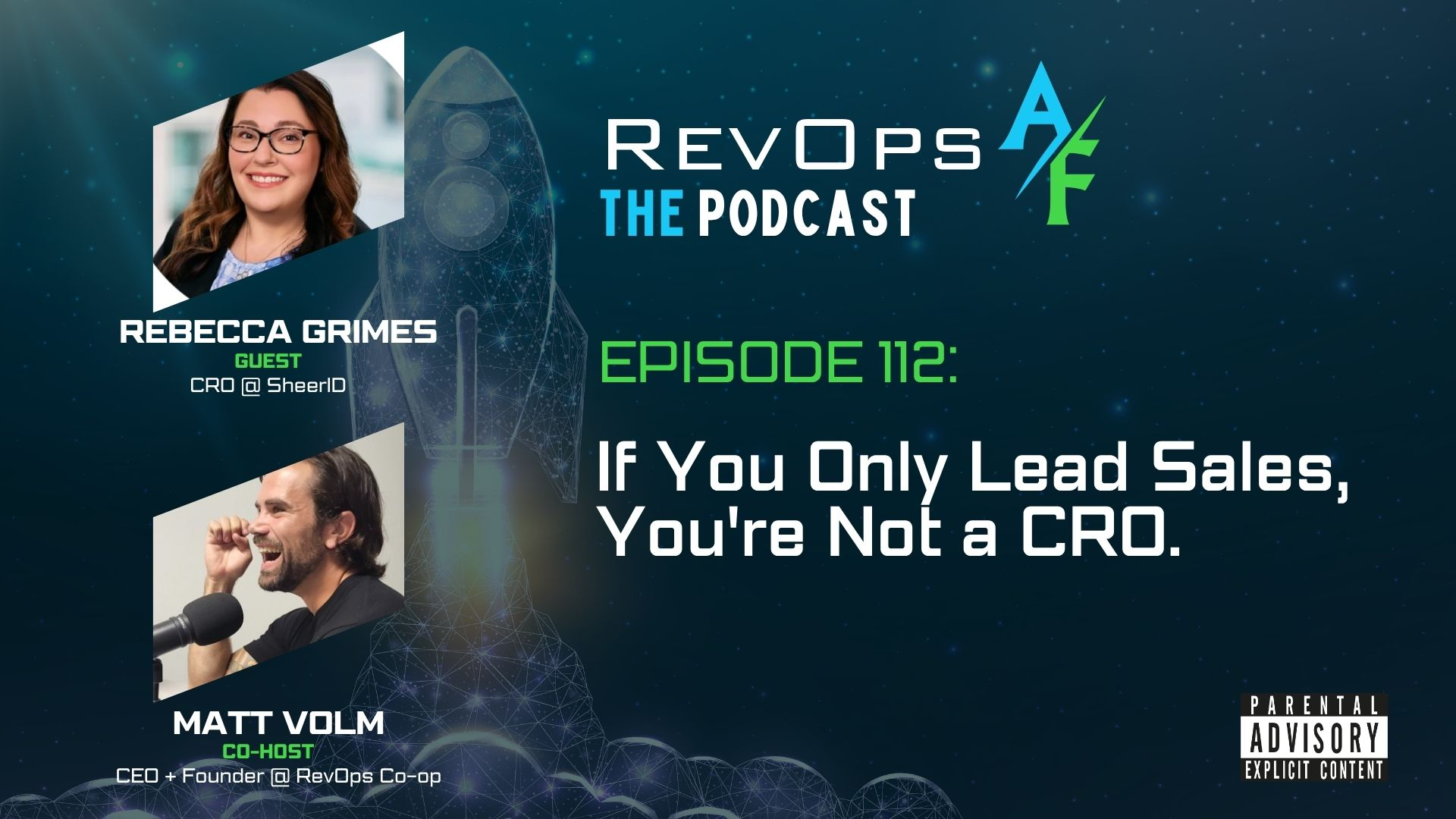
Episode 112: You're Not a CRO If You Only Lead Sales
SheerID CRO Rebecca Grimes makes the case that a CRO who only leads sales is really a CSO and explains what full-cycle revenue ownership looks like.


What separates a truly senior RevOps leader from a technically skilled order-taker? According to James Jackson, the answer isn't found in dashboards or system configurations. It's found in the ability to say no strategically, bring stakeholders along for the ride, and resist the seductive pull of becoming a high-functioning service desk.
In this episode of RevOpsAF, James — a VP of RevOps multiple times over with stints at Snowflake, DocuSign, and Canva — sits down with host Matthew Volm to unpack two vivid, hard-won stories: a full compensation plan overhaul across a 2,700-person sales org, and a deep dive into the "curse of yes" that quietly breaks so many ops teams. Both stories point to the same truth: the technical work is the easy part.
Before getting into the mechanics of the Snowflake comp overhaul, James laid out the mental model he carries into every compensation conversation. There are three primary stakeholders whose interests must be balanced simultaneously, and getting any one of them wrong creates downstream chaos.
The first is the executive leadership team. Compensation is a means to an end, not the strategy itself. The ELT defines the "why," and comp design is the "how." At Snowflake, the strategy was clear: data gravity, platform adoption, and customer consumption growth. The product was built from the ground up to capture consumption signals in a single-pane-of-glass dashboard, which made metering possible in a way many companies can't replicate.
The second stakeholder is the go-to-market team: the sellers and sales leaders who live and die by their comp plans. As James noted dryly, exceptions committees are never filled with reps saying they got overpaid:
"If anyone's ever run an exception committee in their career, God bless you. It is filled and littered with stories of reps wanting restitution for some type of exception or something where they should have got paid more. It's never the opposite way where, hey, I got overpaid." — James Jackson
The third is finance, which is modeling cost of sale, affordability, and how every design decision fits the overall budget envelope. Decelerators, for example, aren't born from anti-seller sentiment — they exist because paying everyone on every dollar would blow the compensation budget. Understanding that these three stakeholders are always in tension, and that RevOps is the connective tissue between them, is the first step toward navigating a comp redesign at scale.
When James joined Snowflake, he inherited something that sounds benign on paper but was actually deeply dysfunctional: a total consumption-based comp plan. On a total consumption model, reps are credited for everything a customer does, including the consumption that would have grown organically regardless of their effort. The result was a compressed attainment band where nearly everyone landed between 85% and 110% of quota.
This created two compounding problems. First, it was a fairness problem. Reps who were actively driving growth looked identical to reps coasting on an installed base that was growing on its own. Second, it was a signal problem. If you're trying to run a high-performing sales team, you can't manage performance when you can't distinguish talent from luck.
The solution was conceptually straightforward but operationally brutal: move from total consumption to incremental consumption. Instead of crediting reps for all usage, the new model established a hurdle rate: take the prior 12 months of consumption, divide by 12, and only pay commissions on consumption above that threshold. True growth, not organic lift.
"To me, the lesson here is incremental is the only honest signal, and there's a lot of difficult trade-offs that you have to accept." — James Jackson
The trade-offs were real. Incremental consumption amplifies the exception committee problem dramatically. Every customer downsizing, every anomalous usage pattern, every rep who felt their hurdle rate was set unfairly — all of it flows into the exceptions queue. James's team ran a two-hour standing exception committee meeting every two weeks just to manage the volume. And quota relief requests, already a constant in any sales org, became a recurring negotiation at scale. This is exactly the kind of operational complexity compensation planning at scale demands — and why it rarely gets done well without serious investment in the process.
One of the most technically rigorous parts of the Snowflake overhaul was validation. Before rolling out a comp change to 2,700 reps, James and his team ran Monte Carlo simulations: retroactively running the new comp model against a prior year to model out the distribution of attainment outcomes.
This isn't a nice-to-have. It's how you walk into a CRO conversation with something other than a gut feeling. The question James would bring to the CRO was specific: under option A, 40% of your reps will not make quota. Under option B, the distribution looks like this. Are we comfortable with those trade-offs?
James's own comp design principles serve as a useful benchmark: 40–50% of reps hitting quota, a mean attainment around 90%, and the top 10% reaching 250% of on-target earnings (OTE). The goal is a healthy distribution: enough winners to sustain culture and motivation, enough variance to separate performance from noise. Before the overhaul, that distribution didn't exist. Afterward, reps were landing at 25% or 400% depending on actual performance, which was exactly the point.
For RevOps leaders dealing with the tactical complexities of compensation planning, this kind of simulation work is what separates a thoughtful redesign from a reactive one.
Here's where the Snowflake story becomes something more than a comp mechanics lesson. James inherited an organization where sales leaders described ops as a "black box" and used, in his words, a lot of four-letter words to describe how comp plans had been designed and pushed through without input. The trust was gone.
Rather than defending the institution or leading with the new design, James started with a listening tour. He traveled to Boston and London. He sat with sales leaders and just listened.
"I don't need to agree with them. They don't need to agree with me on everything, but they needed to feel heard." — James Jackson
The listening tour directly shaped the rollout. When it came time to present the new incremental consumption model, James used a four-layer communication plan — cascading from fourth-level sales leaders down to individual contributors. And the very first slide in every single presentation was a two-column layout: "This is what we heard from you" on the left, "This is what we did about it" on the right.
The tiger team he built during the listening tour included the actual faces of the sales leaders and sellers who had provided feedback. The effect was immediate — it diffused what had been an emotionally charged, adversarial environment. People could see their concerns reflected back at them, and they could see that action had been taken.
The entire transformation took nine to ten months. It was, by James's description, a lot of weekends and late nights. But the buy-in it generated was the only path to durable change. As James put it: you can be right, but if you're not bringing everyone along for the ride, it doesn't matter.
This is a principle that extends well beyond comp planning. The ability to drive change management at scale is, in James's view, the single skill that most separates senior operators from technically proficient ones.
The second story James shared is about a different kind of failure mode — one that's quieter but just as destructive. When he joined Canva as VP of RevOps, he found an ops organization that was perpetually behind. Quotas were late. Territories were deployed late. Annual planning was finishing a month past the sales kickoff (SKO), which is the operational equivalent of building the runway while the plane is already on it.
The root cause wasn't capacity. It wasn't tooling. It was that no one had held the line.
Sales leaders were requesting mid-year restructures, new verticals, territory changes — and ops kept saying yes. Every single time. James called this the "curse of yes," and he framed the downstream consequences as a doom loop:
"Ops just keeps saying yes. And when ops says yes to everything, ops delivers everything late, and when everything's delivered late, who does Sales point the finger at? They point the finger at Ops. They lose faith, they lose credibility in front of the sales org. So everything, the cycle just keeps repeating itself." — James Jackson
The antidote isn't to develop zero flexibility. James was explicit that an ops org with no flexibility just creates resentment and political friction. The mental model he operates with is "flexibility where it matters, policy where you need scale." One-off situations that genuinely need to be honored — honor them. But when a pattern emerges, set policy and stop firefighting.
This connects directly to one of the most common failure modes in RevOps: the reactive posture that turns an ops team into a ticket-taker rather than a strategic function. The perpetually reactive org never gets ahead of the work because it's always responding to the last fire instead of preventing the next one.
The specific flashpoint at Canva was holdover deals — a perennial source of contention in annual planning. For the uninitiated, there are two types: account holdovers, where a rep retains commission credit for activity in an account for a defined period after it transitions away; and opportunity holdovers, where a rep gets commission credit if a deal that didn't close in one period closes shortly after in the next.
James's view on holdovers is characteristically direct: the vast majority of them are theater. In his experience across DocuSign, Snowflake, Canva, and others, 90% or more of holdover deals do not close when promised. And when they do close, they're typically more tactical than the seller originally represented. Sellers, as James noted with some affection, are good at selling — including selling ideas to themselves.
"I don't know why they're largely — I think they're largely theater. Like I've worked at DocuSign, lots of companies, like 90% plus of holdovers do not close when they say they will." — James Jackson
But here's the key: James didn't kill holdovers. He knew that would produce a mutiny. Instead, he set strict limits — a small number of holdovers per rep, enough to honor the spirit of the policy without letting it become an unbounded exception engine. For the most strategic, up-market segments where meaningful deals were genuinely in flight and territorial restructuring was already underway, he allowed more flexibility.
The result: quotas and territories were delivered before sales kickoff. Promises were kept. And at the end of Q1, a sales leader who had pushed back hard on the holdover limits came back and said, unprompted, that James had been right — almost all of them had gone nowhere.
James's response to that moment is illustrative of how he thinks about the role. He told the sales leader it doesn't matter who was right:
"If you're crossing a street, you have the walking sign, you got the — you can cross the street. A guy just blazes through the stoplight. Even though technically I had the right of way, I could have walked in front of the car. I'm gonna get hit by the car. I'm not gonna have a good time." — James Jackson
Being technically correct but politically tone-deaf is still a loss. The job isn't to prove you were right. The job is to get to the right outcome without blowing up the relationships you need to operate effectively.
One of the most practical frameworks James shared wasn't about comp or holdovers — it was about how to think about prioritization as a RevOps leader when the incoming request volume never stops. His mental model uses a simple hierarchy: big rocks, pebbles, and sand.
The sand is the reactive escalations — the fires that come in every day and demand immediate attention. The pebbles are the mid-tier projects that materialize mid-year. The big rocks are the high-impact commitments made at the start of the year — the ones that tend to get displaced by everything else.
James's operating principle for cutting through the noise is a question: does this touch revenue, and is it "above the line"? Above-the-line items get priority. Everything else gets triaged. And critically, James advocates for making this prioritization transparent — his teams have published quarterly newsletters sharing their OKRs and focus areas with go-to-market counterparts, inviting disagreement and discussion rather than letting misaligned expectations fester quietly.
This kind of proactive transparency is what influences without requiring formal authority — a capability that defines the best RevOps leaders.
"I'd rather come with conviction, come with a point of view, and if I'm wrong — I'm like, let's discuss it. But I'd rather do that than the opposite, which is a very passive, a very reactive posture of just reacting to what other people want you to do." — James Jackson
An ops team that never pushes back, never brings a perspective, and never owns a point of view is, in James's framing, just a sophisticated tool. And tools don't get a seat at the table.
Check out our blog, join our community and subscribe to our YouTube Channel for more insights.