Podcast

October 9, 2026
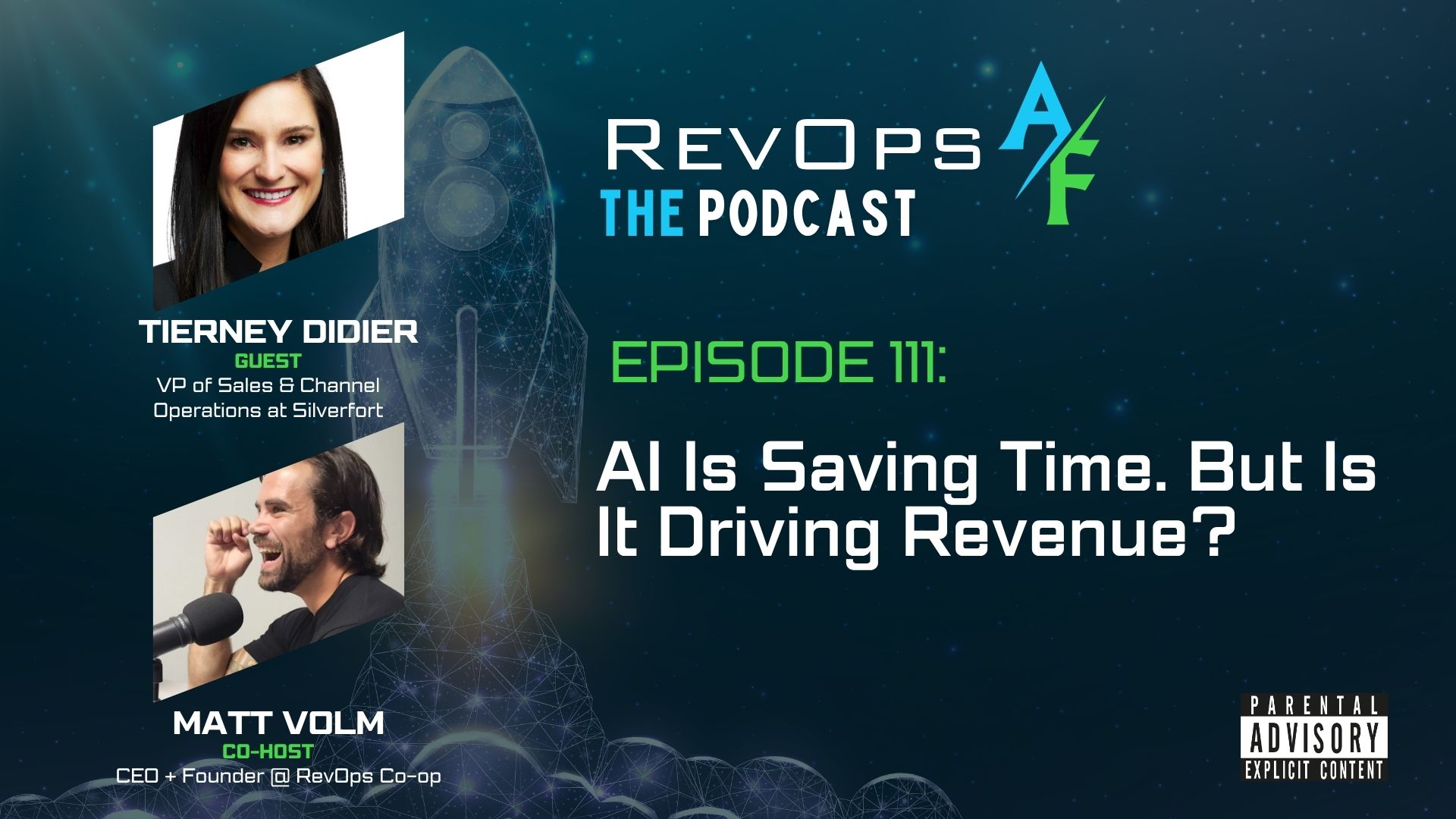
Episode 111: AI Is Saving Time. But Is It Driving Revenue?
AI is saving time in RevOps — but is it driving revenue? Tierney Didier of Silverfort breaks down what's actually working and what's still TBD.


What if the reason your AI initiatives keep underdelivering has nothing to do with the AI itself — and everything to do with the foundation you built it on? That's the question at the center of this conversation, and the answer has direct implications for every RevOps team trying to figure out where AI actually fits into their work.
In this episode of RevOpsAF, Spencer Hardey, VP of Business Operations at HG Insights, joins co-host Matthew Volm to talk cross-functional alignment, the foundational work that most teams skip, and why none of your AI ambitions will land without the boring stuff done first. Spencer brings a rare double perspective to this conversation: he's a working revenue operator himself, but he's operating inside a revenue technology company whose platform is built around go-to-market intelligence. Ten years at HG Insights means he's watched both the RevOps function and the AI conversation evolve in real time — and he has pointed observations about where most teams get it wrong.
There's a version of RevOps that exists to manage the CRM and run reports. Spencer is uninterested in that version.
In his view — shaped by a decade of watching what CEOs actually need from an operations function — the number one job of RevOps is cross-functional alignment across sales, marketing, and customer success, and extending that alignment into the product side of the house. The structural reason for this is straightforward: every other function in the business is optimized for singular focus. Marketing focuses on pipeline. Sales focuses on closing. CS focuses on retention. That singular focus makes each team more effective at its core job, but it creates a gap. Nobody else is standing back to look at the full customer journey and asking what breaks at the handoffs.
"There's no other function in the business that is focused on paying attention to and really prioritizing driving that alignment and who has visibility of when there is misalignment and the impact that has on the business." — Spencer Hardey
This is a theme the RevOps community returns to constantly, and for good reason. Episode 74: Influence Without Authority: The RevOps Way explored the organizational dynamics of how operators make change without direct authority — a prerequisite skill for the alignment work Spencer describes.
In practice, what this looks like for Spencer is showing up to a product launch meeting and recognizing that the sales team isn't actually ready to sell the new feature. Not because the product team failed — they've done the QA, the sandboxing, all of it — but because nobody has developed the targeted discovery questions, the persona-specific deck, or the crisp definition of what problem this feature solves for which buyer. Spencer's job in that moment isn't just to call out the gap. It's to own the fix: schedule the cross-functional meeting, bring a proposed course of action, project manage the resolution, and establish the recurring interlock cadence that prevents the same gap from appearing next quarter.
"RevOps should own that reporting cadence and that interlock cadence, and potentially even you're bringing the data or the insights or the problems or the project priorities to the meeting already, letting people debate what's most important." — Spencer Hardey
The implication here matters: alignment isn't a soft goal or a cultural aspiration. It's an operational discipline with owners, cadences, and accountability. If RevOps doesn't own it, no one will.
Matthew asks Spencer to put together the checklist — the foundational pieces every operator should pressure-test against before claiming their house is in order. Spencer's list is worth sitting with because it's not abstract. These are the specific gaps he's watched create downstream pain, both internally and at the B2B software companies HG Insights works with.
Start with the funnel. Spencer is deliberately non-prescriptive about methodology — MQL definitions are evolving, and he's not going to dogmatically defend any particular framework. But the high-level requirement is non-negotiable: within your addressable market, you need to know which accounts you're engaged with and which you're not, where meetings are coming from, and what converts to pipeline and then to revenue. If you can't report on those things consistently, you don't have a marketing foundation — you have a marketing activity log.
Opportunity stages need to be clearly defined, and the framing matters enormously. Spencer's recommendation is to orient stages around the buyer's journey and motivations, not around your internal sales process. The goal is a minimal, customer-focused data capture requirement that doesn't turn your sales team into CRM administrators. A handful of key data points — who's meeting with you, what role they play, what pain point they're experiencing — gathered cleanly throughout the sales process creates the foundation for a successful post-sale handoff.
This is where Spencer sees the most consistent failure. Companies nail the pre-sales process and treat post-sales as a black box. For any recurring revenue or consumption-based pricing model, that's a liability. The specific metrics that matter: how many customers finished implementation successfully, how many didn't, did they go live, what was their feedback, are QBRs happening. Tracking post-sale with the same rigor applied to pre-sale is the difference between understanding churn and being surprised by it.
Every executive team should be able to describe the company's ICP and segmentation in the same language, to the board, to investors, and to each other. If different leaders are using the same words to mean different things — a failure mode Spencer has watched play out repeatedly — the reporting debates never end because people are arguing about definitions, not about the business. Clear segmentation, mapped into the CRM, gives everyone a shared context for interpreting what the data actually means. This connects to the broader data foundation challenge explored in Episode 50: Thinking of AI? Think Data First.
Spencer's team approaches win-loss from two directions simultaneously: the account team's firsthand experience, and AI-driven analysis of call transcripts. The human perspective captures context — what the customer struggled with, where implementation broke down, what the team actually observed about fit and execution. The AI analysis surfaces what the customer said in their own words, independent of how the team interpreted it. The real value, Spencer is direct about this, comes from comparing the two and identifying where they diverge.
"The transcript itself is gonna pick out things literally just from the voice of the customer themselves. So I think comparing the two is what I get the most value from." — Spencer Hardey
Having a strong foundation means nothing if you can't get budget and executive support to build it. Spencer's advice on communicating upward is pragmatic and grounded in how boards and executive teams actually make decisions.
The core shift required: move from technical framing to outcome framing. Executives are not going to care about the architectural complexity of what you're proposing to build. They are going to care about two things — revenue growth and net income. Every initiative needs to be translated into one of those terms, even if the translation involves napkin math rather than a precise model.
"Even if you don't have the exact numbers, you didn't make a model, you should be in a place to have at least done some napkin math to say or have an estimate of what is the actual revenue impact of this issue or this challenge, and size that against the potential other things that are happening at the business." — Spencer Hardey
Spencer also flags something operators underdo: asking for appropriate resources. If you believe an initiative has material revenue impact, you have an obligation to ask for what it actually takes to execute it. Underselling the scope of the work is not humility — it's a setup for failure.
One framework Spencer uses for standardizing how metrics get communicated to the business: volume, velocity, and conversion rate. How much. How long. How efficiently. It's a clean structure that helps executives digest business performance without getting lost in operational complexity. This kind of disciplined reporting approach also makes it far easier to tell a coherent story about why foundational investments matter — the kind of storytelling the RevOps Co-op blog breaks down in depth.
Here's where the conversation gets most directly relevant to the moment most RevOps teams are living in right now.
Spencer's observation from working with B2B software companies through HG Insights is consistent: the organizations that are struggling with AI are not struggling because the technology is bad. They're struggling because they deployed AI on top of an unclear foundation, and the AI has no meaningful context about their business.
Think of it like onboarding a new employee. A new hire's effectiveness is almost entirely determined by the quality of the context you give them: who your customers are, what problems you solve, how you segment the market, what a good fit account looks like, how you differentiate from competitors. If that context doesn't exist as documentation — if it only lives in the heads of a few people who've been around long enough to absorb it — the new employee produces generic, inaccurate output. The same thing happens with AI.
"The only context AI is gonna have about your unique product or service, where you fit in the market, how you compete with other people, how to tell different stories between different segments of the market — that's all based on the foundations of RevOps, which is ICP, segmentation, having good underlying data and data accuracy." — Spencer Hardey
The specific failure modes Spencer has seen: AI-powered outbound prospecting agents producing messaging that doesn't reflect how the company actually segments its market; post-call AI summaries that hallucinate or misrepresent what happened because the system has no grounding in the company's sales process or product definitions; AI that can't distinguish between a churned customer who never finished implementation and one who implemented successfully but found the product didn't sustain their use case — because neither scenario was properly documented in the first place.
HG Insights' own platform is built around exactly this kind of grounding data — technographic intelligence, ICP scoring, account prioritization — that gives go-to-market teams the market context their AI tools need to operate accurately. The companies that are winning with AI, in Spencer's observation, have invested in maintaining accurate, up-to-date data infrastructure at the account and contact level, and have ensured that their internal product definitions and ICP criteria are documented and cross-functionally aligned before they start building on top of it. This point lands squarely with the argument made in Episode 83: Why You Should Stop "Doing AI" and Start Solving Problems — that AI deployment without a defined problem and clean underlying data is theater, not transformation.
One of the more practical insights Spencer offers is easy to miss: you don't have to wait until the foundation is perfect before using AI. You can use AI to help you build the foundation.
For documentation work specifically — ICP definitions, process documentation, segmentation criteria, post-sale journey mapping — AI is a legitimate accelerant. It can help you draft, battle-test your own thinking, catch gaps in logic, and create a working document faster than a blank page allows. The critical caveat: a human in the loop is required throughout. AI-generated documentation still needs operator judgment to finalize and validate. But the combination of AI-assisted drafting and human review is meaningfully faster than either approach alone.
"As an operator, it's a great tool that you can help drive consistency of documentation and other things that later on you'll leverage within AI to instruct it." — Spencer Hardey
This connects to a broader point Spencer makes about tool agnosticism. One of the most important mindset shifts for operators navigating the current AI environment is to resist the impulse to default to familiar tools or established approaches. The right solution for any given business will depend on that business's specific data infrastructure, team structure, and where they are in their foundation-building journey. The operator's job is to understand what's actually required for a given outcome — and then find the right combination of tools and process to get there, rather than retrofitting the business to match a preferred tool.
Check out our blog, join our community and subscribe to our YouTube Channel for more insights.
Want to learn more about how HG Insights helps revenue teams build the market intelligence foundation that makes AI actually work? Visit HG Insights.