Podcast

November 20, 2026
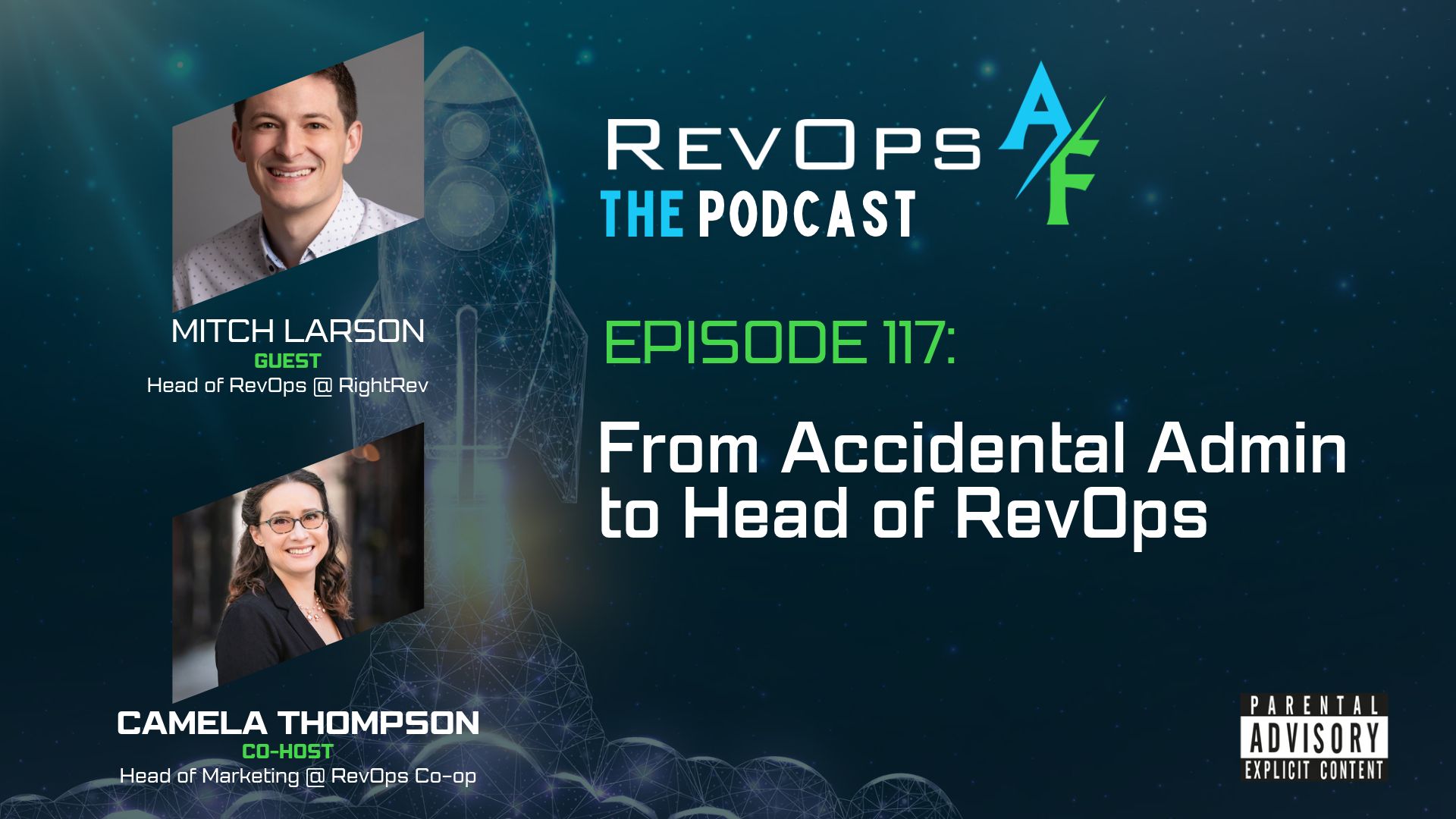
Episode 117: From Consulting to In-House, a RevOps Career Pivot
Mitch Larson made the jump from boutique GTM consulting to in-house RevOps. Here's what the transition actually looks like — imposter syndrome and all.


The RevOps job market is tougher than it's been in years, and a specific pattern is emerging: consultants who built their careers moving from client to client are quietly reconsidering whether the in-house path makes more sense right now. The frustration points in consulting are consistent across agencies and one-man shops — context-switching fatigue, the hustle of maintaining a client pipeline, the nagging sense that you built something good and never got to watch it grow. What's less discussed is what actually changes when you move back in house, and what the transition reveals about how you think about your own career.
Camela Thompson sits down with Mitch Larson, Head of Revenue Operations at RightRev, to work through those questions from both sides. Mitch's path is instructive: he started in a startup marketing operations seat that was handed to him almost by accident, spent several years at a boutique go-to-market consulting firm called Cortado Group doing full-stack RevOps work for private equity-backed portfolio companies, and recently made the transition back in-house. Four months into the role, he's candid about what the move has looked like in practice — including the imposter syndrome, the scope ambiguity, and the value of the professional relationships that made it all navigable.
The conversation covers what consultants underestimate about the in-house environment, how to manage imposter syndrome at any career stage, and why networking — genuine, patient, reciprocal networking — is the asset that actually drives careers in this field.
If you surveyed a room of revenue operations practitioners and asked how many deliberately chose the career path, the honest answer would be a small minority. Mitch's origin story is representative of how most people actually arrive in RevOps — through a fortuitous accident, a moment of organizational chaos, and a willingness to say yes to something they weren't fully qualified for.
The setup: Mitch was finishing his internship at Canopy Tax, a software startup, with a full-time content marketing analyst offer in hand, when the company executed a deep layoff — cutting roughly 80 percent of its sales team. The offer evaporated. When he came in the following week to wrap up, the CRO pulled him aside with a different proposition.
"Our marketing operations person is gonna be leaving in 30 days. How would you feel about taking over HubSpot?" — Mitch Larson
He took it. And then, within six months, as attrition continued to ripple through the organization, the same CRO came back with a follow-up ask: would Mitch run Salesforce too, until they could rebuild the team? He was barely a year out of college, holding together two critical platforms with a contractor assisting on the side.
This kind of origin story — chaotic, unplanned, far outpacing formal qualification — is not unusual in RevOps. What matters is what you do with it. Mitch's framing for early-career practitioners is worth holding: be curious, do your best work in whatever you're currently doing, and stay alert for operational problems where you can have impact. Opportunity in this field rarely announces itself with a formal job posting. It tends to show up sideways.
That observation connects directly to something the RevOps Co-op community discusses regularly — the distinction between falling into RevOps and building deliberately within it. The first part is often out of your control. The second part is entirely up to you.
One of the more practically useful distinctions in the conversation comes from Mitch's time at Cortado Group, where a partner introduced a framework that cuts through a lot of career confusion: the difference between a builder and a runner.
The builder finds fulfillment in creating — designing the sales process, implementing the system, architecting the data infrastructure, layering in the AI components. The runner finds fulfillment in optimizing what already exists — refining, iterating, pushing the system toward higher performance over time. Neither is superior, and the terms don't map cleanly onto seniority or strategic versus tactical roles. A highly strategic operator can be a builder; a deeply technical one can be a runner. What matters is where you draw your energy from.
The reason this framework matters for the consulting-to-in-house transition specifically is that consulting, almost by design, tends to select for builders. The model Mitch describes — SWAT team dropped in, rapid changes made, handoff executed, move on to the next engagement — provides a steady diet of building with almost no running. The frustration that often builds over time isn't about the work itself; it's about never seeing the arc complete.
"There's a lot of things where I was feeling, man, I would just love to… We built something really cool here. I would love to see that continue to grow and continue to flourish." — Mitch Larson
Camela names the same pull from her own vantage point: her energy peaks when she's building out a data infrastructure or designing AI layers on top of it, and drops when the work becomes maintenance-heavy. The question for anyone considering the transition isn't just "do I want to go in-house?" — it's "do I want to become a runner for a while, or am I moving toward a place where I can build and then own what I built?"
That's a meaningfully different question, and it has real implications for which companies and roles are worth pursuing. A startup at build stage looks very different from a scale-up that needs someone to optimize an existing RevOps function. Knowing which one you're walking into — and which one you're suited for — matters a great deal.
For practitioners thinking through where they fall on this spectrum, the RevOps career tracks piece offers a useful complement to this framework.
A thread that runs through the whole conversation is the tension between appearing competent and actually building competence — a tension that's particularly acute in RevOps, where practitioners often find themselves as team-of-one operators who are expected to know everything about systems they may have only recently touched.
Camela's approach to this, developed across years of working with Salesforce, Zoho, HubSpot, Marketo, Eloqua, Zendesk, and others, is worth taking seriously: she knows the underlying logic of these platforms well enough to operate, but she also knows what she doesn't know — and she advocates explicitly for bringing in fractional consultants with deep platform expertise when the stakes are high enough to warrant it.
The business case she makes to organizations is straightforward: a messy CRM is expensive to migrate. The technical debt that accumulates when someone who doesn't quite know what they're doing configures a critical system compounds quickly. A small upfront investment in expert guidance — not to do the work for you, but to validate your approach and catch the things you'd miss — is almost always cheaper than the cleanup.
Mitch connects this to a broader principle about the cost of trying to look like you know everything:
"It's really hard, at least it's been hard for me to get out of that mindset of I don't have to be the expert in everything, right? It's okay to say, 'I don't know.' It's okay to say, 'Okay I need some time to go look and understand and digest the situation.'" — Mitch Larson
The trap he's describing is familiar to high-achieving operators: the need to project total competence pushes you toward making decisions in the moment that you should have taken more time on, and toward avoiding the admission of uncertainty that would actually lead you to a better answer. In RevOps particularly, where the downstream cost of a misconfigured system or a flawed data architecture can be significant, this is a trap worth naming explicitly.
The practical antidote Camela describes — identifying a fractional specialist, framing the ask to leadership as risk mitigation rather than a gap in your skills, and treating outside expertise as a check on your own thinking rather than a replacement for it — is an approach that scales across both in-house and consulting contexts.
The conversation gets candid on imposter syndrome in ways that are genuinely useful — not because the advice is novel, but because both speakers are willing to describe it in present tense rather than past.
Mitch is four months into his first in-house role after consulting, and the experience of imposter syndrome has been, in his words, a rollercoaster. Camela — who has been in RevOps long enough to be called out as being on the cutting edge of AI and analytics — acknowledges feeling the same way, daily.
This pairing is worth sitting with. The conventional framing of imposter syndrome positions it as an early-career affliction that fades as you accumulate experience and credentials. The reality that both speakers describe is different: the form it takes changes, but it doesn't go away. What shifts is your relationship to it, and the systems you build to manage it.
Mitch's first line of defense is relational. He keeps in touch with former colleagues and mentors — including someone from his Cortado Group days — specifically so he has people he can go to when the doubt gets loud. The value of that isn't just emotional support; it's calibration. Someone who knows your work and knows you can tell you, with some credibility, that the gap between how you're perceived and how you're perceiving yourself is wider than you think.
The scope ambiguity of in-house work, he notes, compounds the problem in ways that consulting doesn't prepare you for. In consulting, there's a signed scope document. There's a defined project. There's a timeline. In-house, the scope is whatever you and your leadership negotiate, and the gap between what's on your list and what's actually getting done can feel enormous — especially when you're cross-functional and subject to the priorities of multiple stakeholders.
His practical response has been to treat prioritization as a form of imposter syndrome management: if you can clearly articulate what your highest-impact work is right now, and you're making visible progress against it, you have something concrete to point to when the doubt starts to spiral. This connects directly to the RevOps roadmap challenge — the ticket-taker dynamic that undermines the strategic positioning of most RevOps teams.
Camela adds a dimension that matters for people coming from consulting specifically: when you move in-house, your scope of accountability shifts. In consulting, you're often the one answering every question — clients expect you to have a perspective on pipeline generation, on sales process, on marketing strategy. In-house, there are other people who own those things. Learning where you actually fit — and resisting the consulting instinct to treat everything as within your purview — is a real adjustment.
"Coming to RightRev, it's hey, there's other— I'm not the one that has to be in charge of all of these things, and I'm not the one that has to be accountable for all of these things. What is my role?" — Mitch Larson
This is a question that benefits from explicit conversation with leadership rather than inference. RevOps can look substantially different depending on company stage, go-to-market motion, and what the function was doing before you arrived. Assuming you know what the job is — based on your experience elsewhere or your consulting engagements — is a faster path to feeling like an imposter than taking the time to define it clearly.
If there's a single through-line across the conversation, it's that professional relationships — built genuinely, maintained consistently, and treated as long-term investments rather than transactional exchanges — are the actual infrastructure of a RevOps career.
Camela is direct about the evidence from her own career: she can count on one hand the number of times a job opportunity came through social media posting or a cold application. Almost everything else came through someone she'd worked with, someone she'd met through the RevOps Co-op community, or someone who'd gotten to know her through a podcast or conference.
Mitch frames networking as a garden: you plant seeds, tend them occasionally, tolerate a lot of weeds, and wait for the flowers that eventually bloom. The return on that investment is rarely immediate and rarely predictable. The person you helped understand RevOps at a cocktail party might refer you to a role you couldn't have known you wanted. The colleague you kept in touch with after a consulting engagement might talk you off a cliff when you're four months into a new job and questioning everything.
What makes the RevOps community specifically valuable, in Mitch's view, is shared context. RevOps practitioners have historically operated in an ambiguous space where most people around them don't fully understand what they do. That shared experience of being in a box that nobody quite gets creates real solidarity — and a genuine willingness to help.
"I don't know any RevOps person that's a good RevOps person that isn't willing to help, 'cause I think there's just this community of revenue operations people that we've always been in this box of no one really understands who we are and what we do." — Mitch Larson
There's also a point here about the AI moment that's worth naming. As AI becomes more pervasive — and as it gets better at replicating the surface texture of human communication — genuine human connection becomes more differentiated, not less. The relationship that actually opens the door to an opportunity isn't a LinkedIn message that could have been written by a language model. It's the person who met you in-person at a RevOpsAF event, or talked through a gnarly HubSpot configuration problem with you over a Zoom call, and remembered you six months later when something came up.
Camela's practical advice: start the conversation by asking what the other person is excited about right now. With RevOps practitioners, that question tends to unlock an hour of genuine technical exchange — the kind of conversation that actually builds a relationship, not just a connection.
The importance of relationships in RevOps career development is a topic that comes up repeatedly across the community, and for good reason: it's the variable that most practitioners underinvest in relative to its actual return.
Camela closes the conversation with a point that emerged directly from her recent experience interviewing RevOps candidates — and it's one that connects to imposter syndrome in a practical way.
Candidates, particularly those coming from non-traditional paths, frequently undersell what they've done. They hedge on whether something they did "really counts" as RevOps. They decline to claim credit for work that wasn't formally titled revenue operations even when that's exactly what it was. When asked about a capability they haven't directly exercised in a specific form, they stop at "I haven't done that" rather than drawing a parallel from something they have done.
The reframe she offers is useful: when interviewers who understand RevOps are evaluating candidates, they're often less interested in a perfect functional overlay than they are in the thought process — how you approach a problem, who you think to involve, how you manage change, how you document and communicate. Those patterns transfer across contexts. The person who figured out how to build an account health score in customer success has more to offer on the question of marketing analytics than they might think — if they can make the connection explicit.
Don't undervalue the experience you have. And don't confuse the absence of the exact job title with the absence of the actual work. Many of the best RevOps practitioners in the community followed the same path Mitch describes: RevOps found them, they said yes, and they built something real — whatever the official title on the org chart.
Check out our blog, join our community and subscribe to our YouTube Channel for more insights.