Podcast

October 9, 2026
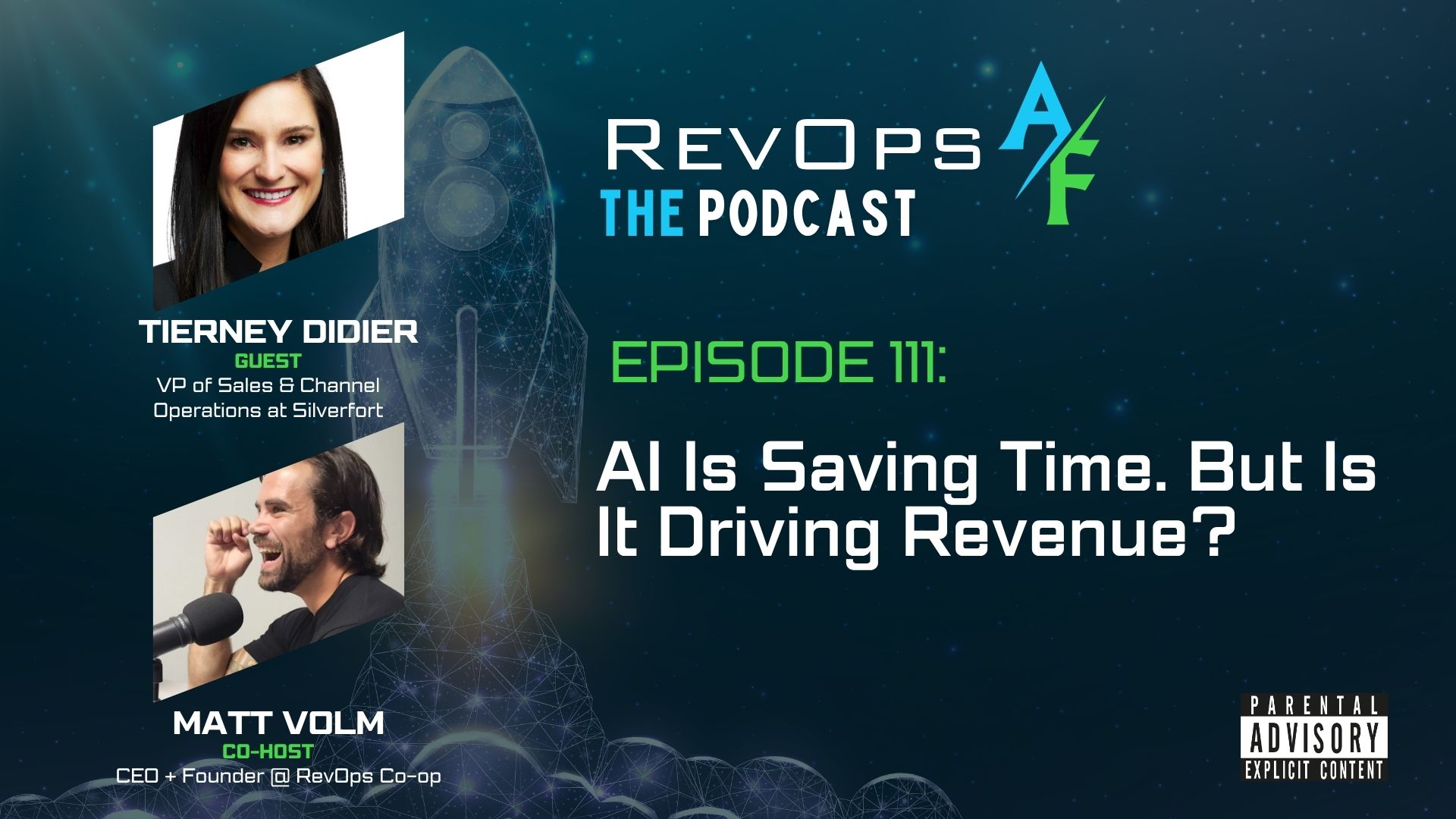
Episode 111: AI Is Saving Time. But Is It Driving Revenue?
AI is saving time in RevOps — but is it driving revenue? Tierney Didier of Silverfort breaks down what's actually working and what's still TBD.


Most RevOps professionals spend their careers solving problems. The great ones spend their careers solving the right problems — the ones the executive team is already losing sleep over. That distinction, simple as it sounds, is what separates operators who get stuck from operators who build careers worth talking about.
In this episode of RevOpsAF, Gabriel Rustice, VP of Revenue Operations at Seedtag, joins co-host Matthew Volm for a conversation that cuts through the noise around RevOps career growth. Gabriel brings over 12 years in sales and revenue operations across companies ranging from early-stage Canadian SaaS to a health tech company where he led a RevOps team of 80-plus people across multiple countries. His path — from customer care rep at FedEx Express Brazil to VP-level operator — isn't a straight line, and the detours are where the most useful lessons live.
Every company has a set of priorities the leadership team is actively working against. Gabriel calls it the music that's playing. Not every team is paying attention to it — but the ones who are tend to be the ones who advance.
The metaphor isn't abstract. Early in his career at FedEx Express, Gabriel was a customer care rep who kept applying for internal promotions and kept getting rejected. Three rejections in a single month. The instinct, after something like that, is to double down on proving how good you are. Gabriel did the opposite.
"I learned to actually flip my mindset to actually do the opposite, to actually pay attention to what the company needs, what's important here, and then go out and do my very best to support that mission."
— Gabriel Rustice
The customer care department at FedEx Brazil was focused on SLA optimization and rep efficiency. Gabriel wasn't asked to focus there. It wasn't in his job description. But he recognized it was what mattered, and he put his energy there. That work created the opening that eventually got him into sales operations.
The lesson scales up. For RevOps practitioners at any level, the temptation is to prioritize problems that feel important — the ones closest to your immediate scope, the ones you're most equipped to solve, the ones your team has been complaining about. But importance isn't the same as alignment. A problem can be genuinely worth solving and still not be on the exec team's radar, which means pouring time into it may produce nothing but a finished project that goes nowhere.
Gabriel's practical version of this: if the problem you want to solve isn't already a leadership priority, go make the case before you start building. Get buy-in from your CRO, your VP, whoever is the right path. The alternative — deciding something is important and working on it without executive alignment — is one of the most common ways ambitious RevOps projects quietly die.
This connects to a broader pattern that Episode 67: Why RevOps Roadmaps Fail - Breaking the Ticket Taker Mindset explored: operators who define their work by the queue in front of them rather than the priorities behind them tend to stay reactive. The music-listening framework is the antidote to that.
Identifying the right problem is half the equation. The other half is communicating it in a language that makes executives act.
Gabriel has a story about this — a good example and a bad one. The good example: earlier in his career, billing was broken because Salesforce and NetSuite weren't talking to each other. Data was missing, invoices were wrong, customers were affected. Everyone knew. Nobody had fixed it because nobody had quantified it.
Gabriel built the case: how many customers were impacted, how much revenue was at risk, how long the problem had been going on, and what it would cost to fix. He then went to his COO with a 20-slide deck he was genuinely proud of. The COO stopped him at slide four.
"He told me, 'Okay, pick up the plane and what do you need? Do you wanna go to Calgary and fix it? Go. Do you need money? Do you need budget? Go and fix it.'"
— Gabriel Rustice
The lesson wasn't that the deck was a waste of time — it was that the first three slides had already done the job. Problem, impact, cost to fix. Executives aren't waiting for the full story. They're waiting to know if it's worth their attention and what they need to approve.
The bad example is the one RevOps teams fall into more often: framing impact around the work itself. "If I don't update this Salesforce report, things will break." That framing puts the RevOps function at the center, not the business outcome. It sounds like a threat about operational stability rather than an argument for investment. Executives don't speak that language because they don't have to.
The discipline Matthew added to this is worth holding onto: every RevOps story needs to resolve into one of two things — top-line revenue growth or bottom-line net income improvement. If a proposal can't be translated into one of those, it's not ready for the executive audience. Beyond KPIs: The Art of Storytelling With Data goes deeper on this translation work, and it's genuinely foundational for any operator who wants a seat at the table.
Gabriel has observed the same hiring tension throughout his career: operators who understand business strategy but can't navigate data and systems, versus operators who can build anything in Salesforce but can't translate their work into business impact. Neither profile is complete.
The ones who advance are the ones who have both — not necessarily at expert level in each, but enough of each to operate across both dimensions without needing a translator. That combination, Gabriel argues, is rare enough to be genuinely differentiating.
The AI wave is replicating this dynamic in real time. On one side: non-RevOps people who are building impressive things with AI tools but lack the foundational practices that make those things durable. On the other: RevOps teams watching from the sidelines, anchored to their existing function, not building the AI fluency that's quickly becoming table stakes.
"RevOps teams should be at the very forefront of the revolution, the very first ones in every company to lead the AI transformation. In some companies they are, but not in every company."
— Gabriel Rustice
Matthew's own experience with this is instructive. He described going from zero familiarity with Claude Code to pushing production code into a live application — within six months, starting from a single Saturday morning of deciding to just figure it out. The barrier to entry was lower than expected. The discomfort was real. The payoff was significant. The point isn't that every RevOps practitioner needs to become an engineer. It's that the discomfort of not knowing something isn't an excuse anymore. Episode 83: Why You Should Stop "Doing AI" and Start Solving Problems makes a similar argument — the teams that are winning with AI aren't doing AI for its own sake. They're solving specific problems with it.
There's a version of the AI conversation that implies the rules have changed — that speed and tooling matter more than process, that you can build your way out of foundational problems, that the fundamentals are somehow less important now that large language models can generate workflows and code on demand. Gabriel doesn't buy it.
The problems businesses face haven't changed. The technology for addressing them has. And the operators who lose track of that distinction end up with beautifully built solutions to the wrong problems.
The fundamentals Gabriel names aren't surprising, but they're worth stating explicitly because they're the ones most often skipped in the rush to build:
Go-to-market strategy comes before tooling. Customer segmentation and ideal customer profile (ICP) definition need to be real before you automate anything that depends on them. Data architecture matters — AI can work with messy data, but the outputs will reflect that mess. Sales process documentation isn't bureaucracy; it's the prerequisite for being able to diagnose what's breaking when something goes wrong.
"Once you have that, then you can debate, shall we think about a headless CRM and then automate stages entirely? Amazing. But you have a pre-documented sales process that then allows you to diagnose if anything's not going right."
— Gabriel Rustice
The pattern Matthew identified — people building stage-movement automation before anyone has agreed on what the stages mean or what moves a deal from one to the next — is a near-perfect illustration of this. The automation is impressive. The foundation is missing. When something breaks, no one can figure out why, because the definitions were never settled in the first place. Episode 50: Thinking of AI? Think Data First. and Episode 45: Systems + Data = Optimal Operations both trace this same argument in detail.
Reading the P&L is the other foundational skill Gabriel returns to. If the music playing at any company is its strategic priorities, the financial statements are the sheet music. Understanding how the company actually makes money — unit economics, margin structure, the mechanics of how deals translate into recognized revenue — makes every RevOps decision better calibrated. It's also what allows an operator to speak the language of the executive team without needing to approximate.
The career conversation closes on a question Gabriel poses deliberately: do you actually want to lead?
Not "do you want the title" or "do you want more authority." Those answers are easy. The harder question is whether you want what leadership actually requires — serving the team, absorbing the unglamorous problems, being the last to take credit, fighting battles that don't always have obvious wins.
"A lot of people will say yes to 'Yeah, I wanna lead, I wanna have more authority, I wanna have more power to change things.' But not a lot of people want to serve and to actually be the last one to be recognized and to be the ones who actually fight the battles that are tough to fight."
— Gabriel Rustice
Gabriel's point isn't that leadership is the right answer for everyone. It's that people should ask themselves honestly before they commit years of effort to a path. Wanting a VP title and wanting to lead are different things. The first is a status goal. The second is a purpose goal. One of them tends to produce fulfillment. The other tends to produce frustration.
Matthew's addition to this: give yourself permission to change your mind. If you move into management and discover you'd rather be building, that's useful information, not a failure. The career trajectory in RevOps doesn't have to be linear, and the individual contributors who are exceptional at their craft create enormous value — value that doesn't require a management layer to be significant. Episode 61: From CRM Admin to the C-Suite traces what the upward path can look like for operators who do want to move toward leadership, and is worth reading alongside this conversation.
The throughline from everything Gabriel covers is consistent: the operators who build careers that matter are the ones who understand the business, align their work to what actually matters to leadership, communicate in financial terms, stay fluent in both strategy and systems, and ask themselves honestly what kind of impact they're trying to have. None of that is secret. Most of it is, as Gabriel put it, hiding in plain sight.
Check out our blog, join our community and subscribe to our YouTube Channel for more insights.