Podcast

October 15, 2026
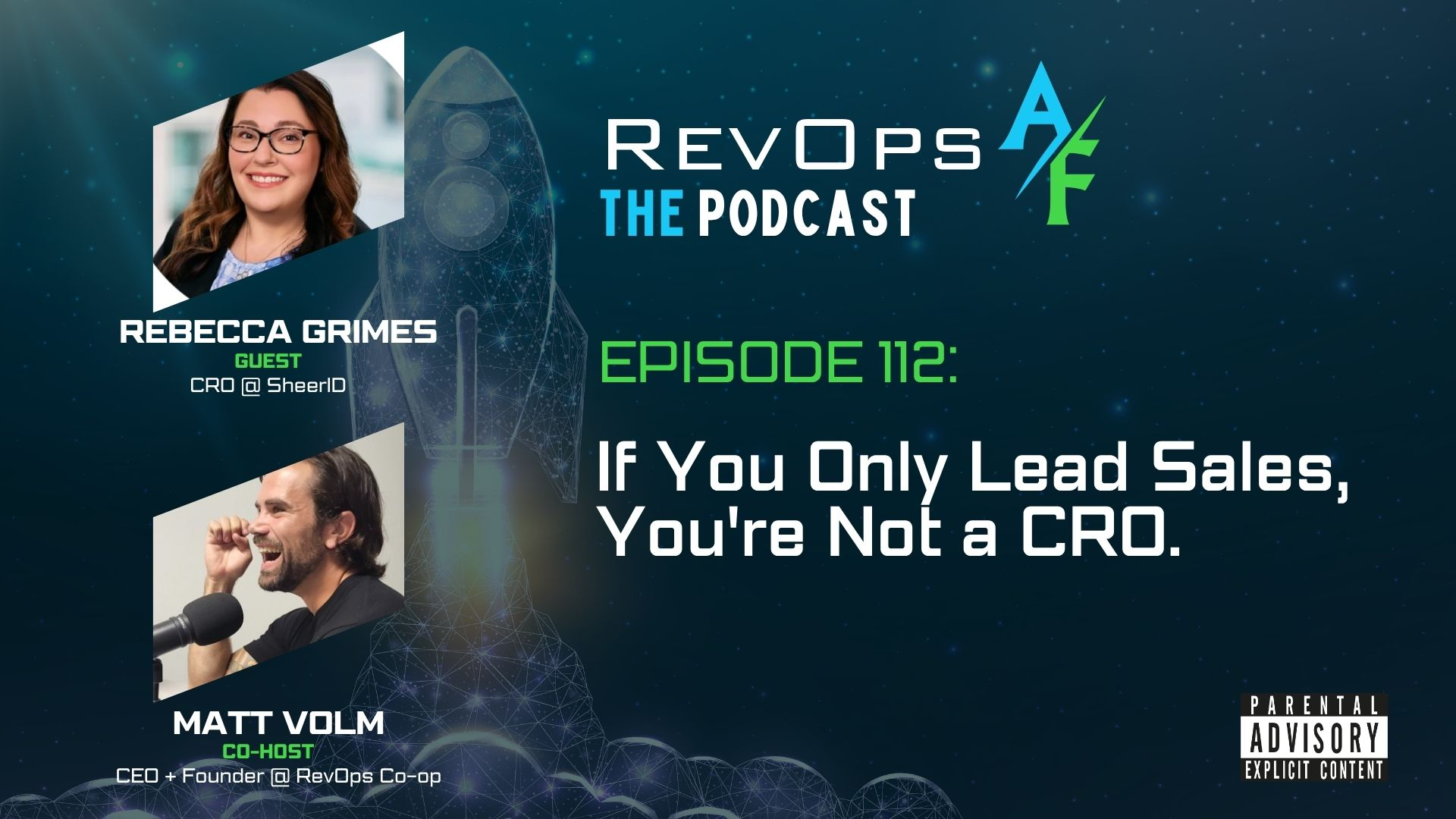
Episode 112: You're Not a CRO If You Only Lead Sales
SheerID CRO Rebecca Grimes makes the case that a CRO who only leads sales is really a CSO and explains what full-cycle revenue ownership looks like.


Most revenue teams can tell you what is happening in their pipeline. The 80/20 split, the deals stalling in the middle stages, the reps who carry the number while everyone else waits. What they can't tell you is why — and without the why, every intervention is a guess.
In this episode of RevOpsAF, Roope Heinilä, co-founder and CEO of Optivian, joins co-host Camela Thompson to dig into one of the most persistent and underexamined problems in B2B sales: the mid-funnel execution gap. Roope brings two decades of founder experience — scaling his first company from zero to north of $10 million ARR with enterprise customers including Google, Amazon, PwC, and EY, then taking over as CEO of a combined entity and growing it past $40 million ARR — and a clear-eyed view of what actually breaks when top performers carry everyone else. His diagnosis is specific, his proposed remedy is unconventional, and his take on where RevOps fits in the AI era is worth sitting with.
The top-line observation, that 20% of reps drive 80% of results, is familiar to anyone who has spent time near a sales org. What Roope found across both of his companies and across the broader portfolio of their shared investors is that this pattern isn't random. It has a structural cause, and it lives in the middle of the funnel.
"Of course, there's top-of-funnel problem, but you solve that differently. But then it doesn't really matter how much you're bringing in top-of-funnel if the mid-funnel isn't moving that pipeline forward."
— Roope Heinilä
The response to this problem followed a familiar playbook: invest in training, hire enablement resources, buy more tools. Roope's companies had Gong, Clari, Salesforce, HubSpot, deal rooms. The needle didn't move. The dashboards kept showing the same picture. And the reason those interventions fell short wasn't that they were wrong in concept — it's that they couldn't answer the underlying question. They could show the 80/20 split. They couldn't explain it.
This connects to a challenge the RevOps community has been grappling with for years: the difference between data that describes outcomes and insight that explains them. Fixing funnel leaks requires understanding where and why they occur, not just measuring their effect on conversion rates.
Roope and his COO spent hours each day manually reviewing customer emails and call recordings, trying to identify the patterns that separated top performers from average ones. It produced some insight. It was not scalable.
"If we're running, let's say, 200 deals in a quarter, we're not gonna have each one of these gonna have, let's make it simple, ten customer interactions at the bare minimum. We're not gonna review two thousand individual customer interactions. So what you end up doing is you take a small sample and you extrapolate and make the assumption that this is happening everywhere."
— Roope Heinilä
The same problem, he points out, exists with AI when it's used naively. Ask an LLM to analyze a large and undifferentiated set of deals, and it will do what a human does when overwhelmed: sample and extrapolate. The solution is to structure the analysis at the deal level first. Build a point of view on each individual deal, then aggregate across deals to identify repeating patterns. Only at that point can you separate signal from noise reliably.
The implication here matters. RevOps teams that are beginning to use AI for pipeline analysis need to think carefully about what they're feeding the model, how they're structuring the analysis, and whether the output actually reflects all the deals or just the ones the model happened to surface. As Roope puts it, if you press the AI on its methodology, "it will usually say, 'Oops, you're right. I only took a few deals.'"
When Roope's team was able to analyze deals at scale, the patterns they found were, in his words, "the classics." The failure modes weren't exotic, they were the same breakdowns that show up in pipeline hygiene reviews and forecasting post-mortems across the industry. What changed was the ability to see them systematically rather than anecdotally.
Multithreading gaps. Deals that lack engagement across multiple stakeholders are fragile, and reps managing 20-plus live opportunities at once will naturally focus their attention on deals closest to closing. That's rational behavior, but it means deals in earlier stages quietly fall through the cracks without anyone noticing until it's too late.
Champion enablement failures. This is the observation Roope returns to most pointedly. The buying process, in his account, is largely invisible to the sales rep: roughly 80% of the internal selling happens without them in the room. The champion is doing that selling, but the champion has usually spent only an hour or two with the rep. Nobody would consider that adequate onboarding for an employee.
"You spend an hour in a meeting with them, and you expect that they're gonna be able to sell your solution to the actual decision maker."
— Roope Heinilä
The gap this creates is real and largely unaddressed. A great rep would map discovery findings to value propositions, find supporting case studies, quantify the business case, and build enablement materials tailored to that specific champion's internal audience. The problem is that doing this well takes hours, and there aren't enough hours in the day to do it for every deal. So it gets done for some deals (usually the ones the rep is most excited about) and not for others.
Insufficient competitive response. When a competitor surfaces in a deal, the rep needs to know what's worked against that competitor previously. If a battle card exists, great. If not, the rep is on their own. AI can cross-reference all previously closed deals involving the same competitor and surface what actually worked, a function that supports the kind of business case building that historically only top performers reliably executed.
Here's where Roope's account takes a turn that's worth pausing on. Once Optivian had built an analysis engine that could surface winning patterns and compare them to live deals in real time, the team assumed reps would welcome it. The reception was something different.
"The rep saying, 'Love the idea. I would love to understand what I can do better. I have 10 different tools I'm using today. I do not need an 11th. I'm simply not gonna use it. And secondly, I do not need another person coming and telling me how to do my job.'"
— Roope Heinilä
Two distinct objections: tool overload, and the inherent resistance to being coached by software. Both are real, and both are worth taking seriously by anyone who has dealt with adoption challenges in RevOps.
The reframe that followed was conceptual before it was technical. The question isn't "how do we get reps to use another tool?" The question is "what would it look like if AI just did the work?"
"AI should not be thought of as one more tool. Instead, it should be thought of as an employee, as a coworker. Because the difference between a tool and a worker is that the worker provides the end result. They do the work."
— Roope Heinilä
Roope's analogy: you can buy a hammer and build a patio yourself, or you can hire a builder and get a patio. AI is closer to the builder than the hammer. When applied to mid-funnel execution, this means the AI doesn't tell the rep what to do, it identifies that the economic buyer hasn't been engaged, determines the optimal path to reach them, drafts the email, and delivers it to the rep. The rep's job is to hit send. They still own the relationship. They've just gained a coworker who did all the preparation.
Delivery matters too. If reps don't want an 11th tool, you don't build an 11th tool. You deliver the AI's output through channels reps already live in, primarily Slack and Teams. The "digital coworker" model that results monitors the full pipeline, learns from historical deal patterns, and surfaces interventions proactively, at the moment they're needed, where the rep is already working.
The analogy Roope uses is a golf caddy. The caddy doesn't play the game, the player does. But the caddy carries the bag, recommends the club, reads the green, and handles all the support work that would otherwise slow the player down.
This is a question Roope has tested empirically, and his answer is unambiguous: RevOps.
He's tried sales reps as the primary owners. They're not self-critical enough to use analysis of their own deal execution productively. Sales leaders are strong at coaching individual deals but aren't accustomed to working with data at the level of granularity this kind of analysis produces. RevOps, in Roope's experience, is the natural fit.
"By far the most successful is when RevOps owns it. They are used to having to, for one, influence salespeople, influence sales leaders in order to actually drive the outcome, and they're extremely good at understanding and connecting the dots in the data. Now they have one additional. They're able to go one level deeper and understand the why."
— Roope Heinilä
The implication extends beyond tool ownership. If RevOps is the function that hires and manages AI coworkers, then RevOps needs to think like a hiring manager. What does the AI need to know to do its job well? What constitutes good output? How do you evaluate whether the system is driving the outcomes you want?
This is a meaningful expansion of the RevOps remit, and one that connects directly to the broader conversation the community has been having about what RevOps should look like as organizations mature and what it means for RevOps to move from execution support to strategic ownership.
Getting AI to produce useful output requires understanding what's actually limiting it. Roope's framing is deliberately demystifying.
"AI and AI service providers like ourselves are basically two things. We're selling tokens or reselling tokens and managing context. That's it. All these unicorn companies valued at ten billion, et cetera, they're reselling tokens and managing context. That's it."
— Roope Heinilä
The models, in his assessment, are no longer the bottleneck. They all have, as he puts it, "a PhD in everything." The bottleneck is context: giving the model the right information to perform the task at hand, without overwhelming it with irrelevant data. The same cognitive limit that affects humans affects models. Throw 20 call transcripts and 50 emails at a model without synthesis, and it will do what a human does: skim, sample, and extrapolate.
The practical guidance that follows from this is specific and actionable.
Be precise in what you ask. Don't ask "why am I winning in Canada?" Ask: "I want to understand why we're winning deals in Canada in the last three months. Compare won and lost deals, focusing on deals above $50K ARR. Look for repeating patterns in won deals and compare them to lost deals, on both a per-rep and per-team level."
Start with an action verb. "Analyze," "investigate," "compare". These signal to the model what kind of output you need and consistently produce better results than open-ended prompts. This is the kind of structured analytical thinking that RevOps practitioners already apply to dashboards and reporting; it translates directly to prompt design.
Structure the analysis at the deal level before aggregating. Don't ask for patterns across the full pipeline in a single pass. Build deal-level summaries first, then aggregate to find common patterns. This is how you avoid the sample-bias problem that undermines both human and AI analysis.
An example Roope gives: ask the model to look at every call where a customer mentioned needing budget sign-off, identify who they typically named as the approver, group similar titles, and return the top five most common economic buyer profiles. That kind of analysis, he notes, "would have been very difficult to draw pre-AI."
One practical application that emerges from this kind of analysis is identifying gaps in sales enablement materials. If the AI can surface that deals consistently stall when the economic buyer isn't engaged and the champion isn't equipped with a business case, that's a signal about what content needs to be built.
Roope's recommended sequence: start with a win-loss analysis to understand where the actual bottlenecks are, rather than guessing. Then ask what the top reps or teams are doing differently from average performers. The gap between desired behavior and average behavior is the target for enablement.
"With AI, you can quite often find ways of actually replicating the top rep behavior by providing that behavior, like keys in hand to the mediocre rep and doing the work for them."
— Roope Heinilä
The goal isn't to build more content in the hope that reps will use it. It's to build the specific content that addresses the specific bottlenecks the data has identified, and then, where possible, have AI deliver that content to the rep at the moment it's needed, rather than requiring the rep to go find it.
This approach connects naturally to the broader question of what effective enablement actually looks like when it's grounded in data rather than intuition.
Roope's closing observation is worth taking seriously. The role of RevOps, in his view, is going to expand significantly as organizations become hybrid human-AI teams — and the expansion will be driven precisely by the skills RevOps practitioners already have.
"Organizations are gonna be made up of a mixture of AI agents and humans working hand in hand. I think the revenue operations will effectively become the bosses of these AI agents. But that also means that they need to have the same way that if you were managing humans, you wanna have a somewhat of an understanding of your subordinates, what motivates them."
— Roope Heinilä
The skills that matter most in this world, in his framing, are systems thinking, the ability to evaluate what "good" looks like, and the ability to build repeatable processes that capture that standard. These are the skills RevOps practitioners have been developing for years, they just haven't been applied to AI management yet.
When Camela asks whether she's covered the key areas people should be developing, Roope's addition is concise: "Knowing what good looks like. Like you need somebody who's able to evaluate what good looks like so you know if the output you're getting is the desired output, and then you need a way of replicating that."
The analytical thinking RevOps already brings to data and systems is, in his view, exactly what's needed to manage AI effectively. The practitioners who lean into that and start thinking of themselves as people who design and manage systems (rather than people who execute within them) are the ones who will be most valuable as this shift plays out. For more on building that kind of strategic positioning, Episode 86: Adapt or Die? RevOps in the Age of AI and Episode 83: Why You Should Stop "Doing AI" and Start Solving Problems cover adjacent territory worth revisiting.
Check out our blog, join our community and subscribe to our YouTube Channel for more insights.
Learn more about how Optivian is tackling the mid-funnel execution gap with AI sales coworkers at optivian.ai.