Welcome to our blog series on elevating quote-to-cash with governed execution in partnership with our friends at DealHub AI. Here's a brief outline so you can jump to other articles in the series:
If you've made it through the first three articles in this series, you know the problem inside out. You've seen how approval workflows fail when governance sits outside the transaction path. You've watched revenue become indefensible when the audit trail doesn't exist. You've calculated what ungoverned workflows are costing across time, money, and trust.
Now the question is: what does the fix actually look like?
Not the marketing pitch. Not the feature list. The architecture. Where does the logic live? How does it enforce policy at the point of execution? And why does it deliver ROI faster than process improvements or headcount additions ever could?
Governed execution isn't a feature you buy. It's an architectural decision about where revenue logic lives and how it's enforced. And understanding that distinction is the difference between systems that police deals after the fact and systems that govern deals as they happen.
Here's how most quote-to-cash stacks work today:
The rep builds a quote in the CPQ. The system generates a PDF. The rep downloads it. If the deal needs approval, they trigger a workflow. The approval request routes through email, Slack, or a disconnected approval tool. The CFO clicks a button. The quote is "approved."
But here's the problem: nothing stops the rep from editing the PDF after approval. Nothing prevents payment terms from changing during negotiation. Nothing enforces that what was approved matches what was signed.
Governance exists as a checkpoint, not a control. The approval happened, but it didn't govern the outcome. It just created a record that someone clicked "approve" at some point before the deal closed.
This model operates on hope: hope that reps follow process, hope that approvers see the full context, hope that the signed contract matches the approved version, hope that billing can process what was actually sold.
That hope breaks down in the three failure modes we covered in Article 1: post-approval edits, approval treadmills, and extended negotiations the system never sees. By the time Finance or Legal discovers the mismatch, the deal is closed and the damage is done.
The fix isn't faster approvals or more notifications. It's moving governance into the transaction path itself.
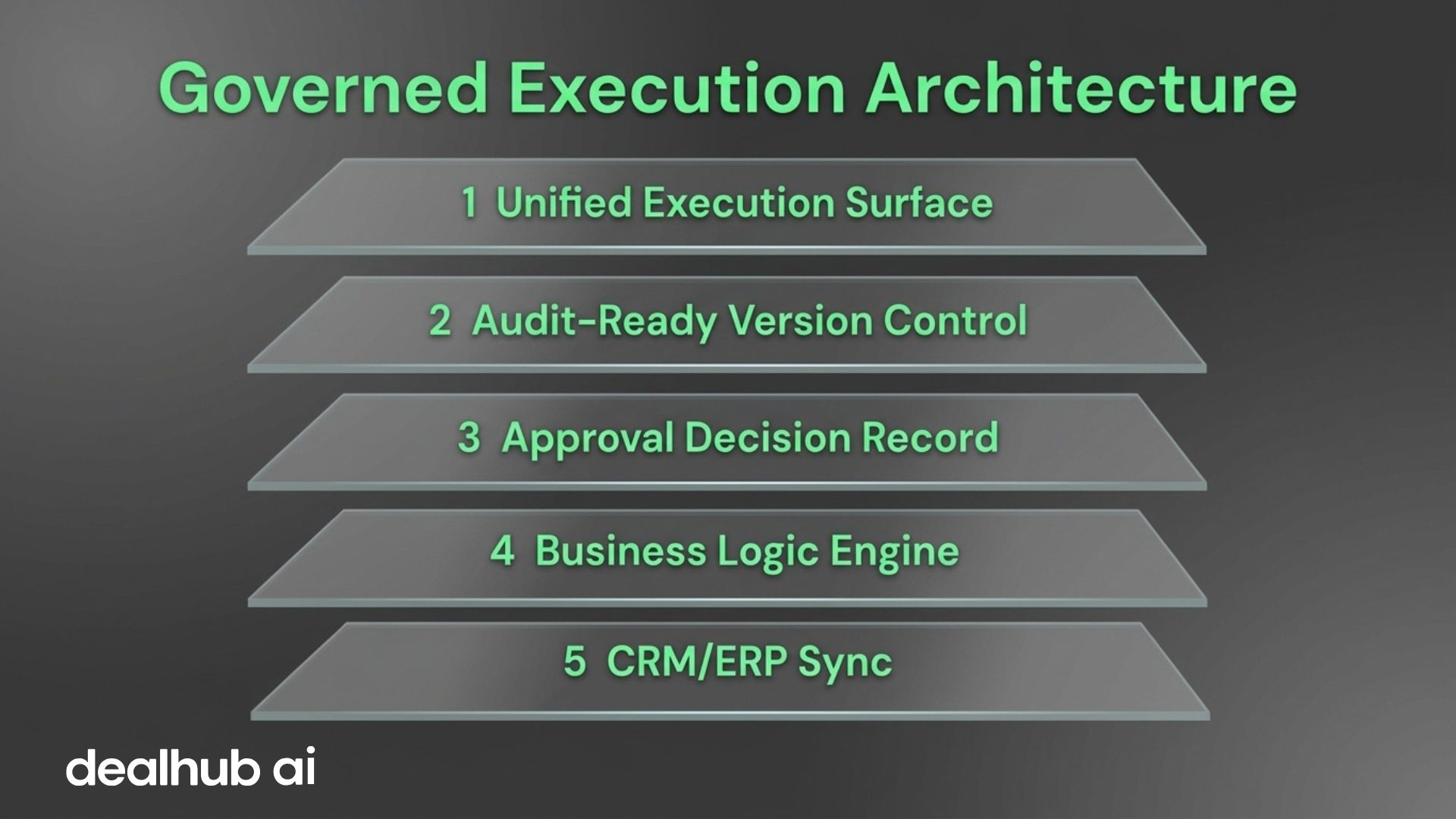
Governed execution architecture is built on five integrated layers, each serving a specific governance function. Together, they create a system where revenue logic lives in the workflow, not bolted on afterward.
This is the customer-facing document: the quote, the proposal, the contract. In a governed system, this isn't a static PDF generated and forgotten. It's a living artifact that enforces a single version of truth and prevents post-approval changes.
Here's what that means in practice:
When Socure implemented these layers, they achieved a 70% reduction in quote-to-order cycle time while maintaining 90%+ quote accuracy without a dedicated Deal Desk. The mechanism wasn't headcount. It was architectural: the system prevented the post-approval edits that used to require Deal Desk cleanup.
This layer maintains forensic deal history and an audit-ready approval chain. Every change is tracked. Every version is timestamped. Every approval is logged with full context about what the approver actually saw.
In traditional systems, version control means "final_v2_FINAL_revised.pdf" living in someone's downloads folder. In governed execution, version control is structural:
This is the layer that solves the reconstruction problem from Article 2. Revenue isn't just reported. It's defensible. The trail exists in the system because the trail is the workflow.
This layer powers dynamic approval workflows, ends rogue approval decisions, and kills Slack and email chasing.
Traditional approval workflows route every advanced request type the same way: rep submits, manager approves, VP approves, CFO approves. A typo fix triggers the same chain as the initial 40% discount that was already approved. The system can't distinguish between material changes and clerical corrections.
Governed execution uses conditional routing based on deal attributes:
This is smart tolerance in action. The system knows what matters and what doesn't. Minor changes don't restart the approval treadmill. Material changes trigger the right approver with the right context.
SIDEBAR: How Architecture Delivers Speed
When Zapier moved to governed execution, approval cycles dropped from multi-day manual routing to ≤8 hours with parallel SLA-tracked flows. The time savings didn't come from approvers working faster. It came from eliminating preparation work.
In the old model, a rep spent hours building a business case to explain the deal before submitting for approval. In the governed model, the system presents structured deal data automatically. The approver sees discount impact, margin change, and competitive context the moment the request hits their queue. No explanation required. No Slack follow-ups. Just data and decision.
“The biggest unlock was finally having reliable data. Before, everything depended on reps entering it correctly, making audits a nightmare. Now, every quote captures the exact data we need, letting us quickly search HubSpot to see how many deals include a component. That clean data foundation powers confident growth.” – Dyan Meahl, Revenue Operations Manager @ Zapier
This is the layer where commercial rules live. Not hard-coded in Apex. Not buried in external automation tools. Encoded declaratively in the system itself.
The business logic engine provides:
This layer is why governed execution scales without adding headcount. The system enforces policy automatically. Deal Desk stops being human middleware that interprets rules and becomes strategic architects who design better rules.
SIDEBAR: Why Governed Execution Built as a Single System Matters
Most quote-to-cash cycles don’t start and stop with CPQ. Context moves from quote, to PDF, to invoicing system, and beyond. In stark contrast, a system that flawlessly ingests, interprets, and synthesizes this information from input to revenue received leaves zero room for interpretation and error.
DealHub can deliver them as a unified system: one data model where the quote record, contract record, and billing record are the same object. Not synchronized copies.
DealHub’s simplified data model resulted in Built In eliminating reliance on external consultants entirely. Pricing changes that used to require weeks of waiting now deploy in 20 minutes because RevOps owns the configuration. The business logic layer (Layer 4) made that possible.
“With the old CPQ, I’d need six months. With DealHub? Two weeks. I’m a yes person now.” – Ali Andrew, VP of Ops @ Built In
The final layer ensures the system of record stays current. Bi-directional sync of standard and custom data, native connectors to CRM, and real-time updates mean what was approved, what was signed, and what Finance sees are the same thing.
In traditional stacks, this is where the handoff breaks. Sales closes a deal in the CPQ. It syncs to Salesforce. Then the data pushes to NetSuite, but each line item is just slightly off. By pennies. But those pennies add up to significant discrepancies over time.
Governed execution eliminates the confusion:
This is the layer that prevents the 15% margin loss we covered in Article 3. When systems agree on pricing, discounts, and terms from the start, there's no drift to correct.
The architectural shift changes what RevOps actually does day-to-day.
Before governed execution:
After governed execution:
The job shifts from policing to governing. From reactive cleanup to proactive architecture. From explaining what broke to building systems that don't break.
Governed execution gains that are structural and not behavioral. This means they’re repeatable. The value isn't in optimizing existing processes. It's in eliminating entire categories of work that shouldn't exist.
The ROI comes from three sources:
Time back to strategy: When reconciliation work drops from 40% of RevOps bandwidth to under 10%, those hours don't disappear. They shift to designing better commission structures, building predictive forecast models, and architecting systems that enable growth. The strategic projects that never had time suddenly become feasible.
Margin protection: When discount creep stops because the system enforces thresholds automatically, margin doesn't erode 6 points below target. The governed execution model prevents the problem rather than detecting it after the quarter closes.
Scale without headcount: When Deal Desk isn't manually reviewing every exception, you don't need to double the team when deal volume doubles. The system scales with the business. People focus on edge cases that actually require judgment.
The difference between governed execution and process improvement is structural. Process improvement says "let's route approvals faster." Governed execution says "let's move approvals into the workflow so routing becomes automatic."
One optimizes the existing system. The other changes where the logic lives.
This is what governed execution looks like when it's built as a single system rather than assembled from parts. DealHub's architecture runs the five layers from one data model: the quote record, the contract record, and the billing record are the same object. Not synchronized copies.
The business logic engine is no-code, which means RevOps owns pricing rules, approval thresholds, and tolerance logic without opening a ticket. And because the platform runs across Salesforce, HubSpot, and Dynamics 365 from the same governed data model, the architecture isn't contingent on which CRM you're locked into.
Here's the distinction that matters:
You can buy CPQ software, approval workflow tools, contract management platforms, and billing systems. Lots of vendors sell those. But buying tools doesn't give you governed execution.
Governed execution is an architectural decision about where commercial logic lives and how it's enforced. It's the difference between systems that record what happened and systems that determine what's allowed to happen.
When governance sits outside the transaction path (in email threads, Slack approvals, external workflow tools), it becomes a checkpoint that reps route around. When governance lives in the transaction path (encoded in the quote itself, enforced at the moment of configuration), it becomes a control that shapes the outcome.
The five-layer architecture we've outlined is specific to DealHub CPQ. The unified execution surface, audit-ready version control, approval decision record, business logic engine, and CRM/ERP sync aren't features. They're the structural components that make enforcement possible, and DealHub CPQ is the sole provider of this architecture.
Companies succeeding with governed execution didn't just buy new software. They changed where revenue logic lives. They moved it out of people's heads, Slack threads, and disconnected systems. They encoded it into the workflow where deals are actually built.
The result isn't just faster approvals or cleaner audits. It's a fundamental shift in what RevOps can deliver. When the system governs automatically, RevOps stops being the department that explains why things broke. They become the function that designs systems where things don't break in the first place.
That's the shift from policing to governing. And it's the difference between revenue you report and revenue you own.
To learn more about DealHub, check out their website, case studies, and request a demo. Oh, and tell them your friends at RevOps Co-op sent you 😉