



This series is brought to you in partnership with Airspeed. They build AI that reads what customers actually say and writes it back into your CRM. We'll get to what that unlocks in article four. For now, thanks to the Airspeed team for backing a series that respects the reps enough to talk about the work before the tooling.
The Forecasting Series:
You built the forecast. Stages, categories, exec alignment, the whole version one. That was article one, and if you did it right, you have a structure nobody can argue with.
The problem is that a structure is not a forecast. A forecast is a habit, and habits are built by repetition under load.
You can have the most beautiful pipeline stages in your industry and still produce a garbage number every quarter, because the number doesn't come from the architecture. It comes from data points that help management figure out whether the salespeople are reading buying signals correctly, chasing the right deals, and doing the work to get them over the finish line.
The trick to generating trust in the forecast is creating the right meeting cadence tailored to each audience.
The forecast call I’m about to describe is a nightmare I’ve sat through way too often.
Sales does the talking. Finance is there. Marketing is there. Customer Success is there. The CEO is lurking in the background, camera off.
Every sales rep takes a turn calling their number and explaining why it's going to land the way they say it will.
Nobody enjoys it. Halfway through, three people are quietly wondering why this feels exactly like the KPI call they sat through on Tuesday, even though that one had different departments and a completely different point to it. And every few weeks, someone floats the question nobody wants to answer out loud: does this meeting need to exist at all?
This call exists because of a failure. It got created because nobody trusted the forecast, and when nobody trusts the forecast, everybody wants to dissect every deal. So many deals had fallen through in the past that the organizational response was to put fifteen people on a call to interrogate each one. The meeting is a monument to a broken number.
You don't fix that with a better agenda for the mega-call. You fix it with better management, stronger communication, and layers of meetings that are each built for one purpose and one audience.
The ninety-minute cross-functional interrogation is what happens when you skip that work. Do everyone a favor and do the tedious work to fix it.
Rhythm-of-the-business reporting is widely adopted for a reason. Done right, it means nobody gets surprised at the end of the quarter, and that's good for everyone who matters.
It's good for your business leaders, because early warning gives them time to actually change the outcome instead of explaining it after the fact.
It's good for your investors, who have dramatically more confidence in a leader who understands their numbers and can act on them than in one who shows up to the board meeting with a story.
The trick is threefold:
That last one is you, RevOps. That's job security wearing a trench coat.
Here's the cadence I'm used to, for the sales org specifically:
Notice that each of these has a different audience and a different job. The Monday sales-and-RevOps call is not the Tuesday cross-functional call is not the month-end exec review. When you collapse them into one giant meeting, you get the ninety-minute roll call from hell.
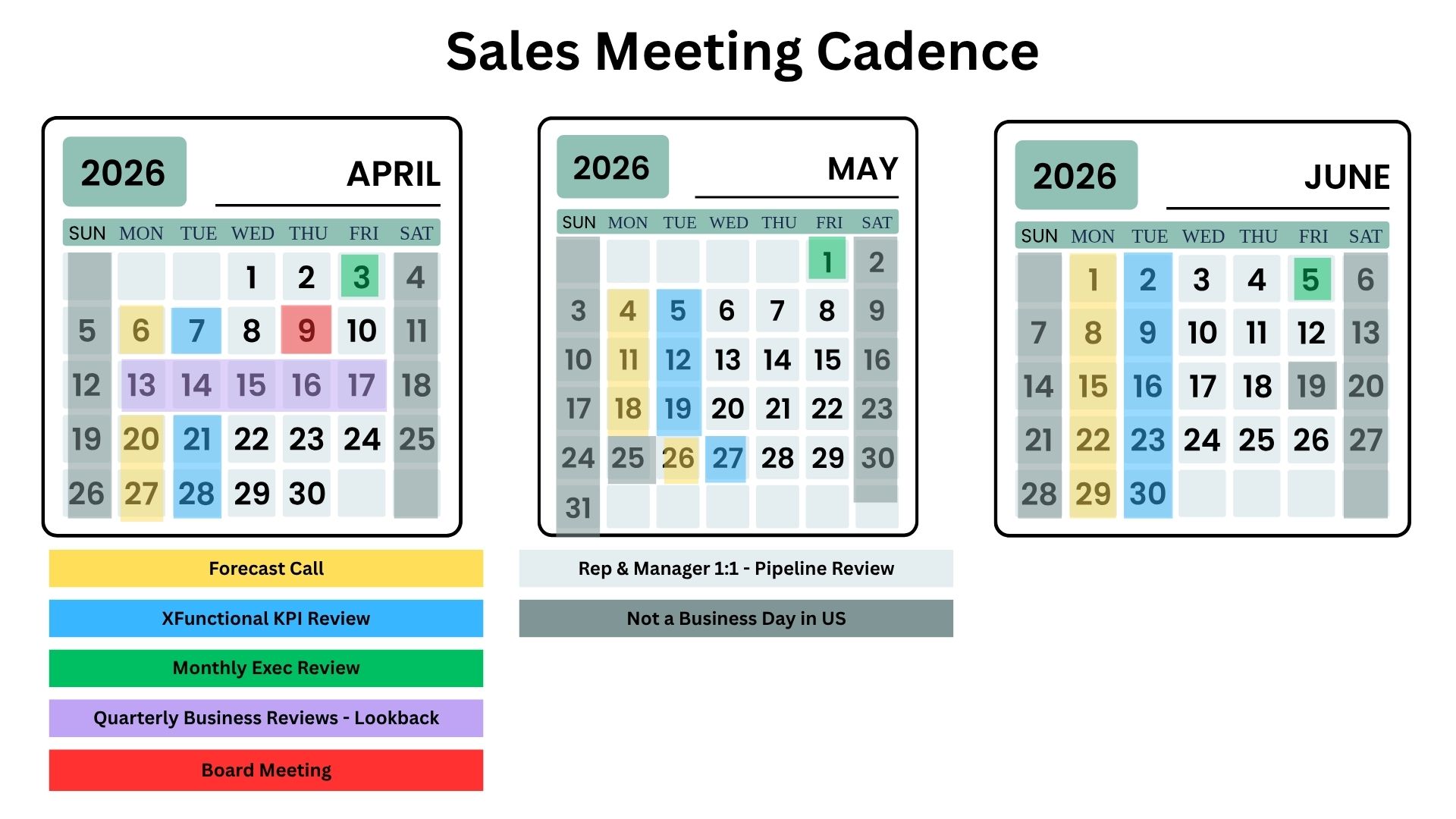
The layers exist so that the right conversation happens in the right room, in front of the right people.
Somewhere in your company's history, a sales methodology got rolled out. MEDDICC, Command of the Message, SPICED, the Sandler thing with the submarine. There was a kickoff. There were laminated cards. And then, at a lot of companies, it quietly became a thing people talk about in interviews and nowhere else.
That's the failure. A methodology that lives in a training deck is decoration. A methodology that lives in your forecast is infrastructure.
The difference is whether the exit criteria map to fields. When "we've confirmed economic buyer" is a checkbox that has to be true before a deal advances, the methodology is now load-bearing. It gates the stage, the stage feeds the category, and the category feeds the number. The framework you chose matters far less than whether its requirements show up as fields a deal has to satisfy to move.
And here's where the work should get lighter every year, not heavier. Ideally, as many of those fields as possible get populated automatically, from call and meeting recording summaries and workflow integrations, rather than from a rep typing them in at 6 p.m. on a Friday.
The methodology still governs what has to be true. It just stops depending entirely on a tired human to log it.
You'll also need to take a hard look at what's required in the system, because every field you demand is a tax on the seller. The principle is simple: capture what you need to report on, and nothing else. If management wants the methodology steps in structured fields, great, that's easy to report on. If they want them in notes, that's harder, but if that's the call, that's how we'll build it.
The failure mode is the opportunity record type with 40 validation rules. Your sales team will find the CRM unusable, and an unusable CRM is exactly how forecasting lands back in a spreadsheet. You've just undone article one.
So the escape hatch is to creatively solve or avoid data entry wherever you can: AI summaries and automation for what a machine can capture, and a firm pushback on the rest. And if your CFO insists data entry is why your seller has a base salary, that’s a lie they need to stop telling themselves.
On a good Monday forecast call (see my preferred meeting structure above), I want to hear an SVP challenge an area director on their number. Not politely accept it. Challenge it.
For that to happen, the SVP has to walk in armed, and this is a place RevOps quietly makes or breaks the meeting. The SVP should know who on that director's team has a history of sandbagging and who runs perpetually optimistic. That's rep-level accuracy history, and it's your job to have it ready. Armed with it, the SVP can ask the questions that reveal whether a deal smells off.
We also expect larger deals to be more complex and require more vetting by leadership to trust that it will come in at the end of the quarter. Expect questions like: have we gone wide enough on this account, or is the whole thing still riding on one champion? I’ve seen this question uncover (true story) that we were waiting on a single contact only for them to unexpectedly go on medical leave. That deal smelled off, and it smelled off for a specific, nameable reason: it was single-threaded through someone who was about to be unreachable for three months.
A good call surfaces that risk in week two. A roll call surfaces it in the quarter-close post-mortem.
There is a report I've relied on at every company that has been a spooky accurate way to flag whether someone's pipeline is legitimate or is masking their hunt for a new job. It compares recent activity against pipeline age and deal count: a rep sitting on a big number with stale activity and thinning pipeline is usually a rep who has already checked out. This was a pre-LLM, pre-Clari, pre-Gong spreadsheet, and it had the SVP of Sales walking into my office every month to figure out who was at risk of leaving the company. (See the "Front Line Sales Management" section here for the template.)
This is the section that starts fights in our community, so let me be direct about where I land.
RevOps builds the rhythm. We put the meetings on the calendar, we streamline the tools, we automate what we can, we recommend and build the reporting infrastructure, and we hold the line on what the definitions mean when someone tries to bend them. That's the job.
Here's what is not the job: chasing reps for updates.
The moment RevOps becomes the team that pings sellers for missing next steps and nags them to log their calls, we have volunteered for a role that generates nothing but conflict and blame.
When the forecast is wrong, you're now the person who "didn't get the data in," and when reps resent the pinging, you're the bad guy who made the CRM a chore.
Enforcing rep behavior belongs to the person who manages the rep. Full stop.
What we do bring is credibility and insights. We need to be able to help the managers understand who on their teams are reliable forecasters and who err either up or down. If you want to challenge a number, you have to be deeply fluent in the selling methodology and able to challenge a seller's read without getting waved off.
If you don't know the methodology cold, you're a note-taker and a numbers nerd. If you do, you're the person who can say "that deal's been in commit for three weeks with no new activity" and have it land. Aim to be the second one.
Track forecast accuracy by rep and by manager, across trailing quarters. Not the deal-level detail, the accuracy of the call itself: what did they commit, what actually closed, and how far apart were those two numbers, quarter after quarter.
When an SVP wants to know whether to trust a director's commit number, they don't need a philosophy. They need to know that this director has come in within five percent for six straight quarters, or that this one is optimistic by twenty percent every single time. The scorecard turns "I have a good feeling about this number" into "the history says discount it."
Start collecting this now, quietly. We're going to do a lot more with it in article three, and it's much easier to publish a trend when you already have the trailing data than to start counting the day someone finally asks for it.
You can build a flawless cadence, map every field to a methodology, run challenging forecast calls, and keep an honest scorecard. And your number will still be wrong.
Not as wrong. But wrong. Because everything in this article depends on the same fragile input: a human being, who carries a quota, telling you what they think is going to happen. The cadence surfaces bias faster and the scorecard quantifies it after the fact, but neither one removes it. The optimism is baked into the source.
That's what article three is about. You have the cadence now. Next, let's talk about why the number is still wrong, and the indicators you can build to catch it before quarter close, using nothing but the data you already have.
Your turn. Where does RevOps sit in your forecast call: facilitating or owning? I've staked out my position. Tell me where I'm wrong in the community.


