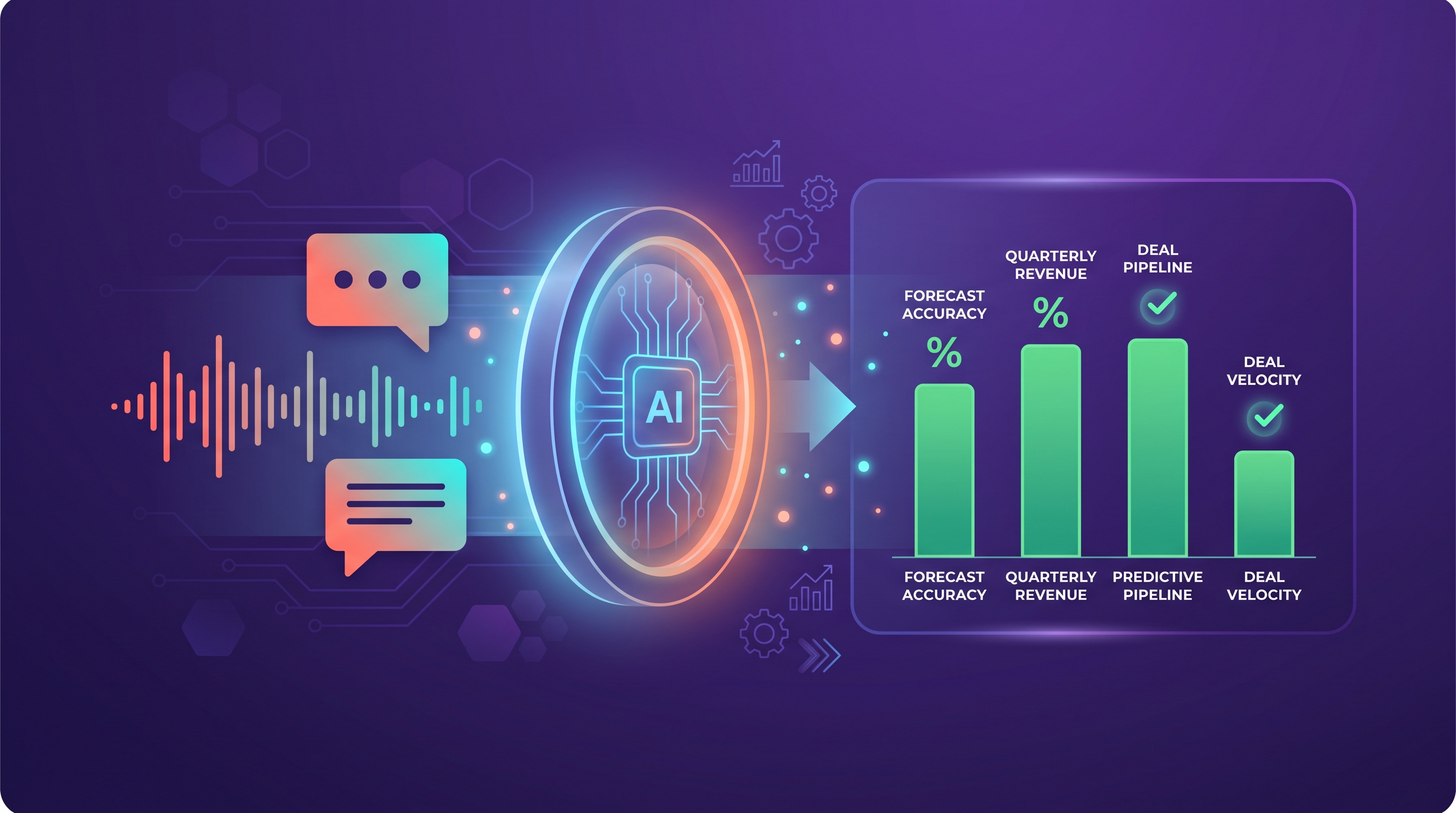
This series is brought to you in partnership with Airspeed. This is the article where we finally talk about what they built, and it lands better because the first three articles were honest about everything you have to do before a tool like this can help you.
The Forecasting Series:
Let's go back to that deal that sat in commit for three quarters while the buyer quietly ghosted us. Turns out the buying committee turned over and we were starting from scratch without realizing it.
In article three, I told you every quantitative signal eventually caught it. No activity, single-threaded meetings and communication, with a close date pushed out three times. All true. And all of it lit up months after the deal actually died.
Here's the important point about this deal. It didn’t actually die quietly. It died on a call in week two. The champion said something like "we're aligned, but I want to loop in our new VP before we go further," and our rep heard "we're aligned" and moved on. That sentence was the moment. The VP never took the intro call, and that’s beyond a red flag. That’s a deal’s death knell.
The transcript had the answer in week two. Our CRM didn't surface it until week thirty, because a CRM can only see what somebody logged, and nobody logs "the customer said a thing that made me vaguely uneasy." The signal existed. We just had no way to read it at scale.
That gap, between what the customer actually said and what made it into a field, is the difference between forecasting based on a gut feel and forecasting with evidence to back it up.
I need to say this before saying anything nice about technology. No system is magic. We still need to do the “eat your vegetables” part of the job that is always a slog, which includes:
Fifteen years ago, the pitch was that a CRM would fix your forecast. Buy the system, get the reps to log their deals, and the number would finally be trustworthy. You know how that turned out. The CRM didn't fix the forecast, because the CRM just captured whatever the rep decided to type, and the rep is an optimist with a quota. Garbage in, confident garbage out.
AI forecasting is walking into the exact same trap, dressed in nicer clothes. The pitch is identical: buy the tool, point it at your data, and the number will finally be trustworthy. And it will also fail if you skip the foundation. An AI model pointed at a pipeline with no defined categories, no consistent stages, and no clean history to learn from will produce a prediction that is wrong faster and with more confidence than your reps ever managed. You will have automated the guessing.
The difference, and it's a real one, is the input. A CRM records what the rep says about the customer. Conversational AI reads what the customer said, directly. That's not a smarter guess. That's a different, better source. But it only works if articles one through three in this series actually happened. AI doesn't skip the foundation. It sits on top of it. If you haven't built the foundation, you are not ready to buy this, and I'll give you the checklist to prove it to yourself in a minute.
Here's what changes when the source is the conversation instead of the CRM field. These are the signals a human filters out, forgets, or quietly rounds up, and they're exactly the ones that predict the deal:
Every one of these was theoretically available to you before. It was sitting in your call recordings, your synced inbox, and your meeting tools. What changed is that until recently there was no practical way to read all of it, across every deal, every week. Now there is. That's the actual advance. Not a smarter crystal ball, just the ability to finally read the material you were already collecting.
Do not buy an AI forecasting tool until you can check every one of these boxes:
If you can't check these, AI isn't your next priority. Putting the foundation in place is.
When your CRM admin, Sales VP, or vendor gets really excited about automating close dates and deal stages, I advise you to think long and hard about implementing that change.
By all means, make it easier for managers to spot problem mismatched stages and close dates. A deal should be flagged and debated if AI says it has a 20% chance of closing and the rep insists it’s worth committing. This creates coachable moments.
But that doesn’t mean you should throw out a salesperson’s opinion on day one of rolling out AI. Trust needs to be built over time. As your quarters with an AI layer add up, so will your manager’s confidence in its output (assuming you did the homework we called out above).
The AI does not get a vote. It gets a voice. The model's score is not a verdict that overrides the human; it's a signal that forces a conversation.
So the governance rule is not "the AI decides" and it's not "the rep decides." A disagreement between the model and the rep is a mandatory review, and the human with authority (the manager, per article two, not RevOps) makes the call with the rep's reasoning and the model's reasoning both on the table. The rep has to explain why they're more optimistic than the signals. Sometimes they have a genuinely good answer the model couldn't see, like a handshake on the golf course the AI wasn't invited to. Sometimes they don't, and the silence is the answer.
Two things make this work, and both are non-negotiable.
First, the model has to show its reasoning, or the whole thing collapses into "the computer said no" and reps will rightly revolt. A score with no explanation is not something a professional can argue with, and you want them arguing with it.
Second, RevOps stays out of the arbitration. We surface the disagreement and we keep the receipts on who was right over time. We do not adjudicate deals. That's the manager's job, and article two already explained why we don't want it.
I want to be super clear about what AI can’t fix. It’s something I wish people had done often and early with tools like multi-touch attribution (maybe if we had understood the limitations clearly, it wouldn’t be so loathed today by so many).
AI reads what was said. It does not read what was decided in a room it wasn't in. There will always be more blind spots than transcribed conversations, and that’s because the majority of the deal is decided behind closed doors without your salesperson there to represent the product.
The budget that got frozen in a board meeting, the internal reorg that just deprioritized your entire project, the new CFO who has a favorite vendor from her last company: none of that shows up in your call transcripts until it's already too late, if it shows up at all. The AI is only as omniscient as your access to the customer.
It also can't fix a comp plan. Some forecast problems are conversation problems, and AI is genuinely great at those. Some forecast problems are compensation problems wearing a costume, and no model will save you from those. Like when reps know they’ll get more compensation for the deal if they push it to the next quarter than if they close it now despite that same deal making the difference between hitting the company’s quota and missing it.
And it can't create the authority to act. A model that flags risk to an organization where nobody is allowed to challenge the VP of Sales is just a waste of time.
None of this is a reason not to use AI. It's a reason to use it for what it's actually good at and clearly communicate the right expectations to management who bought into the tool with the belief that it would solve ALL their problems.
I've spent three and a half articles telling you what to build and what to fix. Here's the tool that made me want to write the series in the first place.
Airspeed is a revenue execution platform.
Underneath everything is one shared data layer. Airspeed captures every call, and the same conversation data that writes back to Salesforce or HubSpot (scoring MEDDIC, BANT, or SPICED automatically, with no rep logging in) is the data that feeds the forecast. That matters more than it sounds. In most stacks, your conversation intelligence and your forecasting tool are different products that barely speak. Here they're the same brain, which means the forecast is reading the actual conversations, not a summary of a summary.
On top of that sits the Forecasting Agent, and here's what it does that maps directly to this series:
The reps still build the forecast the way they always have, choosing their categories, but now every deal carries its score as a built-in gut check, and every manager can see the whole team's roll-up with the same signal layer before the meeting instead of during it.
The thing that excites me as a practitioner is that Airspeed writes back to the system of record, which means it slots into the governance model I laid out above instead of fighting it. It gives you a defensible number and the reasoning behind it, and it hands the human the disagreement to resolve rather than pretending to resolve it for them. That's the right division of labor.
One caveat, and Airspeed would tell you the same thing: none of this rescues an org that skipped putting a foundation in place. If you point it at a clean, well-governed pipeline, it's a force multiplier. If you point it at chaos, it's a very sophisticated mirror.
If you want to see it run on your own pipeline, Airspeed does a 30-minute demo on your actual calls and deals, which is the only kind of demo worth sitting through. Ask them the hard question while you're there: show me a deal where the model disagreed with the rep, and show me who was right.
Here's the series, restated as the progression it always was.
You built a forecast from nothing: stages, categories, and the exec buy-in to make them stick. You turned it into a muscle with cadence, methodology, and an honest answer about who owns the number. You learned to catch rep optimism the old-fashioned way, with indicators and history and no budget at all. And only then, standing on all of it, you layered in AI that reads the customer directly and skips the optimistic middleman entirely.
That order is not decorative. It's load-bearing. The reason this series spent three articles in the weeds before we ever said the word "agent" is that the weeds are where forecast accuracy actually lives. AI doesn't replace that work. It's the reward for having done it.
Build the foundation. Then, and only then, go read what your customers have been telling you the whole time.
Your turn, and let's make it a good one. What's the deal where the signal was right there in a conversation and everybody missed it until it was too late? You've got one. We've all got one. Post it in the community, and if you've started layering AI into your forecast, tell us what it caught that you would have missed.