Most go-to-market teams are drowning in data — five to seven sources, siloed dashboards, and reps who don't know what to prioritize. The problem isn't a lack of signals. It's that 80% of those signals never get actioned, and your best opportunities are getting buried in the noise.
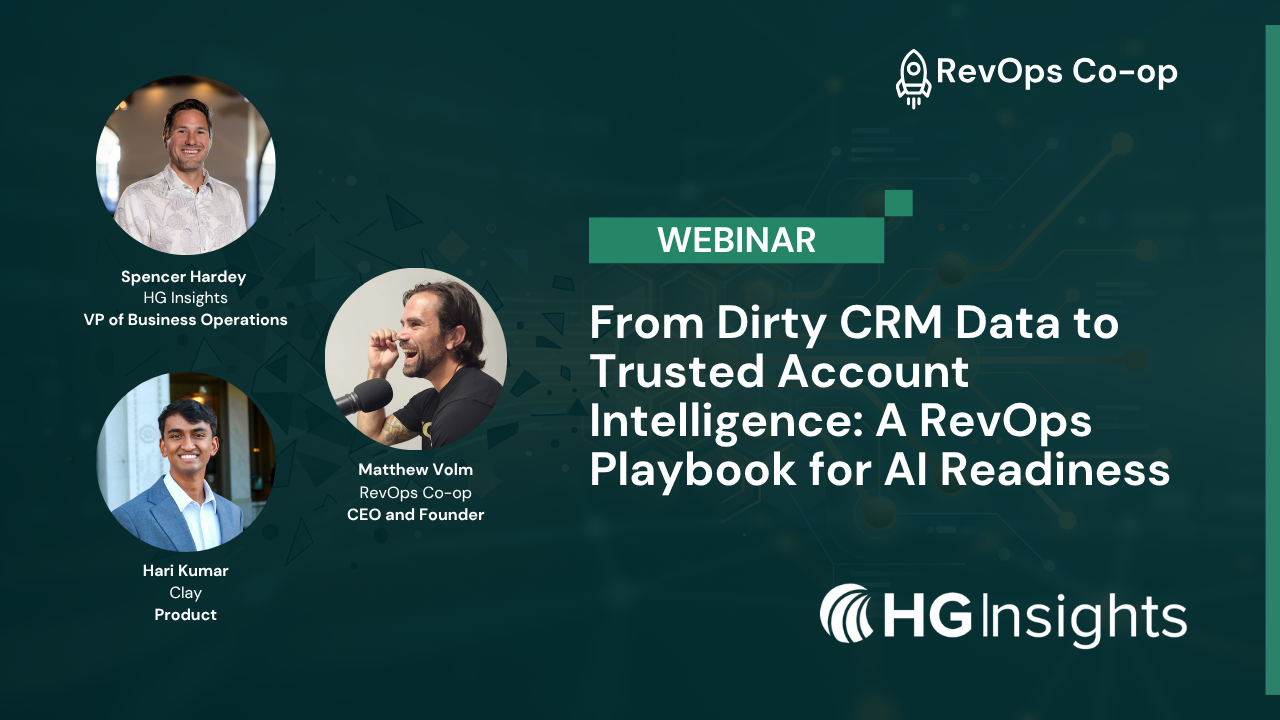
In a recent RevOps Co-op webinar, Spencer Hardey, VP of Business Operations at HG Insights, and Dan Rosenthal, Co-Founder at Workflows.io, joined RevOps Co-op CEO Matt Volm to break down how high-performing revenue operations teams cut through the noise, prioritize the right competitor signals, and build the infrastructure needed to actually turn those signals into pipeline. Together, they shared frameworks for ICP scoring, signal orchestration, and execution accountability that any RevOps team can start implementing today.
The promise of a data-rich GTM environment has a dark side. Every tool in the modern revenue stack — your CRM, your intent platform, your marketing automation, your sales engagement platform — is generating signals. And instead of making life easier, the volume has made focus nearly impossible.
"Go-to-market teams are drowning in all this data and not really feeling like they're winning with it." — Spencer Hardey, VP of Business Operations at HG Insights
Spencer described the pattern he sees repeatedly with HG Insights customers: an ops team stitching together five to seven data sources, fighting dropout rates at every matching step, while sales, marketing, and customer success each operate from completely separate data sets. The result is that the best opportunities — the accounts most likely to convert — get buried under the volume of lower-quality signals.
Dan Rosenthal reinforced this from the implementation side. His team at Workflows.io works with B2B tech companies across automated outbound, LinkedIn content, RevOps, and account-based marketing (ABM) — and almost every engagement starts with the same diagnosis:
"The easiest part is capturing the signal. The whole art is in actioning the signal and doing that effectively. Expecting your reps to log into a bunch of different siloed data sources and somehow action it is ultimately never really going to happen." — Dan Rosenthal, Co-Founder at Workflows.io
This isn't just a tooling problem — it's a process and prioritization problem. And it's one that gets significantly worse without a clear foundation in place first.
Before any signal orchestration can work, Spencer argued, teams need to establish a single, defensible definition of their ideal customer profile (ICP) — one that every sales leader, CS leader, and exec can articulate consistently.
Without that alignment, signals create cross-functional friction rather than pipeline. Reps get assignments for accounts that don't fit. Trust in the system evaporates fast.
"If you don't have your ideal customer profile clearly defined — in a way that your sales leader, your CS leader, your exec team can all reiterate — you're gonna end up with a lot of cross-functional friction." — Spencer Hardey
The ICP definition needs to live somewhere actionable: tracked in your CRM as a field, connected to your territory model, and used to tier accounts before any signal-based routing decisions are made. Spencer recommended a simple A/B/C tiering model that combines fit score and intent score — not because simplicity is easier to build, but because it's easier for reps to trust and act on.
Dan echoed this from the rep perspective: the difference between a score of 89 and 75 is meaningless to a field rep. What matters is whether something is Tier 1 — and what that tier tells them about the urgency and format of their response.
"I believe as a rep, I don't really care about the difference between a 89 or 75. I just want to know, is this a tier one opportunity? I want to associate a certain level of importance to tier one opportunities." — Dan Rosenthal
The practical implication: the number of tiers you create should equal the number of meaningfully different decisions you'd make based onthose tiers. If you'd only ever route to an AE, an SDR, or an AI SDR, you need three tiers — not twenty. For more on building effective account tiers, HG Insights has written extensively on how to build a target account list for your go-to-market.
The session's most actionable section covered how to actually use competitive signals — and why most teams are thinking about them too narrowly.
Spencer challenged the audience to move beyond the binary question of "are they using a competitor?" and instead think in terms of which competitor, which use case, and what the intensity of that usage looks like over time. At HG Insights, the team tracks not just competitive technology presence but the decline in competitive technology usage — and that decline is what triggers an outbound campaign.
"If there is a signal that someone's working with a competitive account and their usage of that competitor is declining, they probably have a need that needs to be fulfilled. And if you have a good solution for that, you're helping them in their research process." — Spencer Hardey
The addition of contract renewal timing makes this signal even more precise. When usage is declining and the renewal date is three to six months out, the messaging angle almost writes itself — and it leads with value to the prospect, not a pitch about your product.
Dan added a useful framing for how competitive signals function differently from other signal types. Where a time-sensitive signal like a LinkedIn ad click demands immediate action, competitive signals often function as context — a lens over all your messaging that changes how you approach an account even if you don't reference the competitor directly.
"Sometimes with these competitive signals, it's just about knowing the lay of the land and you approach the messaging in a slightly, maybe intricately different way. I think it's a signal you should always have." — Dan Rosenthal
Spencer also outlined three additional competitive signal types his team at HG Insights actively monitors:
Dan added one more worth tracking: job openings. Companies sometimes post roles that signal they're about to adopt a new piece of technology — a signal you can catch before your competitor does. HG Insights has explored this kind of intelligence further in their work on account-based intelligence.
Dan walked through the exact playbook Workflows.io uses to take a raw signal — say, a website de-anonymization event — all the way to a rep-ready, actionable task. It's a question Dan actually asks during his own hiring interviews: how do you get from raw signal to fully actioned output? No candidate has ever answered it completely.
The framework breaks down into ten steps:
One undervalued benefit of this process: as signals surface net new accounts and those accounts are qualified, they create a natural mechanism for expanding your total addressable market (TAM). Spencer noted this happened recently at HG Insights — inbound wins from accounts outside the original scoring model led to procuring additional data sources and incorporating a new segment into their product data set. This kind of TAM evolution directly feeds financial planning and board-level conversations about market opportunity, and HG Insights covers the mechanics of this in depth in their TAM, SAM, SOM guide.
For a closer look at why clean underlying data is a prerequisite for all of this, the RevOpsAF podcast episode on thinking about data first before AI covers the foundational data strategy that makes signal orchestration possible.
One of the session's most practical debates centered on automation sequencing. Both Spencer and Dan landed on the same principle from different directions: infrastructure before automation, and manual execution before automated touchpoints.
Dan's reasoning is rooted in the feedback loop. If you fully automate the touchpoint before you've manually worked the signal, you never learn which signals actually convert — and you never have the data to improve the system.
"I sometimes feel that businesses are trying to rush the groundwork. My ideal world is you develop the infrastructure to make it very easy for your reps to manually action these signals, and then you layer in automation on top." — Dan Rosenthal
Spencer described the journey HG Insights went through internally. The sales team initially wanted everything — every signal, every trigger — routed to them. Predictably, reps cherry-picked the signals that looked most interesting and left the rest behind. Without follow-through tracking, there was no feedback loop and no way to know what was being missed.
The solution was intentionality about what gets routed where. Tier A accounts showing the strongest signals go directly to AEs. Tier B accounts with engagement signals go to SDRs. Everything outside ICP — including accounts with no first-party engagement — goes to an AI SDR. And the accountability metric isn't just whether a task was completed once, but whether the full engagement sequence was executed: industry averages suggest 10 to 15 relevant touches before a meeting gets booked.
"Being able to go to our exec team and say I can guarantee we are engaging every account who is using a competitive technology and that usage is declining — being able to make statements like that after you've implemented something like this is really powerful." — Spencer Hardey
This connects to a broader point about RevOps credibility. The teams that build this kind of infrastructure don't just generate pipeline — they generate confidence. For more on how RevOps teams can build the kind of strategic credibility that earns a seat at the table, the RevOpsAF podcast episode on what CROs really want from their RevOps teams is worth a listen.
The crawl-walk-run model applies here. Don't try to get from zero to a fully automated signal engine overnight. Start with the single most impactful signal — typically, accounts in your TAM showing first-party engagement — and make sure 100% of those get actioned before you expand to layering additional signals. This aligns with broader RevOps implementation best practices around doing fewer things well before scaling complexity.
A recurring theme throughout the session was accountability — not just for reps, but for the ops function itself. Signal orchestration done well gives RevOps a new kind of leverage: the ability to make provable coverage statements to the business.
Matt drew an analogy to CPQ approval workflows, where 100% of submitted discount requests get approved. If everything gets approved, the step adds no value — it's theater. The same logic applies to signal routing without tracking. If you can't prove follow-through, you can't improve the system.
Dan emphasized that reporting needs to be paired with an open feedback loop between reps and RevOps. Penalizing reps for ignoring signals is counterproductive if you're sending them bad signals in the first place.
"If you're going to start penalizing people for not actioning signals but you're giving them crappy signals, well, that's not very fair. The reporting is what invites those conversations to properly evaluate what you're sending them." — Dan Rosenthal
The reporting stack Dan recommended includes: overdue signal tasks by rep, signal-to-deal conversion rates segmented by signal type, and a pipeline velocity report tracking accounts from an awareness score through to active opportunity. The awareness score — which Dan described as rolling up first and second-party signals into rep-readable language before MQL thresholds are hit — gives the sales team a way to understand account engagement without needing to interpret lifecycle stage terminology.
For RevOps teams still building the case for this kind of infrastructure investment, the post on why and how to build a business case and the HG Insights perspective on the future of GTM data and AI together provide a useful framework for framing the investment in terms executives will respond to.
Signal-based GTM isn't a new idea — but the combination of better data sources, more sophisticated orchestration tools, and leaner revenue teams has made it genuinely executable for mid-market B2B companies in a way it wasn't two or three years ago. The question isn't whether to build this infrastructure. It's whether you'll build it before your competitors do.
Check out our blog, join our community and subscribe to our YouTube Channel for more insights.
And be sure to check out the HG Insights blog for more resources on technographic data, GTM intelligence, and building high-performance revenue operations.