Most revenue teams treat data enrichment like a one-time project. They plan to enrich the record, push it to the CRM, and then move on. But that’s what really happens. Reps source their own lists, duplicates multiply, and the orchestration logic doesn't align with the business complexity. As a result, the operations team is in permanent firefighting mode. By the time anyone quantifies the cost, the damage is already prolific.
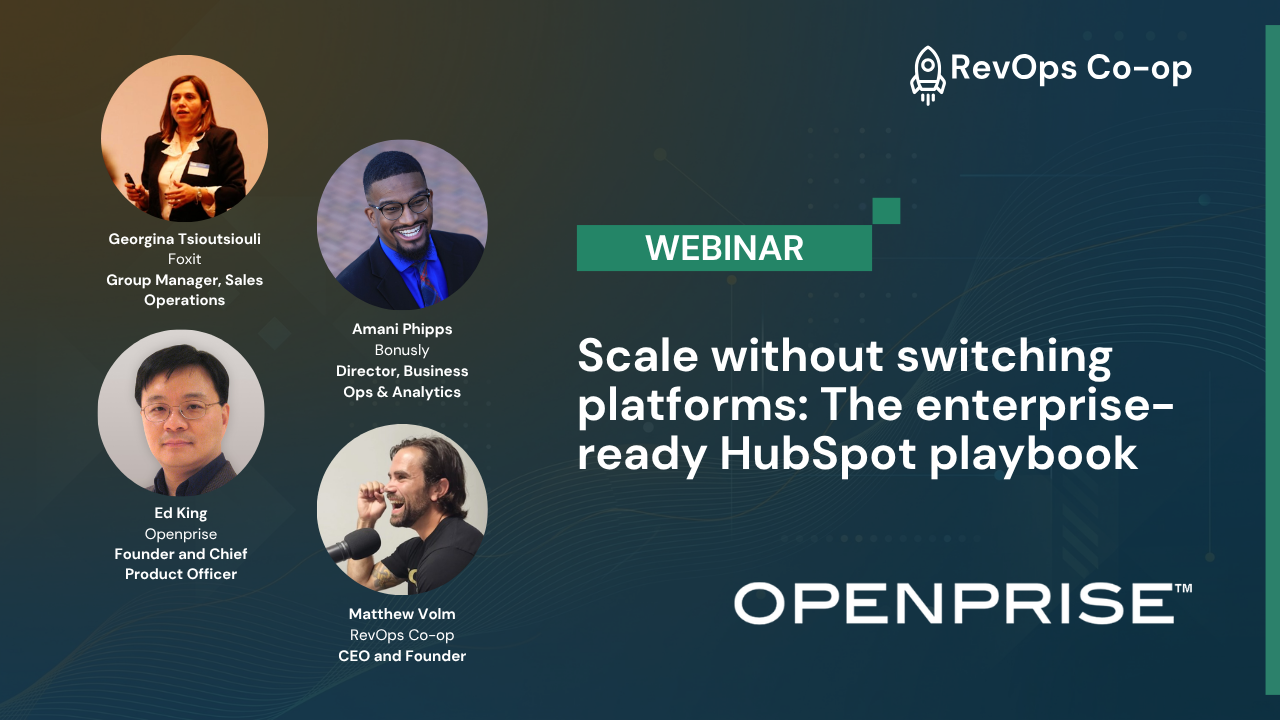
In a recent RevOps Co-op webinar, Matthew Volm, CEO and founder of RevOps Co-op, led a session with Zach Hoogerland, Senior Director of Marketing Strategy and Operations at Rubrik, and Chaz La Salle, Customer Success Manager at Openprise. Together, they walked through how Rubrik built a scalable data enrichment and orchestration system — combining Clay for enrichment and Openprise for orchestration — and what lessons other revenue operations teams can take from that journey.
The session opened with a poll asking attendees how their teams currently handle contact enrichment. The most common answer: something centralized, but inconsistent — followed closely by teams using Clay or a similar product but struggling with governance downstream. The least common answer: fully centralized, governed end-to-end.
That distribution isn't surprising. What is surprising is how rarely organizations frame the cost of this gap correctly.
"When we're talking about enrichment, we're talking about data governance. We're talking about really making sure that it's a pipeline investment. Everything is inextricably linked together." — Chaz La Salle
La Salle introduced the concept of "invisible rot" — the slow, compounding cost of data that isn't quite right. When reps have to validate contacts themselves, cross-reference LinkedIn profiles to confirm job titles, or reformat phone numbers before dialing, that time isn't coming from some abstract overhead budget. It's coming directly out of pipeline generation capacity.
Hoogerland made the macro case even sharper. If reps at a company with hundreds of sellers are each spending meaningful time on data sourcing and QA, the organization effectively needs more headcount to hit the same revenue targets. The invisible rot doesn't just slow deals — it inflates the cost per dollar of pipeline generated.
"You add that up across hundreds of sellers. You gotta have a lot more sellers, and you gotta spend a lot more money to basically get to the revenue." — Zach Hoogerland
This framing — enrichment as a pipeline investment rather than a data hygiene project — is worth internalizing before building any business case. As the RevOps Co-op blog has noted, marketing without attribution is like taking a road trip without a map; similarly, outbound without reliable data is navigation with a broken GPS. You'll move, but you won't know where you're going.
Before enrichment and orchestration were centralized at Rubrik, the operations team was in reactive mode. Hoogerland described it plainly.
"It was just madness. Firefighting galore. You're just trying to keep up. You don't get a lot of headcount to do this stuff, so you're in total reactive mode trying to defend the fort." — Zach Hoogerland
The shift he described — from firefighting to carpentry — is as much a mindset change as a technical one. Firefighting is reactive by definition: you respond to what's already burning. Carpentry is intentional: you build the foundation so the fires don't start.
That mindset shift doesn't happen automatically. It requires a leader willing to paint a vision, make the case to the business, and hold the line when the next urgent ticket threatens to pull the team back into reactive mode. Hoogerland estimated that roughly 80% of the ops professionals he talks to are still stuck in firefighting mode — not because they don't want to build, but because they haven't yet secured the organizational permission or the clear problem statement to do so.
This connects directly to a pattern RevOps teams encounter regularly: the gap between being a strategic revenue operator and being a ticket-taker. The enrichment and orchestration journey at Rubrik is, at its core, a story about making that transition.
One of the more practical sections of the session was Hoogerland's description of how he built the business case for centralized enrichment. His background in accounting and finance might evoke a complex financial model — but his advice was the opposite.
"If you don't start simple... the simple thing should be carried all the way through. If you can explain it in five minutes, you've got something." — Zach Hoogerland
The framework he used: estimate how much time per rep is spent on data sourcing. Attach a dollar amount to that time. Multiply across the seller population. Identify the opportunity cost — pipeline generation, meetings booked, deals advanced — of that time being spent elsewhere.
The goal isn't a CFO-grade model; it's a conversation-starter that makes the problem legible to sales leadership, who then become advocates rather than skeptics.
The second piece of the business case was bringing sellers along, not just leaders. Hoogerland was direct about this: top-down mandates alone don't change behavior in a sales org.
"Until they see that value that they're actually getting as an individual, they're not gonna buy into it, and then you're just fighting an uphill battle." — Zach Hoogerland
His approach was to run a pilot, find champion sellers who verified the improved data quality themselves, and let them carry the message to peers who were skeptical. Leadership provides cover; peer champions provide credibility. Both are required. Building a business case that works internally always depends on having both.
Rubrik's vendor evaluation process for enrichment is a useful template for any team working through a crowded market of providers all claiming similar capabilities.
Hoogerland's starting point was deliberately narrow: what specific business outcome do we need to achieve? For Rubrik, that meant mobile phone coverage and email coverage on inbound and outbound contacts — two data points with a direct line to meeting conversion rates. Not a long list of enrichment fields. Not a feature comparison matrix. Two things.
From there, he ran a structured pilot: every vendor that wanted Rubrik's business had to prove their data quality against that specific criterion across Rubrik's three global theaters (AMER, ANZ/APJ, and EMEA). SDR teams within each theater then validated the perceived quality of the data in practice — not just in vendor-provided statistics.
"I literally just mapped out a test and had every vendor go through it. If you want to do business with us, we're doing a pilot, and I want you to prove the data." — Zach Hoogerland
The result was an evaluation that was nearly objective by the end: here's what each vendor delivered, here's the cost, here's the decision. That kind of data-backed vendor selection also made it easier to defend the choice to leadership — because the criteria had been established before the vendors were evaluated, not after.
The enrichment market is becoming increasingly commoditized, and Hoogerland acknowledged that directly. Which makes the process of determining clear, outcome-based criteria even more important: when vendors make similar claims, the differentiation comes from rigorous testing against your specific use case, not from their marketing materials.
Rubrik designed its enrichment architecture around three distinct workstreams, each solving a different part of the data quality problem.
The inbound waterfall was the entry point — the bread-and-butter marketing ops use case. When a form fill arrives, it runs through a multi-vendor enrichment process immediately, before routing. The goal is to guarantee every inbound lead enters the system with the highest-quality contact data available, so that when it reaches an SDR, they start from a clean slate.
The outbound waterfall addresses the rep list-building problem directly. Rather than leaving SDRs and AEs to source and validate their own contact data, the enrichment process prepopulates the system with what they need. Hoogerland's team took this further by layering AI on top of the enriched data: knowing a contact's job title, email, and likely product interest, the system can create a four-email sequence that flows into Salesforce and then into Outreach — removing another manual step from the rep's workflow.
The re-enrichment loop is the piece most teams skip — and the one Hoogerland argued is the most important for building long-term trust between ops and the sales team. The why is simple: data ages poorly. Job titles change. People leave companies. A record enriched six months ago may no longer be accurate.
.jpg)
Rather than accepting this as an unavoidable reality and shrugging when reps complain about bad data, Rubrik is building a feedback mechanism: when a rep flags a bad record, a re-enrichment process triggers, and the rep receives an alert within 24 hours with updated information. Every record carries a timestamp indicating when it was last enriched and by which provider.
"If you don't continue to put your name on that and say, 'Hey, you have bad data, let me go try again' — you're just throwing it over the fence and you're done." — Zach Hoogerland
This feedback loop does something beyond improving data quality. It demonstrates operational accountability — the kind of behavior that, over time, builds the trust between ops and sales that makes everything else easier. As data management principles for RevOps make clear, quality is not a one-time task; it's an ongoing commitment.
Hoogerland offered an unusual detail about Rubrik's implementation sequence: the orchestration layer came before the enrichment layer. Openprise was already in place — handling routing logic, deduplication, and product-line mapping — before Clay was introduced. That sequencing turned out to be an advantage.
La Salle explained why the order matters. Clay is purpose-built for data acquisition: pulling contact information, firmographic data, and signals from multiple sources in a structured waterfall. What Clay doesn't know is your business specifics — your territories, your product lines, your ICP definitions, your existing CRM records.
"Clay doesn't know your territories, your product lines, your existing CRM records if you need to dedupe against them. Openprise lives as that orchestration layer that sits between the acquisition and the activation." — Chaz La Salle
The analogy he used was a bouncer. Openprise sits at the door between enriched data and the CRM, ensuring that what enters is normalized, deduplicated, matched to accounts, routed correctly, and consistent with the business logic the team has defined. Without that layer, a phone number is just a number. An ARR figure is just a number. Context is what makes data actionable.
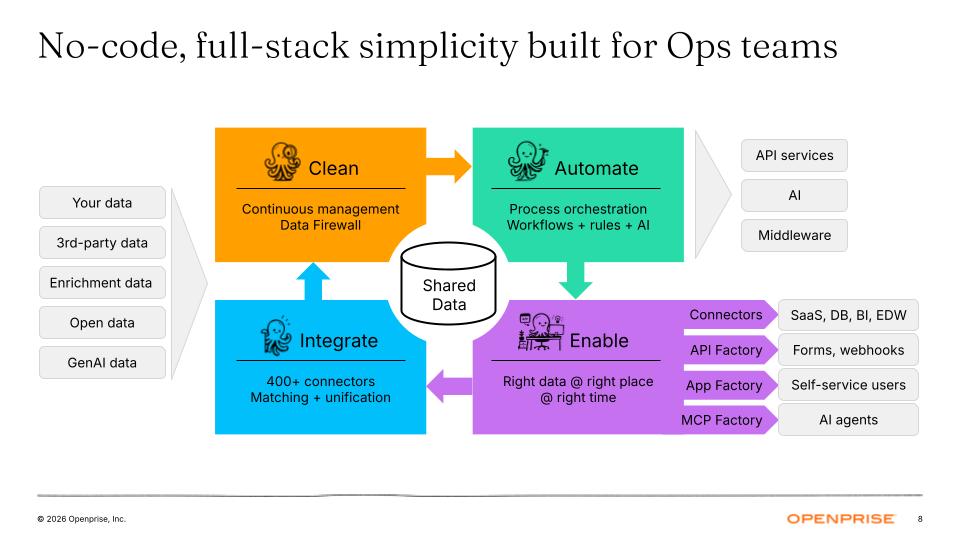
La Salle described the pairing as a "self-healing loop" at the orchestration level: Openprise doesn't just enforce rules on incoming data — it actively works to clear dead records from sellers' queues, flag decay, and maintain the data quality that enrichment established at the point of ingestion. Openprise's approach to data orchestration is built precisely around this acquire-govern-activate framework, and the Rubrik implementation reflects that pattern clearly.
The practical implication for RevOps teams: enrichment and orchestration are not interchangeable, and they're not redundant. They solve adjacent problems in sequence. Getting enrichment right without orchestration means clean data that gets corrupted by your routing logic. Getting orchestration right without enrichment means well-governed garbage. You need both — and the order in which you build them matters less than having a clear picture of where the biggest gap currently is in your system.
The session's final topic — AI readiness — was framed by a challenge Hoogerland said he hears constantly from RevOps practitioners: executive pressure to "use AI" without a clear definition of what that means, combined with data foundations that can't yet support meaningful AI applications.
His framing was direct: if you don't have an agenda, someone will set one for you. Getting ahead of that means building a use-case-driven AI roadmap before leadership asks for one — and being explicit about the prerequisites.
"You're putting AI on top of really bad stuff, and you're gonna get poor outcomes that affect the brand of your company at the macro level." — Zach Hoogerland
The practical move is to find AI use cases that are achievable now, even if they aren't glamorous. Hoogerland offered the example of using AI to translate and normalize job titles — not a headline-worthy application, but one that improves data quality, can be cited as evidence of AI adoption, and lays the foundation for more complex use cases later. Thinking carefully about AI strategy before chasing tools is exactly the discipline Hoogerland described.
La Salle added an important dimension on the risk side. He described a sliding scale of AI adoption among Openprise customers — from those who won't allow AI to touch their systems at all, to those building fully AI-driven SDR motions. Both extremes call for careful handling.
"Bad data in, bad data out. Whatever AI does, it just amplifies the personality you already have. So if you already have bad data, throwing more AI at it is only gonna amplify things and lead you to crash quicker." — Chaz La Salle
His recommended approach: handle as much as possible deterministically first. At Openprise, the heuristic is the 80/20 rule — use deterministic logic to resolve 80% of data quality issues, then apply AI to the remaining 20% that logic alone can't address. That approach safeguards human control, reduces hallucination risk, and keeps costs manageable as AI applications scale. Why most revenue stacks aren't ready for AI is a question worth asking honestly before committing to an AI roadmap.
The agentic future that everyone is pitching — AI SDRs, automated pipeline generation, autonomous GTM motions — is real, but it's downstream of fundamentals. You can't get there without clean, governed, enriched data that the system can act on reliably. Enrichment and orchestration aren't prerequisites to the cool stuff; they are the foundation without which the cool stuff causes damage.
The journey Rubrik is on — moving from rep-sourced data and reactive ops to centralized enrichment, governed orchestration, and a feedback loop that builds trust across the revenue team — is one that most GTM organizations will need to take. The good news is that the path is navigable, the tooling is accessible, and the business case writes itself. The harder part is the mindset shift: from firefighting to carpentry, from reacting to building.
Learn more about how Openprise helps revenue operations teams acquire, govern, and activate go-to-market data across their entire stack.
Check out our blog, join our community and subscribe to our YouTube Channel for more insights.